

Property damage in Orange can become complicated quickly. A tropical storm can drive rain through a damaged roof, rising water can affect flooring and walls, and strong winds can damage several parts of a building during the same event. Even after the property is secured, the insurance claim may involve disputed repair methods, omitted damage, depreciation, moisture testing, code requirements, and questions about which portions of the loss are covered.
TX Public Adjusting helps homeowners, business owners, landlords, and commercial property managers document and present property insurance claims. As a licensed public adjuster in Orange, TX, we represent the policyholder—not the insurance company.
TX Public Adjusting is operated by Rise Public Adjusting LLC, Texas License #3356839. We review new, delayed, denied, and underpaid claims involving residential and commercial property throughout Orange and the surrounding Southeast Texas communities.
Your claim deserves a complete review. Contact TX Public Adjusting for a free claim review with no upfront fees.
Insurance Claim Help for Orange Property Owners
Orange sits in a part of Southeast Texas where tropical weather, heavy rainfall, high winds, drainage problems, and occasional winter freezes can create significant property losses. The city is located near the Sabine River and the Texas-Louisiana border, placing local homes and businesses within a region that must prepare for both coastal and inland effects from hurricanes and tropical storms. The City of Orange specifically advises residents that hurricanes can bring rain, wind, water, and tornadoes well beyond the immediate coastline.
A property insurance claim may look straightforward immediately after a storm. A roof has missing shingles, water is dripping from the ceiling, or several rooms have wet flooring. The real scope of damage, however, may be much larger than the visible problem.
Moisture can travel behind drywall. Wind can loosen roofing materials without removing them entirely. Water can reach insulation, electrical components, cabinets, wall cavities, and contents. A commercial roof may have damaged seams, flashing, membrane sections, rooftop equipment, or drainage components that are not included in the insurer’s first estimate.
A public insurance adjuster in Orange can help identify these issues, organize the supporting evidence, review the carrier’s estimate, and present the policyholder’s claim more thoroughly.
Why Property Owners Hire a Public Adjuster in Orange
The insurance company assigns an adjuster to investigate the loss for the carrier. That adjuster may be professional and experienced, but the carrier’s representative does not work for the policyholder.
A public adjuster works on behalf of the insured property owner.
Orange homeowners and business owners often contact TX Public Adjusting when:
- The insurance estimate does not appear sufficient for the repairs.
- The carrier’s inspection was brief or limited.
- Water damage was excluded from the repair scope.
- Roof damage was classified as wear, deterioration, or maintenance.
- A claim was denied after a hurricane, windstorm, or heavy-rain event.
- The insurer paid for spot repairs when broader replacement may be necessary.
- The property owner is overwhelmed by documentation requests.
- A commercial claim is interrupting business operations.
- The claim has stalled without a clear explanation.
- Additional damage was discovered after the initial inspection.
- The contractor’s estimate is substantially higher than the carrier’s estimate.
- The policyholder wants an independent review before accepting a settlement.
Our role is to examine the property damage from the policyholder’s side of the claim. We review the available policy information, inspect the loss, develop documentation, compare estimates, identify scope differences, and communicate with the insurance company during the adjustment process.
Orange’s Most Significant Property-Damage Risks
Orange County’s hazard planning places particular emphasis on tropical events and flooding. Local preparedness guidance also identifies hurricanes, flooding, and extreme cold as hazards residents should prepare for.
Hurricanes and Tropical Storms
Orange is vulnerable to the inland effects of Gulf Coast tropical systems. A hurricane does not need to make landfall directly in Orange to damage property in the city. Outer rain bands, tornadoes, wind gusts, prolonged rainfall, and drainage backups can affect buildings far from the storm’s center.
Hurricane-related insurance claims may involve:
- Missing or creased shingles
- Damaged metal roof panels
- Roof punctures from debris
- Broken windows and exterior doors
- Wind-driven rain
- Damaged siding and exterior finishes
- Fallen trees and impact damage
- Water intrusion around roof penetrations
- Interior ceiling and wall damage
- Damaged fencing, signs, and detached structures
- Commercial equipment and inventory losses
- Loss of business income
Tropical cyclones can produce strong winds, storm surge, heavy rainfall, inland flooding, and tornadoes. Property owners dealing with wind, water intrusion, or multiple forms of storm damage can review our Texas hurricane damage claim guide for additional steps to take after a major weather event.
Flooding and Drainage Problems
Orange’s location near the Sabine River, bayous, low-lying areas, and Gulf-influenced weather makes water a recurring concern. The city administers a floodplain program, while the Orange County Drainage District maintains hazard-mitigation planning focused heavily on flooding and tropical events.
Property owners should understand that flood damage and water damage are not always treated the same way under an insurance policy. Water entering through a storm-damaged roof may be evaluated differently from rising surface water entering from outside. A single loss can also involve more than one policy, deductible, exclusion, or cause of damage.
Our job is not to assume coverage. We document how and where the water entered, what building components were affected, and what evidence supports the claim under the applicable policy.
High Winds and Wind-Driven Rain
Strong winds can damage more than the most visible roof shingles. Wind may affect ridge caps, flashing, vents, soffits, gutters, siding, fences, windows, doors, rooftop units, and commercial signs.
Wind-driven rain can enter through openings created during the storm. It may also penetrate compromised seals around windows, wall systems, and roof penetrations. Interior damage often appears later as staining, blistered paint, warped flooring, musty odors, or elevated moisture readings.
A complete wind claim should account for the path of damage from the exterior opening to the affected interior materials.
Severe Thunderstorms, Hail, and Lightning
Orange is better known for tropical weather than the large-hail frequency associated with North Texas, but Southeast Texas still experiences severe thunderstorms. These storms can produce hail, straight-line winds, lightning, and intense rainfall.
Hail and wind damage may affect:
- Asphalt shingles
- Metal roofing
- Modified-bitumen and membrane roofs
- Gutters and downspouts
- Window screens
- Siding
- Exterior paint and finishes
- HVAC fins and rooftop equipment
- Skylights
- Carports and detached structures
Property owners should photograph accessible damage, preserve repair records, and document hail damage for an insurance claim before permanent repairs begin. Lightning may also damage electrical systems, appliances, controls, security equipment, and sensitive commercial machinery.
Winter Freeze and Pipe Damage
Orange’s climate is generally warm and humid, but freeze events can still cause serious losses because many local properties are not designed for prolonged cold. Orange County includes extreme cold in its preparedness guidance.
Frozen or burst pipes can damage walls, ceilings, floors, cabinets, insulation, personal property, and electrical components. In commercial buildings, a pipe break may also affect inventory, office equipment, tenant spaces, and business operations.
These claims require careful moisture documentation. Removing only the visibly wet material may leave hidden moisture behind.
Common Insurance Claims in Orange, TX
Hail Damage Claims
Hail damage is not always easy to see from the ground. Even when shingles remain attached, impacts may bruise the mat, remove protective granules, damage soft-metal components, or affect rooftop equipment. Our hail damage roof insurance claim guide explains how these losses are commonly documented and evaluated.
Insurance estimates sometimes include only isolated shingle repairs. The broader questions may involve repairability, matching, roof condition, affected elevations, flashing, vents, gutters, and whether the proposed work will restore the property properly.
TX Public Adjusting reviews the insurer’s scope against the observed damage and available documentation. When a carrier denies the loss or attributes the damage to age or wear, review what to do after a denied hail claim before accepting the decision as final.
Water Damage Claims
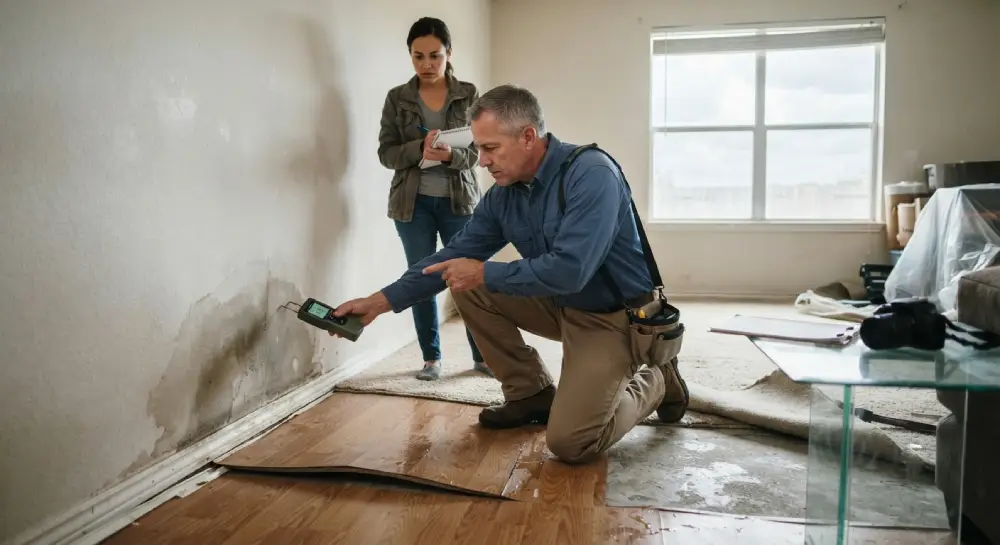
Water losses are among the most documentation-intensive claims we handle in Orange. A water damage public adjuster can help document the source, affected materials, drying work, and repair scope when a burst pipe, appliance leak, roof opening, plumbing backup, or storm-created breach damages the property.
A proper water claim may require documentation of:
- The source and cause of water
- Moisture readings
- Wet building materials
- Required demolition
- Drying and remediation work
- Damaged contents
- Cabinet and flooring continuity
- Mold-related concerns
- Plumbing access and repairs
- Temporary protection
- Additional living expenses
Water can move beyond the room where it first appears. That is why a surface-level visual inspection may not capture the entire loss. Property owners who are already communicating with the carrier may also benefit from our guide to dealing with an insurance adjuster after water damage.
Fire and Smoke Damage Claims
A fire insurance adjuster can help organize losses involving structural damage, smoke residue, soot, firefighting water, damaged contents, temporary housing, code issues, and business interruption.
Smoke can travel through hallways, ductwork, wall openings, attics, and adjacent rooms. Some materials may be cleanable, while others may require sealing, specialized treatment, or replacement. Our fire damage insurance claim guide explains how smoke, soot, heat, and water damage may extend beyond the visibly burned area.
We help organize the claim so the visible burn area is not treated as the entire loss. Property owners can also review typical house fire debris removal costs and the documentation commonly associated with that part of a claim.
Storm and Hurricane Damage Claims
Storm claims in Orange frequently involve several overlapping damage categories. A damaged roof may allow water intrusion. A fallen tree may affect the structure, fencing, and utilities. Wind may damage siding on one elevation while debris affects windows on another.
The carrier’s estimate should account for the full storm-related scope—not only the most obvious damage photographed during the first inspection.
Roof Damage Claims
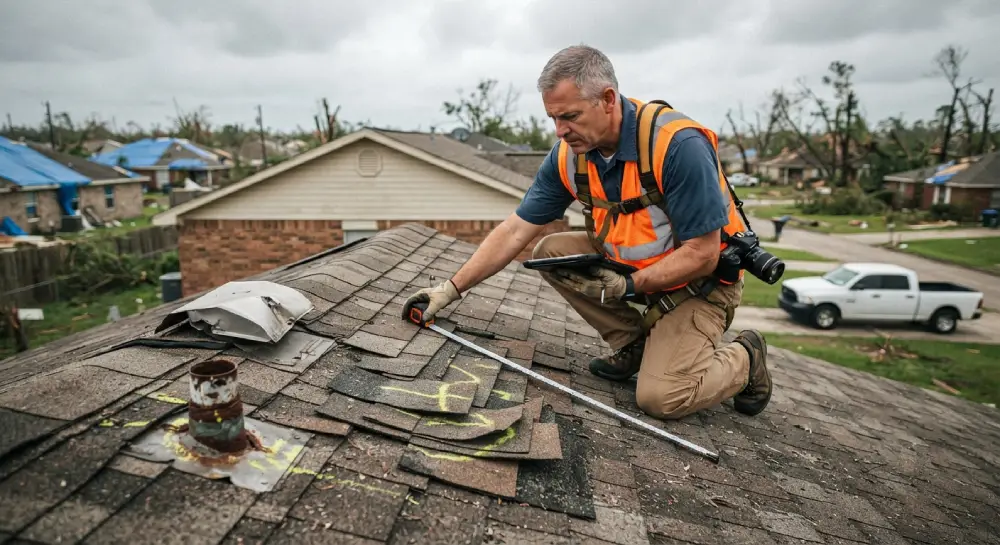
Hiring a public adjuster for a roof claim may be helpful when the carrier attributes damage to age, installation, maintenance, deterioration, or prior conditions. Those issues must be separated from damage caused by the reported event.
We evaluate roofing materials, slopes, elevations, penetrations, flashings, underlayment considerations, interior water paths, and the insurer’s proposed repair method. For commercial buildings, we may also review membrane damage, seams, insulation, coatings, parapets, drains, and rooftop equipment. When the first inspection appears incomplete, a documented roof claim second inspection may help address missed slopes, interior damage, accessories, or repairability concerns.
Commercial Property Claims
Orange and the surrounding area include retail properties, offices, restaurants, industrial facilities, warehouses, churches, multifamily buildings, and businesses connected to shipping, manufacturing, energy, and regional services. TX Public Adjusting assists with complex commercial property claims involving both physical damage and operational losses.
Commercial claims may involve:
- Building damage
- Roof systems
- Machinery and equipment
- Inventory
- Tenant improvements
- Electronic equipment
- Signs and exterior structures
- Business personal property
- Debris removal
- Extra expenses
- Business interruption
- Loss of rental income
A commercial property claim requires more than a repair estimate. The loss can affect revenue, tenants, customers, employees, production, and contractual obligations.
Dealing with an underpaid or complicated claim in Orange? Request a free claim review from TX Public Adjusting. There are no upfront fees.
Why Orange Insurance Claims Become Underpaid
Missed or Hidden Damage
An inspection may document ceiling stains but fail to trace moisture into insulation or wall cavities. A roof estimate may include shingles but omit flashing, vents, gutters, decking considerations, or interior damage.
When the repair scope is incomplete, the settlement may be incomplete as well.
Scope Omissions
The scope of loss is the list of work and materials needed to restore the property. Missing line items can include:
- Removal and disposal
- Access work
- Detachment and resetting
- Drywall texture
- Paint blending
- Insulation
- Trim and baseboards
- Cabinet work
- Roof accessories
- Scaffolding or lift access
- Commercial equipment protection
- General contractor coordination
- Code-related items, when applicable
Several small omissions across multiple rooms or elevations can create a substantial gap between the insurer’s payment and the actual repair cost.
Low Measurements or Quantities
Incorrect roof measurements, room dimensions, material quantities, or affected areas can reduce an estimate before pricing is even considered.
We compare the estimate to the physical property and supporting measurements.
Depreciation Issues
Insurance estimates may apply depreciation based on age, condition, material, or expected useful life. Some depreciation may be recoverable after repairs, depending on the policy and claim.
Problems arise when depreciation is excessive, applied to the wrong items, or not clearly explained.
Pricing Differences
Contractor pricing may differ from the carrier’s estimating software or selected price list. Labor availability, material costs, specialty trades, access limitations, and regional demand after a major storm may also affect repair costs.
A difference in price does not automatically prove the insurer is wrong, but it should be examined alongside the actual scope, quantities, materials, and repair requirements.
Documentation Problems
A legitimate loss can be weakened by incomplete photographs, missing invoices, poor inventories, inconsistent descriptions, or failure to document damaged materials before removal.
We help organize the evidence into a clearer claim presentation. Many underpaid losses begin with the same common property insurance claim mistakes, including incomplete photographs, discarded materials, missed deadlines, and poorly organized repair records.
Repair Versus Replacement Disputes
The carrier may propose repairing a limited section. The contractor may believe a broader replacement is necessary because the material cannot be matched, repaired without additional damage, or restored to a reasonably uniform condition.
These issues require property-specific documentation rather than general assumptions.
Our Public Adjusting Process
1. Claim Review
We begin by discussing what happened, when the damage occurred, what has already been reported, and how the insurance company has responded.
We may review available materials such as:
- Insurance estimates
- Coverage letters
- Payment summaries
- Contractor estimates
- Photographs
- Repair invoices
- Drying records
- Engineering reports
- Proof-of-loss documents
- Relevant policy information
The purpose is to identify the claim’s current position and determine what may need further investigation.
2. Property Inspection
We inspect the reported damage and document the affected areas. The inspection may include exterior components, roofing, interior rooms, contents, commercial areas, and accessible building systems related to the loss.
The inspection is tailored to the claim. A hurricane loss requires a different approach from a kitchen fire or burst pipe.
3. Damage Documentation
We develop supporting documentation that may include photographs, measurements, moisture information, inventories, repair scopes, estimates, invoices, and other records.
Good documentation connects the event to the damage and the damage to the requested repairs.
4. Estimate and Scope Analysis
We compare the insurance company’s estimate with the conditions observed at the property. We look for omitted rooms, building components, labor operations, quantities, materials, and related damage.
When appropriate, we prepare a detailed claim estimate or supporting scope.
5. Claim Presentation and Negotiation
TX Public Adjusting communicates with the insurance company and presents the policyholder’s supporting documentation.
We respond to claim questions, discuss disputed items, coordinate additional inspections when necessary, and advocate for a fair evaluation based on the policy and documented loss.
6. Settlement Review
When the carrier issues a revised decision or payment, we review the outcome with the policyholder.
No public adjuster can guarantee a specific payment. Our responsibility is to present the claim accurately, thoroughly, and professionally while advocating for the insured property owner.
Why Choose TX Public Adjusting
Licensed Texas Representation
TX Public Adjusting is operated by Rise Public Adjusting LLC, Texas License #3356839.
Licensing matters. Property owners should verify that the person handling their claim is properly authorized to provide public adjusting services in Texas.
We Work for Policyholders
Insurance company adjusters represent the carrier’s interests during the claim investigation. TX Public Adjusting represents the insured homeowner, business owner, landlord, association, or property manager.
Our duty is to the policyholder. Property owners unfamiliar with the role can read more about what a public adjuster does during a residential or commercial insurance claim.
Texas-Focused Claim Experience
Texas claims involve distinct weather patterns, construction methods, roofing systems, policy language, deductibles, and post-storm market conditions.
Our team has experience reviewing thousands of residential and commercial claims, including losses involving roofs, water, fire, smoke, hail, wind, hurricanes, and business interruption.
Residential and Commercial Expertise
A residential claim can displace a family. A commercial claim can interrupt operations, affect tenants, stop revenue, and create additional expenses.
We understand that both require urgent attention, but the documentation and financial issues may differ significantly.
Detailed Scope Review
Many claim disputes are not about whether damage exists. They are about how much damage exists, what work is required, which materials are affected, and what the policy covers.
We focus closely on the scope because an incomplete scope often leads to an incomplete estimate.
Clear Communication
Insurance claims generate letters, estimates, requests, deadlines, and unfamiliar terminology. We explain the process in plain language and keep the policyholder informed as the claim develops.
Free Claim Review
Property owners can contact TX Public Adjusting for an initial claim review at no upfront cost. We can discuss the loss, review the current claim status, and determine whether public adjusting assistance may be appropriate.
Serving Neighborhoods and Properties Across Orange
Orange contains a mix of established residential streets, historic properties, newer homes, commercial corridors, waterfront-influenced areas, and industrial facilities.
We assist property owners in and around:
- Downtown Orange
- The Old Orange Historic District area
- Brownwood
- Roselawn
- Sunset Park
- West Orange
- Pinehurst
- Little Cypress
- Mauriceville
- Bridge City
- Vidor
- Orangefield
- Cove
- McLewis
- Areas near Adams Bayou
- Properties near the Sabine River corridor
Local landmarks such as the Stark Museum of Art, Lutcher Theater, and Shangri La Botanical Gardens and Nature Center reflect Orange’s strong cultural identity. Shangri La is located within more than 250 acres in the heart of the city, while the Stark Museum and Lutcher Theater are prominent downtown-area destinations.
From homes near established Orange neighborhoods to commercial properties serving the Interstate 10 corridor, our claim work is shaped by the actual building, damage, policy, and circumstances—not a one-size-fits-all formula.
Areas We Serve Near Orange
TX Public Adjusting assists policyholders throughout Orange County and neighboring Southeast Texas communities, including:
| Service Area | Common Claim Concerns |
| Orange | Hurricane, wind, water, roof, fire, and commercial claims |
| West Orange | Flooding, wind damage, water intrusion, and roof claims |
| Pinehurst | Residential water, storm, fire, and roof losses |
| Bridge City | Tropical weather, wind-driven rain, flooding, and commercial damage |
| Vidor | Wind, hail, roof, water, and fire claims |
| Orangefield | Storm, roof, plumbing, and residential property claims |
| Mauriceville | Wind, tree impact, hail, and water losses |
| Little Cypress | Residential roof, water, fire, and storm claims |
| Port Arthur | Hurricane, commercial, industrial, wind, and water claims |
| Beaumont | Commercial, residential, fire, water, wind, and hail claims |
Frequently Asked Questions
What does a public adjuster in Orange do?
A public adjuster represents the policyholder during a property insurance claim. We inspect and document damage, review the insurer’s estimate, identify missing or disputed items, prepare supporting claim materials, and communicate with the insurance company.
Unlike the carrier’s adjuster, a public adjuster is hired to advocate for the insured property owner. Our comparison of a public adjuster vs. independent adjuster explains whom each type of adjuster represents.
When should I hire a public adjuster after an Orange hurricane?
A public adjuster can be hired soon after the loss, especially when the damage is extensive or affects multiple parts of the property. Early involvement can help preserve evidence, organize documentation, and develop a more complete repair scope.
You may also hire a public adjuster later if the claim is delayed, denied, or underpaid. The available options depend on the claim history, policy requirements, deadlines, and whether the damage can still be documented.
Can you help if my Orange roof claim was denied?
Yes. We can review the denial letter, insurance estimate, inspection findings, contractor information, photographs, and available policy documents.
A denial does not automatically mean it can be changed. We first examine the carrier’s stated reason, the condition of the property, the reported date of loss, and the evidence supporting storm-related damage.
Can a public adjuster reopen an underpaid claim?
Some claims may be supplemented or reconsidered when additional covered damage, omitted scope items, incorrect quantities, or new documentation is presented.
The ability to pursue additional payment depends on the policy, prior claim decisions, repairs already completed, applicable deadlines, and the available evidence.
Do you handle flood claims in Orange?
We assist with property claims involving water damage and may review flood-related losses. Coverage depends heavily on how the water entered and which policy applies.
Rising surface water may fall under a separate flood policy, while rain entering through storm-created roof or wall damage may be addressed differently. We review the cause, damage path, policy information, and carrier position before advising the property owner.
How much does a public adjuster cost in Texas?
Public adjusters commonly work for a percentage of the insurance recovery, subject to the contract and Texas requirements. The fee structure should be clearly explained before services begin.
TX Public Adjusting offers a free initial claim review and does not charge upfront fees.
Can you help with a commercial property claim in Orange?
Yes. We handle commercial claims involving buildings, roofs, equipment, inventory, tenant improvements, business personal property, extra expenses, and potential business-income losses.
Commercial claims often involve several vendors, leases, accounting records, and repair phases. Early organization can make the claim easier to present and evaluate.
What should I do immediately after storm damage?
Protect people first. Follow evacuation orders, avoid electrical hazards, and do not enter an unsafe structure.
When it is safe, photograph the damage, take reasonable steps to prevent additional loss, save receipts, preserve damaged materials when practical, and notify the insurer. Avoid permanent repairs until the damage has been documented unless emergency work is required for safety.
Why is the insurance company’s estimate lower than my contractor’s?
The estimates may differ because of measurements, labor assumptions, material selection, repair methods, omitted work, pricing databases, code requirements, overhead, or the extent of damage included.
We compare the estimates line by line rather than assuming either figure is automatically correct.
How long does an Orange property insurance claim take?
The timeline depends on the size of the loss, coverage questions, inspection scheduling, documentation, contractor availability, expert involvement, and whether the scope is disputed.
A small water claim may move differently from a hurricane loss affecting an entire commercial property. We keep clients informed and work to move the documentation and communication forward efficiently. Property owners experiencing communication delays can also review how long an insurance adjuster has to contact you after a claim is filed.
Get a Free Orange Insurance Claim Review
Property owners in Orange should not have to guess whether the insurance estimate includes all covered damage. Even when the claim has already been inspected or paid, it may not be too late to request help. Review our guide explaining when it is too late to hire a public adjuster for factors that may affect a delayed claim.
TX Public Adjusting can review your claim, inspect the property, examine the carrier’s estimate, and identify areas that may require additional documentation. We assist with hurricane, wind, water, fire, smoke, roof, hail, freeze, residential, and commercial property claims.
TX Public Adjusting
Operated by Rise Public Adjusting LLC
Texas Public Adjuster License #3356839
- Free claim review
- No upfront fees
- Licensed Texas public adjuster
- Residential and commercial claims
- Independent representation for policyholders
Contact TX Public Adjusting today to schedule your free claim review in Orange, Texas.