Most property claims in the Rio Grande Valley come down to three questions: what kind of roof the building has, which county it sits in, and whether the water came through the roof or across the ground. Get those three right and the rest of the claim follows. We inspect Valley homes and commercial buildings, document the damage, write an Xactimate estimate, and handle the back-and-forth with your carrier.
We're based in Belton and travel to the Valley to inspect property. A free review of your policy and the carrier's estimate can start by phone or text.
Question one: what kind of roof?
The Valley has more tile and flat roofs than most of Texas, and each one leads to a different argument with the insurer.
Clay and concrete tile
Tile breaks from wind-borne debris and hail, and tiles slip when fasteners or the underlayment fail. The dispute is almost always scope. The carrier counts the visibly broken tiles and prices spot repairs. But walking a tile roof breaks more tiles, discontinued profiles and colors may not be available, and the underlayment beneath is often damaged too. Whether you're owed a full slope or a full roof depends on your policy's wording on matching and "like kind and quality" (Texas has no statute requiring it). Our article on matching rules for roof replacement in Texas explains what that means in practice.
Flat and low-slope roofs
Many Valley homes and most strip centers have flat roofs behind parapet walls, covered with modified bitumen, built-up roofing or a single-ply membrane. In a downpour these roofs pond, and leaks show up inside days later. Adjusters often call that a drainage or maintenance problem. A storm-damage claim on a flat roof needs evidence: punctures or splits in the membrane, blown-off coping or parapet caps, lifted seams, and moisture readings taken soon after the storm.
Composition shingle
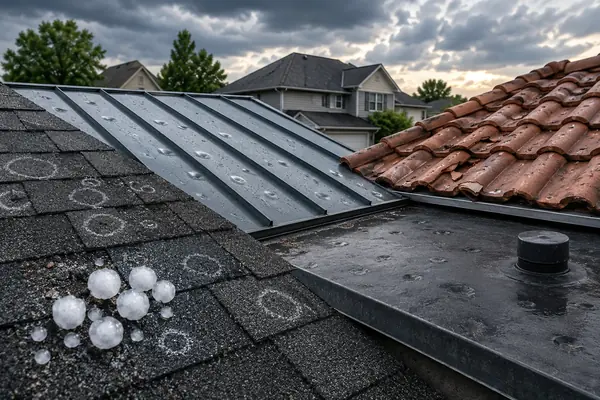
Newer subdivisions in Edinburg, Mission and Harlingen have plenty of shingle roofs. Those claims look like hail and wind claims anywhere in Texas: creased tabs, missing shingles, granule loss and soft metal dents. See how to identify hail damage by roof type.
Question two: which county?
Wind coverage depends on where the property is.
| County | Typical wind and hail coverage | Filing rules to watch |
|---|---|---|
| Cameron (Brownsville, Harlingen, San Benito, Port Isabel, South Padre Island) | TWIA or a private carrier | TWIA: file within one year of the date of damage |
| Willacy (Raymondville, Lyford) | TWIA or a private carrier | TWIA: file within one year of the date of damage |
| Hidalgo (McAllen, Edinburg, Mission, Pharr, Weslaco) | Homeowners or commercial policy | Policy's own reporting terms; Chapter 542 deadlines for the insurer |
| Starr (Rio Grande City) | Homeowners or commercial policy | Policy's own reporting terms; Chapter 542 deadlines for the insurer |
Coastal policies in Cameron and Willacy counties often carry a wind deductible of 1–2% of dwelling coverage. Inland Hidalgo policies may have a flat deductible or a percentage wind and hail deductible, so check your declarations page before you assume the claim is worth filing.
Question three: roof leak or flood?
Hurricane Hanna in July 2020 brought wind and heavy rain across the Valley, and plenty of smaller storms since have done the same. The ground here is flat and drains slowly, so water can stand in streets and yards for days. That's when the coverage question gets sharp:
- Water that came through a storm-damaged roof, window or wall is generally a homeowners or TWIA question.
- Water that rose from the ground and came in under doors is flood, which a standard homeowners policy excludes. It needs an NFIP or private flood policy.
- Water that backed up through drains is often excluded unless you bought a water backup endorsement.
Many homes had some of each. Photograph ceiling stains, the roof, and any waterline on the walls separately, so the claim can be divided correctly instead of the whole thing being labeled flood.
After a storm in the Valley
- Check the roof safely. From the ground or a ladder, photograph cracked or missing tiles, flat-roof ponding and blown-off parapet caps. Don't walk on tile.
- Stop interior water. Tarp, move contents, and start drying. Keep invoices; reasonable mitigation is part of the claim.
- Report to the right carrier. TWIA or your private carrier for wind; your flood carrier for rising water.
- Save a few broken tiles. They help prove the profile and color when matching becomes an issue.
- Compare the estimate to the roof. If the carrier priced a handful of tiles on a roof with damage on every slope, get a second opinion before you sign anything.
Not sure whether your claim needs outside help? The quiz below takes a couple of minutes.
Free toolDo I need a public adjuster?Seven honest questions that tell you whether your claim needs outside help, or whether you can handle it yourself.We charge nothing upfront; our fee is a percentage of the claim payment, capped at 10% under Texas law. Learn more about our roof and hail damage claims and water damage claims work.
Communities covered from this page
Don't see your town? We serve every Texas county. Ask us about your property.
Frequently asked questions
Is McAllen eligible for TWIA windstorm coverage?
No. Hidalgo County is not a first-tier coastal county. In the Valley, TWIA coverage is available in Cameron and Willacy counties.
The insurer will only replace a few broken roof tiles. Is that right?
Not always. If matching tiles are unavailable or walking the roof breaks more, a larger repair may be owed depending on your policy wording. Texas has no statute requiring matching, so the policy language and evidence decide it.
My flat roof leaked after a heavy rain. Is that covered?
It depends on whether the storm damaged the roof. Leaks from wear or poor drainage are usually excluded, while punctures, split seams or blown-off coping from the storm are covered losses on most policies.
Does homeowners insurance cover flooding from a hurricane in the Valley?
No. Rising water is excluded on a standard homeowners policy and needs an NFIP or private flood policy. Rain that came through storm damage to the roof or walls is a separate question.