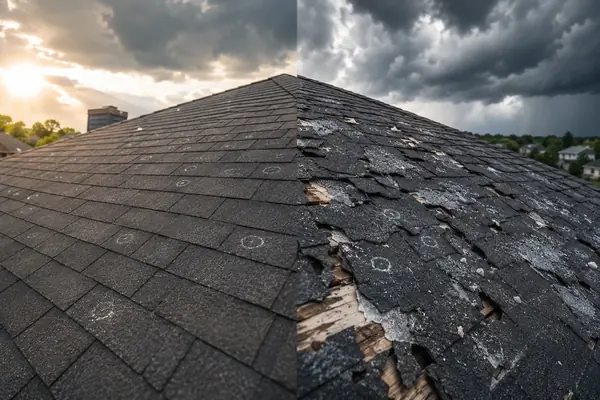
In Midland, Odessa and the rest of the Permian Basin, a hail or wind claim is often a commercial claim: a metal shop on a service yard, a field office, a hotel or crew housing, an apartment complex. Those claims involve more buildings, more line items and more money than a typical house, and insurers scrutinize them closely. We inspect the property, write a detailed Xactimate estimate, and work the claim with the carrier for owners of both commercial property and homes.
Our office is in Belton. We travel to the Permian Basin to inspect each property in person.
Hail and high wind on the Basin
West Texas storms can bring large hail and strong wind across open country with little to slow them down. Flat terrain and few trees mean the full force of the wind reaches roofs, overhead doors, signage and rooftop equipment. When hail does fall on a property full of metal buildings, the damage is widespread.
On a commercial site with several buildings, read how the deductible applies. Some commercial policies apply it per building, others per occurrence, and a percentage deductible may be calculated on each building's insured value. The same storm can produce very different net payments depending on that wording. Check also whether the policy lists each building and its limit on a schedule; a building missing from the schedule is a problem better found before the claim than during it.
Commercial and oilfield properties: what gets missed
Each type of building has its own blind spots on an insurer's estimate.
| Property | Items often left off or underpriced |
|---|---|
| Metal shops and yard buildings | Fasteners and washers, ridge caps and trim, skylight and translucent panels, gutters, overhead doors, insulation under damaged panels |
| Field offices and office buildings | Rooftop HVAC units and their fins, membrane damage under the surface, parapet coping, interior ceiling tiles below leaks |
| Hotels and crew housing | Every building on the site, interior water damage across many units, and the income lost while rooms are out of service |
| Apartment complexes | Roofs on every building, carports, matching across buildings, and lost rent |
| Retail and strip centers | Signage, storefront glass, rooftop units, and tenant build-out depending on the lease |
Metal is the big one. Many commercial policies carry a cosmetic damage exclusion for metal roofs and walls. Under that wording, dents alone may not be paid, so the inspection has to find functional damage: fasteners that are cracked or backed out, seams that no longer seal, panels that now hold water, and broken skylight panels. See cosmetic vs. functional hail damage for how insurers draw that line.
Business income
If your policy includes business income coverage, it can pay lost net income and continuing expenses while the property is being repaired. It is one of the most disputed parts of a commercial claim. Keep profit and loss statements, payroll records, occupancy or booking reports, and a record of the dates the building was out of use. Also check the coinsurance clause on the property coverage; if the building was insured for less than the policy requires, the payment can be reduced.
Our pages on warehouse claims, hotel claims and apartment complex claims go into more detail for each property type.
New construction and fast growth
Growth in Midland and Odessa has added a lot of newer homes, apartments and commercial buildings. A newer roof should mean an easier claim, but two issues come up:
- "Installation defect" denials. When wind takes shingles or panels off a newer building, the insurer may say they failed because of how they were installed, not because of the storm. Construction defects are a builder warranty issue, while storm damage belongs on the insurance claim, so the distinction matters. Storm data for the date, damage on neighboring buildings, and a pattern that matches the wind direction support the storm claim.
- Buildings still under construction. Damage to a building that isn't finished is usually a builder's risk policy question, not the future owner's homeowners policy.
Keep the roof's install date, the contractor's invoice and the product specifications. They answer both the age question and the installation question.
Dust after a wind event
When wind opens a roof edge or breaks a window, dust follows. It coats attics, ductwork, equipment and stock. Cleaning dust that came in through a storm-created opening can be part of the claim; dust that seeped through ordinary gaps usually isn't. Photograph the opening and the dust pattern before cleanup, and replace HVAC filters only after documenting them.
After a loss in Midland, Odessa or the surrounding counties
- Photograph every building on the site, including roofs, rooftop units, overhead doors and signage.
- Make temporary repairs to stop water and dust, and keep the invoices.
- For a business, write down the date operations were affected and start saving income and expense records.
- Find the policy's deductible, any cosmetic damage exclusion, the coinsurance clause and the business income terms.
- Report the claim and get the claim number in writing.
Our fee is a percentage of what the insurer pays, capped by Texas law at 10%, with no upfront cost. We don't do repairs ourselves; Texas law bars a public adjuster from taking part in repairing a property on a claim they adjust.
Free toolDo I need a public adjuster?Seven honest questions that tell you whether your claim needs outside help, or whether you can handle it yourself.Communities covered from this page
Don't see your town? We serve every Texas county. Ask us about your property.
Frequently asked questions
Will insurance pay for hail dents on my metal shop building?
If the policy has a cosmetic damage exclusion, dents alone may not be paid. Damage to fasteners, seams, panels and skylights that affects how the roof sheds water is functional damage and is typically covered.
Does my commercial policy cover lost income after storm damage?
Only if it includes business income coverage. It typically pays lost net income and continuing expenses during the repair period, and it requires financial records to support the amount.
The insurer says my new roof failed because it was installed wrong. What now?
Ask for the basis of the finding and any engineer report. Storm data for the date, damage on nearby buildings, and a damage pattern that matches the wind direction support a storm claim. Our denied and underpaid claims service handles disputes like this.
Do you have an office in Midland or Odessa?
No. Our office is in Belton, and we travel to the Permian Basin to inspect property in person.