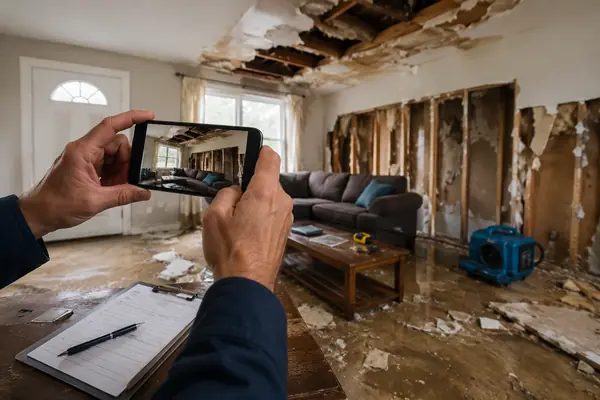
Most East Texas storm claims start with a tree. When wind or ice brings a pine or oak down on a house, garage or barn, your policy generally pays to repair the structure it hit, but tree removal is often capped, and the real structural damage is easy to miss until the tree is gone. We inspect the damage, document the framing before it is covered up, and write an Xactimate estimate that includes everything the tree broke.
We are based in Belton and travel to Tyler, Longview and the rest of East Texas to inspect property in person.
When a tree comes down: how coverage usually splits
Exact terms vary, so read your policy's sections on trees, shrubs and plants and on debris removal. This is how the common situations usually play out on a homeowners policy:
| What happened | What usually happens on the claim |
|---|---|
| Tree fell on the house or an attached garage | Repairs to the structure are covered as a wind or ice loss, subject to the deductible. Removing the tree from the structure is usually covered, often under a separate debris removal limit. |
| Tree fell on a detached garage, shop, barn or fence | Covered under other structures coverage, which has its own, smaller limit. |
| Neighbor's tree fell on your house | Your own policy usually handles it. Whose tree it was matters mainly if the neighbor knew it was dead or dangerous. |
| Tree fell in the yard and hit nothing | Often not covered for removal. Some policies pay a limited amount if it blocks a driveway or a ramp. |
| Tree fell on a vehicle | Handled under the comprehensive coverage on your auto policy, not your homeowners policy. |
Watch the removal limit: Removing large pines from a roof can take a crane and a crew, and the cost can run past the policy's tree debris limit. Get the tree company's invoice itemized: cutting and lifting the tree off the structure, hauling, and stump work are often treated differently.
What the hole in the roof doesn't show
A tree that lands on a house transfers its weight into the framing. Before the structure is closed up, we look for:
- Cracked or split rafters and trusses, including ones next to the impact point
- Broken ceiling joists and cracked drywall or plaster in rooms below
- Walls pushed out of plumb, doors and windows that no longer close
- Damaged decking well beyond the visible hole
- Gutters, fascia and soffit pulled loose along the eave
- Water damage inside from rain that came in before the tarp went on
Ask the tree company to let you photograph the tree in place before they cut, and to leave the framing visible after removal so it can be inspected. Once a roofer sheathes over it, cracked rafters are hard to prove. Our guide on how to document damage for your claim covers what photos to take and how to label them.
Tornadoes and straight-line wind in the Piney Woods
East Texas gets both tornadoes and severe thunderstorm winds. In wooded country, either one mostly shows up as trees down. The way debris lies helps: trees and limbs falling the same direction across your property support a wind claim, and fresh breaks with green wood show the tree came down in the storm rather than from long-term rot. Insurers sometimes argue a tree was already dead. Photos of leaves, fresh wood at the break and healthy neighboring trees answer that.
Ice storms
An East Texas ice storm causes damage in layers. Limbs snap under the weight and fall onto roofs, vehicles and fences. Gutters tear away under ice. Power can be out for days, which can lead to frozen and split pipes. Winter Storm Uri in February 2021 showed how widespread freeze damage can be. Food spoilage coverage, if your policy has it, is usually limited. If pipes burst, our water damage claims page explains how those claims are documented and dried.
Rural property and outbuildings
Plenty of owners around Lindale, Jacksonville, Henderson and Marshall have acreage with barns, shops, well houses, pole sheds and long runs of fence. On a homeowners policy these usually fall under other structures coverage, which is often a set fraction of dwelling coverage. A big storm can use that limit up fast. Two other things to check:
- Business or farm use. Homeowners policies often exclude or limit structures used for business or farming. If you run cattle or keep a shop for paying work, those structures may need a farm or commercial policy.
- Fences and well houses. These are easy to leave off a claim. Walk the fence lines and list every damaged section.
The first 48 hours after an East Texas storm
- Stay away from downed lines. Report them to the utility. Don't climb on a roof with a tree on it.
- Photograph the tree in place. Shoot it from several angles, where it broke, and every point it touches the structure.
- Get the tree off and the roof tarped. This is reasonable protection of the property, and the cost is usually part of the claim. Keep itemized invoices.
- Photograph the framing before it is covered. Rafters, joists and decking around the impact.
- Report the claim and list every structure involved, including outbuildings and fences.
We take these claims through our windstorm claims service. Our fee is a percentage of what the insurer pays, capped at 10% by Texas law, with no upfront fee.
Free toolContents inventory builderBuild a room-by-room list of damaged belongings with ages and prices, then export it as a spreadsheet.Communities covered from this page
Don't see your town? We serve every Texas county. Ask us about your property.
Frequently asked questions
Does homeowners insurance pay to remove a fallen tree?
Usually when it hits a covered structure, often subject to a separate tree or debris removal limit. A tree that falls without hitting anything is often not covered, though some policies pay a limited amount if it blocks a driveway.
My neighbor's tree fell on my house. Whose insurance pays?
Usually yours. The neighbor's policy generally comes into play only if the neighbor was negligent, for example by ignoring a tree they knew was dead.
The insurer says the tree was dead before the storm. What can I do?
Photograph the break, the leaves and the wood before the tree is hauled off. Fresh, green wood at the break and healthy surrounding trees are strong evidence. Our denied and underpaid claims service covers disputes like this.
Is my barn covered by my homeowners policy?
Often under other structures coverage, which has a lower limit than the house. If the barn is used for farming or a business, the homeowners policy may exclude it, so check the policy wording.
Do you have an office in Tyler?
No. Our office is in Belton, and we travel to Tyler, Longview and the surrounding counties to inspect property in person.