

Property damage in Stafford can create a complicated insurance claim long after the storm, leak, or fire is over. A damaged roof may also involve wet insulation, ceiling stains, damaged flooring, exterior components, and repairs needed to prevent further loss. A public adjuster in Stafford helps identify and document the complete scope of damage while representing the policyholder—not the insurance company.
TX Public Adjusting is a licensed Texas public adjuster providing insurance claim assistance for Stafford homeowners, landlords, business owners, commercial property managers, and other policyholders. We handle residential and commercial property damage claims involving hail, wind, water, fire, roof damage, and other covered losses.
Our company operates as Rise Public Adjusting LLC and is licensed in Texas under License #3356839. We have reviewed thousands of property claims and understand how documentation, policy language, repair estimates, and insurer communication affect a claim.
Concerned that your Stafford property claim was underpaid, delayed, denied, or incompletely documented? Request a free claim review from TX Public Adjusting. There are no upfront fees.
Property Insurance Claim Help for Stafford Policyholders
Stafford occupies a distinctive position within the Houston metropolitan area. Located in Fort Bend County near Sugar Land, Missouri City, and southwest Houston, the city combines established residential areas with warehouses, office buildings, retail centers, restaurants, schools, apartments, and industrial properties.
The city has long promoted itself as an “Island of Business Opportunity,” and its commercial identity is visible along the US 59 and Beltway 8 corridors. That mix of property types means a single weather event can generate very different insurance claims across Stafford.
A windstorm might damage shingles and fences in a residential subdivision while affecting membrane roofing, rooftop equipment, signage, loading areas, and inventory at nearby commercial buildings. A plumbing leak in a home may be confined to several rooms, while a similar loss in an office, restaurant, apartment building, or warehouse can interrupt operations and affect tenants.
Insurance companies send their own representatives to investigate claims. Those adjusters work within the carrier’s claim-handling system. A public insurance adjuster in Stafford works for the policyholder and prepares the claim from the property owner’s side.
Our work may include:
- Reviewing the policy and claim documents
- Inspecting visible and potentially hidden damage
- Preparing photographs, measurements, estimates, and supporting records
- Identifying omitted or undervalued repair items
- Organizing contents and business-property documentation
- Communicating with the insurance carrier
- Negotiating the covered scope and value of the loss
The objective is not to inflate a claim. It is to present a detailed, supportable claim that reflects the damage and the reasonable cost of restoring the insured property.
Why Property Owners Hire a Public Adjuster in Stafford
Many Stafford policyholders contact a public adjuster after realizing that the insurance process requires more time and technical knowledge than expected.
A carrier estimate may appear detailed because it contains many pages and line items. That does not necessarily mean it includes every damaged component. Roofing accessories, gutters, flashing, insulation, paint transitions, flooring continuity, cabinetry, debris removal, equipment access, and code-related work may be missing or undervalued.
Property owners often hire TX Public Adjusting when:
- The carrier’s estimate is lower than contractor estimates
- The claim payment does not cover the expected repairs
- Important rooms or building components were omitted
- The insurance company classified damage as maintenance or wear
- A roof was approved for a limited repair rather than replacement
- Water damage spread beyond the area included in the estimate
- The claim has stalled or communication has become inconsistent
- The policyholder is managing a large commercial loss
- A denied claim needs to be reviewed
- The owner wants professional help before submitting the claim
Stafford property owners also face a practical challenge: damages frequently overlap. Wind can lift roofing materials and allow rain into the building. Water can move through insulation, wall cavities, ceilings, and flooring. A fire can produce smoke contamination far beyond the visibly burned area. Hail can affect the roof, vents, gutters, fencing, siding, windows, and outdoor equipment during the same event.
A claim should tell the full story of the loss. When the documentation addresses only the most obvious damage, the settlement may not reflect what is actually required to restore the property.
Stafford Weather Risks and Property Damage
Stafford is inland from the Gulf Coast, but it remains exposed to Houston-area tropical weather, severe thunderstorms, heavy rainfall, hail, tornadoes, and damaging straight-line winds.
The City of Stafford warns that severe weather can occur throughout the year and that thunderstorms may bring strong winds, tornadoes, hail, lightning, and flash flooding. The city also notes that heavy local rainfall can cause flooding outside mapped floodplains and recognizable drainage channels.
Heavy Rain and Localized Flooding
Stafford is not generally subject to direct coastal storm surge, but tropical systems and slow-moving thunderstorms can produce substantial inland rainfall. The city describes Stafford as a hurricane pass-through area rather than a storm-surge location.
That distinction matters. A property does not need to be near the coast to experience:
- Wind-driven rain
- Roof leaks
- Water intrusion around doors or windows
- Overflow from drainage systems
- Interior ceiling and wall damage
- Wet insulation
- Flooring damage
- Electrical or equipment damage
- Business interruption
Insurance coverage for rain and flooding depends heavily on how the water entered the building and which policy applies. Surface flooding is commonly treated differently from water entering through storm-created damage. Careful cause-of-loss documentation can therefore become one of the most important parts of a Stafford water claim.
High Winds and Tropical Systems
Hurricanes and tropical storms can weaken before reaching Stafford while still producing damaging winds, extended rainfall, fallen trees, roof damage, and power interruptions. Property owners dealing with hurricane property damage should document both the direct wind damage and any resulting interior water intrusion.
Stafford’s emergency guidance states that hurricanes, tropical storms, winter storms, and severe thunderstorms can all generate high-wind hazards. It also notes that thunderstorms in the region can produce straight-line winds reaching or exceeding 75 miles per hour.
Wind damage may include:
- Missing, creased, or lifted shingles
- Damaged ridge caps and flashing
- Detached gutters or downspouts
- Broken fencing
- Damaged siding
- Tree impact
- Water intrusion
- Damaged rooftop units
- Commercial signage damage
- Exterior door and window damage
Some wind damage is subtle during a ground-level inspection. A roof may remain in place while seals are broken or materials are loosened. Those conditions can later lead to leaks and further deterioration.
Hail and Severe Thunderstorms
Stafford is also exposed to hail-producing thunderstorms. The city’s severe-weather guidance specifically includes hail among the hazards residents should prepare for.
A hail damage roof insurance claim may involve far more than damaged shingles. A complete inspection may need to consider:
- Asphalt shingles or commercial roof membranes
- Metal roof panels
- Roof vents and flashing
- Gutters and downspouts
- Window screens and glazing
- Garage doors
- Siding and exterior paint
- Fences and gates
- HVAC fins and rooftop equipment
- Signs, awnings, and exterior lighting
Damage patterns vary based on hail size, wind direction, roof age, material type, and building orientation. That is why a few photographs from the ground may not provide enough information to establish the complete scope.
Freeze and Pipe Damage
Although Stafford is known for warm, humid weather, freezing conditions can still cause significant property losses. Unprotected plumbing lines, exterior pipes, sprinkler systems, and equipment can freeze and rupture.
Once temperatures rise, water may spread into walls, ceilings, cabinetry, flooring, insulation, offices, apartments, or inventory areas. These claims may involve emergency mitigation, plumbing access, material removal, drying, reconstruction, and contents damage.
Common Insurance Claims in Stafford
Hail Damage Claims
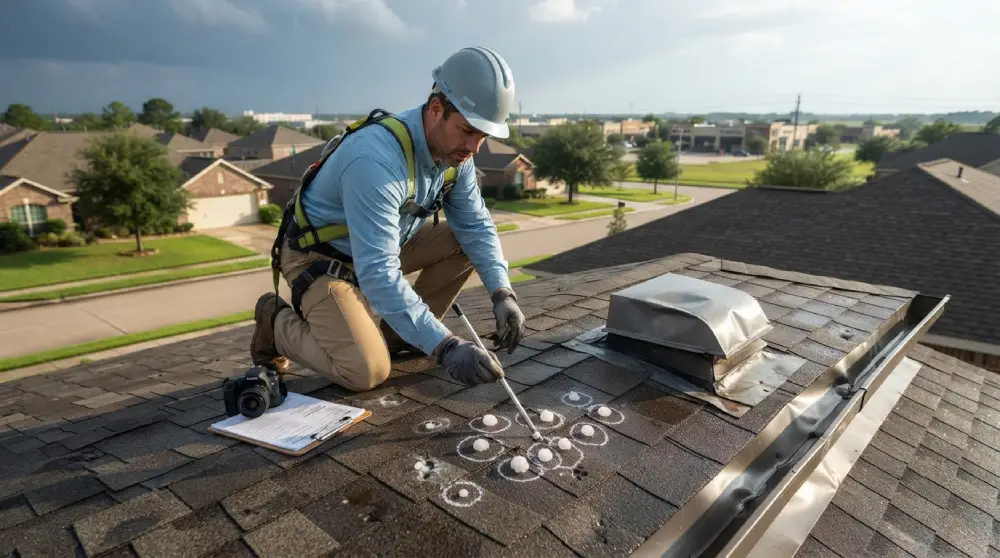
A Stafford hail claim may involve residential roofing, apartment buildings, warehouses, office properties, retail centers, or industrial facilities. Soft-metal impacts and collateral damage can help establish the direction and intensity of the storm, but every claimed item should be supported by inspection findings.
Knowing how to document hail damage for an insurance claim can make a substantial difference. TX Public Adjusting records affected elevations, roof surfaces, exterior components, and interior damage connected to the event. We also compare the carrier’s estimate with the observed scope and available repair information.
Water Damage Claims
Common water claims in Stafford include burst pipes, failed plumbing connections, appliance leaks, roof leaks, overflowing fixtures, HVAC drain problems, and rain entering after storm damage. A water damage public adjuster can help determine whether the carrier’s inspection and estimate account for the full affected area.
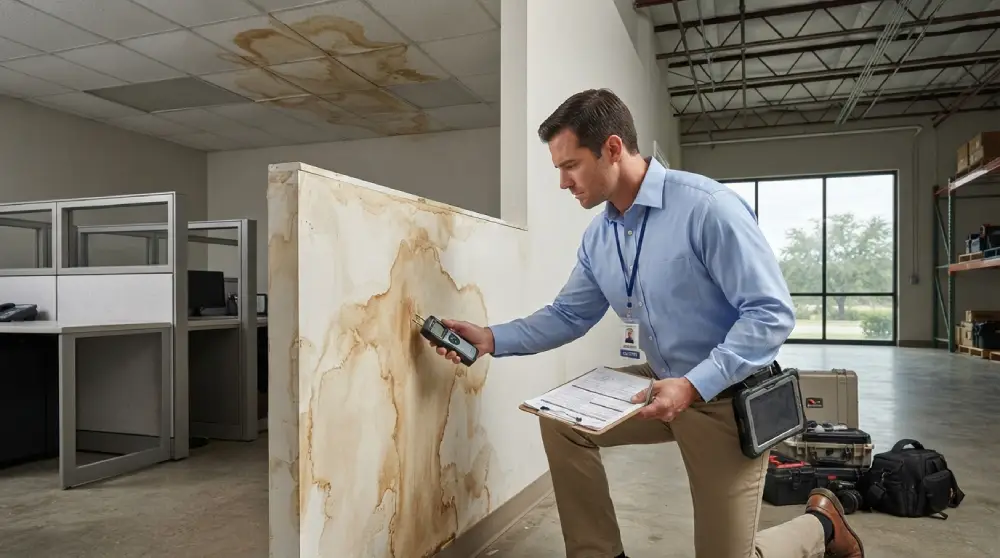
Water rarely remains limited to the point where it first appears. It may move under flooring, behind cabinets, through drywall, or into insulation. Proper documentation may include moisture readings, mitigation records, photographs, plumbing reports, repair estimates, and a timeline of the loss.
Coverage depends on the policy, cause, exclusions, and timing. We review those details before presenting the claim.
Fire and Smoke Damage Claims
Fire claims are often among the most demanding property losses. A fire insurance adjuster working for the policyholder can help organize the structural, contents, smoke, expense, and business-loss portions of the claim. The visible burn area may represent only one part of the damage.
A Stafford fire insurance claim can include:
- Structural damage
- Smoke and soot contamination
- Odor treatment
- Water used during firefighting
- Electrical damage
- HVAC contamination
- Damaged personal or business property
- Debris removal
- Temporary living expenses
- Business interruption
- Code-related repairs
We help organize the building, contents, expense, and operational portions of the loss so they can be addressed as a coordinated claim.
Storm and Wind Damage Claims
Storm claims frequently combine roof, exterior, interior, and contents damage. A wind-created opening may allow rain to affect ceilings, walls, insulation, flooring, and electrical components.
Our inspection focuses on both the direct storm damage and resulting covered damage. We then compare those findings with the insurer’s scope.
Roof Damage Claims
Roof claims are commonly disputed because carriers may attribute the condition to age, deterioration, installation problems, or prior damage. A public adjuster for a roof claim can compare the carrier’s findings with the storm pattern, observed damage, repair requirements, and related interior conditions.
A roof assessment should consider the roofing material, storm direction, damage pattern, repairability, matching issues, flashing, ventilation components, penetrations, underlayment, and related interior leaks.
Stafford’s property mix includes pitched residential roofs and low-slope commercial roofing systems. Each requires a different inspection and estimating approach.
Commercial Property Claims
Stafford has a substantial business and industrial presence, particularly near major transportation corridors. A commercial public adjuster may assist property owners with complex building, inventory, equipment, tenant, income, and operational-loss documentation. Commercial claims may involve warehouses, offices, retail centers, restaurants, apartments, churches, schools, medical spaces, and light-industrial buildings.
A commercial claim may require documentation of:
- Building damage
- Tenant improvements
- Inventory
- Machinery and equipment
- Rooftop mechanical systems
- Signage
- Business personal property
- Lost income or extra expenses
- Lease responsibilities
- Temporary protection
- Code and access requirements
Commercial losses require close coordination because repairs, tenant needs, operations, and insurance requirements may all move on different timelines.
Mid-page claim review: If your Stafford insurance estimate appears incomplete, TX Public Adjusting can review the claim, inspect the property, and explain whether important damage may have been missed. The initial claim review is free, and there are no upfront fees.
Why Stafford Insurance Claims Become Underpaid
Missed Damage
Fast inspections may focus on the most visible portion of the loss. Damage beneath roofing materials, behind walls, under flooring, around windows, or inside mechanical systems may receive little attention.
Scope Omissions
A scope can acknowledge a covered loss while leaving out important repair steps. Common omissions include demolition, disposal, access work, detach-and-reset labor, surface preparation, material transitions, painting, overhead items, and related room repairs.
Depreciation Issues
Policies may allow depreciation based on age and condition. Problems arise when depreciation is excessive, applied inconsistently, or withheld without a clear explanation of what can be recovered after repairs.
Low Repair Estimates
Carrier estimates may use quantities, labor assumptions, or repair methods that differ from what contractors believe is necessary. A public adjuster can examine the differences and prepare a documented response.
Documentation Problems
Claims are easier to evaluate when the evidence is organized. Missing photographs, incomplete contents lists, unclear invoices, limited mitigation records, and inconsistent descriptions can weaken an otherwise valid claim.
Cause-of-Loss Disputes
The insurer may argue that damage resulted from wear, maintenance, long-term leakage, or another excluded cause. Establishing the storm date, damage pattern, timeline, and relationship between exterior and interior conditions may become essential.
Our Public Adjusting Process
1. Claim Review
We review the policy, carrier correspondence, estimates, payment records, photographs, contractor documents, and claim status. This allows us to identify unanswered questions and determine the next appropriate step.
2. Property Inspection
We inspect the accessible areas connected to the loss. Depending on the claim, this may include roofing, exterior elevations, rooms, mechanical components, contents, commercial spaces, and evidence of moisture or smoke movement.
3. Damage Documentation
We prepare a supportable claim package using photographs, measurements, inventories, estimates, reports, invoices, and other relevant records. The documentation is organized to explain what happened, what was damaged, and what restoration may require.
4. Carrier Communication and Negotiation
TX Public Adjusting communicates with the insurance company, answers claim questions, participates in inspections when appropriate, and presents the documented scope from the policyholder’s perspective.
5. Settlement and Claim Resolution
We work to resolve disputed scope and valuation issues under the policy. No public adjuster can guarantee a particular settlement, but professional documentation and consistent claim management can give the property owner a stronger, clearer presentation.
Why Choose TX Public Adjusting
Licensed Texas Representation
TX Public Adjusting operates through Rise Public Adjusting LLC under Texas License #3356839.
We Represent Policyholders
An insurance company adjuster serves the carrier’s claim process. A public adjuster represents the insured property owner. Our responsibility is to prepare and advocate for the policyholder’s claim.
Residential and Commercial Experience
We assist homeowners, landlords, investors, business operators, and commercial property owners. Our team has reviewed thousands of claims involving roofing, water, fire, wind, hail, contents, and business property.
Texas-Focused Claim Knowledge
Texas claims are shaped by hailstorms, hurricanes, severe thunderstorms, freezes, high winds, and rapid weather changes. We focus on property losses throughout Texas and understand the documentation demands associated with these events.
Detailed, Independent Claim Review
We independently evaluate the observed damage and compare it with the carrier’s findings. We do not work for the insurance company, and we do not rely solely on its original estimate.
No Upfront Fees
Stafford policyholders can request a free initial claim review. Public adjusting fees are generally handled through a written agreement and tied to the claim recovery rather than collected upfront.
Areas We Serve in and Around Stafford
TX Public Adjusting assists policyholders throughout Stafford and surrounding southwest Houston and Fort Bend County communities. View our complete list of Texas service areas for additional locations served by our team.
Within Stafford, we serve properties near:
- The Promenade at Stafford Run area
- Vaccaro Manor
- Dove Country
- The Grove
- Stafford Colony
- Kingsway
- Sugar Creek-area properties near the Stafford boundary
- Commercial and industrial properties near US 59
- Properties near West Airport Boulevard
- Buildings along Murphy Road and FM 1092
- Business properties near Beltway 8
We also serve nearby:
- Sugar Land
- Missouri City
- Meadows Place
- southwest Houston
- Alief
- Bellaire
- West University Place
- Richmond
- Rosenberg
- Fresno
- Arcola
- Pearland
Local landmarks and community assets include the Stafford Centre, Stafford Civic Center, Gordon Fountain Lake Park, Stafford City Park, and the Margaret Havens Historical Memorial Garden. The city manages six municipal parks in addition to civic and community facilities.
Stafford’s history is also closely connected to the development of Texas rail transportation. Stafford’s Point became the terminal point of the first railroad tracks built in Texas, adding to the city’s long-standing role as a transportation and commercial crossroads.
Frequently Asked Questions
What does a public adjuster in Stafford do?
A Stafford public adjuster represents the policyholder during a property insurance claim. The adjuster reviews the policy, inspects the loss, documents damage, prepares estimates and supporting records, communicates with the carrier, and negotiates disputed claim issues.
Unlike the insurance company’s adjuster, a public adjuster does not represent the insurer. Understanding the difference between a public adjuster vs. independent adjuster can help Stafford property owners identify which professional represents their interests. TX Public Adjusting works for the residential or commercial policyholder.
When should I hire a public adjuster after Stafford property damage?
You may hire a public adjuster before filing, while the claim is being investigated, or after receiving an estimate that appears too low. The best timing depends on the policy, loss date, claim status, and any applicable deadlines.
Early involvement can make documentation easier because damaged conditions may change during mitigation and repairs. However, an existing, underpaid, delayed, or denied claim may still be reviewable. Learn more about when it is too late to hire a public adjuster before assuming that your opportunity for professional claim help has passed.
Can you help with an underpaid roof claim?
Yes. We review the carrier’s roof estimate, inspect the accessible damage, evaluate omitted roofing and exterior components, and document related interior damage.
We also examine repairability, flashing, vents, gutters, soft metals, material matching, access requirements, and other items that may affect the proper scope.
Does homeowners insurance cover flooding in Stafford?
Standard property insurance and flood insurance are different. Surface water entering from outside is commonly handled under a separate flood policy, while rain entering through storm-created building damage may be evaluated under a homeowners or commercial policy.
The cause and entry path should be documented carefully. Stafford advises that local heavy rainfall can cause flooding even outside mapped floodplains.
Can a public adjuster help after hurricane or tropical-storm damage?
Yes. Inland properties can experience wind damage, wind-driven rain, roof leaks, fallen trees, power-related losses, and business interruption even without coastal storm surge.
We help separate the different components of the loss and document the building, contents, expense, and commercial portions that may apply.
What if the insurance company says my damage is wear and tear?
Wear and maintenance exclusions are common points of dispute. The presence of an older roof or building component does not automatically answer whether a storm caused new damage.
We evaluate the reported event, damage pattern, prior condition, photographs, repair history, and related interior evidence before presenting the policyholder’s position.
How much does a Stafford public adjuster charge?
Public adjusters typically work under a written contingency-fee agreement based on the claim recovery. The fee and scope of representation should be clearly explained before the agreement is signed.
TX Public Adjusting offers a free initial claim review and does not charge upfront fees.
Can you help with a denied Stafford insurance claim?
A denial can be reviewed to determine the carrier’s stated reason, the policy provisions cited, and whether additional evidence may support reconsideration.
Not every denied claim can be changed. We provide an honest assessment based on the policy, facts, damage, and available documentation.
Do you handle commercial insurance claims in Stafford?
Yes. Stafford’s strong commercial and industrial base makes commercial claim support especially relevant. We assist with warehouses, offices, retail spaces, restaurants, apartments, churches, schools, and other business properties.
Commercial claims may involve building repairs, equipment, inventory, tenant improvements, business personal property, and loss-of-income documentation.
How long does a Stafford property claim take?
Claim duration varies. A straightforward residential loss may move faster than a large commercial claim involving engineers, multiple buildings, disputed causation, extensive contents, or business interruption.
Timely inspections, organized documentation, prompt responses, and a clearly supported estimate can reduce avoidable delays, but no public adjuster can guarantee a specific completion date.
Request a Free Stafford Insurance Claim Review
Property damage can affect far more than the first visible leak, broken shingle, or burned room. The quality of the inspection and documentation can influence whether the claim reflects the complete loss.
TX Public Adjusting helps Stafford policyholders prepare, document, and negotiate residential and commercial insurance claims. We work for property owners—not insurance companies.
Contact TX Public Adjusting for a free review of your Stafford residential or commercial property claim.
- Licensed Texas Public Adjuster
- Rise Public Adjusting LLC
- Texas License #3356839
- Residential and Commercial Claims
- No Upfront Fees
- Stafford and surrounding Fort Bend County communities