Property damage near Fort Bliss can look very different from a typical claim elsewhere in Texas. Homes, rental properties, retail buildings, apartment communities, offices, warehouses, and military-adjacent businesses in this part of El Paso County face intense sun, sudden desert thunderstorms, high winds, blowing dust, hail, plumbing failures, and short bursts of heavy rain that can overwhelm roofs and drainage systems. When the resulting insurance claim is delayed, denied, or underpaid, a licensed public adjuster in Fort Bliss can help document the loss and represent the policyholder.
As a licensed Texas public adjuster, TX Public Adjusting provides residential and commercial insurance claim assistance throughout Fort Bliss, Northeast El Paso, Central El Paso, East El Paso, and surrounding communities. We are operated by Rise Public Adjusting LLC, Texas License #3356839. Our public adjusters work for property owners—not insurance companies.
Request a Free Claim Review. There are no upfront fees.
Fort Bliss is a United States Army installation centered in El Paso County, with a much larger operational footprint extending into southern New Mexico. The installation includes Biggs Army Airfield and sits beside densely developed El Paso neighborhoods, commercial corridors, schools, medical facilities, rental housing, and military family communities.
Why Property Owners Hire a Public Adjuster in Fort Bliss
An insurance company sends an adjuster to investigate a claim, but that adjuster is assigned and paid by the carrier. Understanding the difference between a public adjuster and an independent adjuster can help property owners determine who each professional represents. A public adjuster serves a different role. We represent the policyholder and prepare the claim from the property owner’s side.
That distinction matters when a Fort Bliss property has widespread roof damage, water intrusion, damaged mechanical systems, smoke contamination, or business interruption. A carrier inspection may last only a limited amount of time. Damage hidden behind walls, above ceilings, beneath roofing materials, or inside electrical and HVAC systems may not be fully reflected in the first estimate.
Property owners often contact TX Public Adjusting when:
- The insurance company’s estimate appears too low.
- Important rooms, materials, or repair steps were omitted.
- A roof claim was limited to minor repairs.
- Wind-driven rain caused interior damage.
- Water mitigation and reconstruction estimates do not match.
- The claim has stalled without a clear explanation.
- Depreciation was applied incorrectly or misunderstood.
- A commercial loss includes inventory or business-income issues.
- The carrier denied damage that appears connected to a covered event.
- The owner does not have time to manage inspections, estimates, records, and negotiations.
Our job is to identify covered damage, prepare supporting documentation, develop a detailed scope, communicate with the insurer, and pursue a fair claim resolution under the policy.
Property-Damage Risks Around Fort Bliss
Fort Bliss and the surrounding El Paso area have a high-desert climate. That does not mean properties are safe from severe weather. The combination of extreme heat, dry conditions, strong winds, monsoon moisture, thunderstorms, hail, and localized flooding creates a distinctive claim environment.
High Winds and Blowing Dust
Wind is one of the most persistent threats around Fort Bliss. Strong gusts can loosen shingles, lift membrane roofing, damage flashing, bend metal panels, detach exterior components, and drive dust into mechanical equipment.
Thunderstorm outflow can also produce sudden dust walls or haboob-like conditions. Recent National Weather Service-based reporting has warned that the El Paso area can experience thunderstorm-driven dust, sharply reduced visibility, strong outflow winds, and an increased chance of storms during the summer moisture season.
After a wind event, damage may include:
- Lifted, creased, or missing shingles
- Detached roof flashing
- Damaged vents and rooftop equipment
- Open seams in commercial roof membranes
- Fence, gate, awning, and sign damage
- Broken windows or damaged seals
- Wind-driven rain beneath roofing materials
- Dust contamination in HVAC systems
- Damage from displaced outdoor objects
Some wind damage is subtle. A roof may remain in place while its weather seal has been compromised. Those conditions can lead to leaks during a later rainstorm.
Hail and Severe Thunderstorms
El Paso receives fewer severe storms than some parts of North Texas, but damaging hail still occurs. A localized thunderstorm can affect one Fort Bliss neighborhood or commercial corridor while leaving nearby areas relatively untouched.
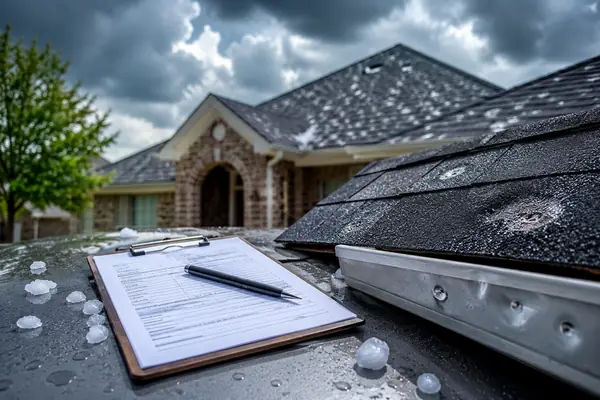
Hail claims may involve more than asphalt shingles. Local properties frequently include stucco exteriors, metal roofs, tile systems, flat commercial roofing, rooftop HVAC units, skylights, solar equipment, exterior lighting, and metal fencing.
Hail damage can affect:
- Asphalt shingles and underlayment
- Clay or concrete roof tiles
- Standing-seam and exposed-fastener metal roofs
- Modified-bitumen and single-ply commercial roofs
- Rooftop air-conditioning equipment
- Window screens, glazing, and frames
- Stucco coatings and exterior finishes
- Gutters, scuppers, and drainage components
- Solar panels and mounting systems
A complete hail damage insurance claim should account for all affected systems—not only the most visible marks on the roof.
Flash Flooding and Wind-Driven Rain
Fort Bliss sits in an arid region, but short periods of heavy rain can produce rapid runoff. Hard desert soil, paved surfaces, sloped terrain, drainage channels, and overwhelmed roof drains can combine to create localized flooding.
Flooding and water intrusion are not automatically treated the same way under an insurance policy. Surface water may be excluded from a standard property policy, while wind-created openings, roof leaks from covered damage, broken plumbing, or certain accidental discharges may be covered. The cause of loss must be investigated carefully.
A water damage insurance claim may become disputed when the carrier questions how the water entered, how far it traveled, or which materials require replacement. Water-related claims around Fort Bliss may involve:
- Roof leaks following wind or hail
- Overflowing roof drains
- Water entering around windows and doors
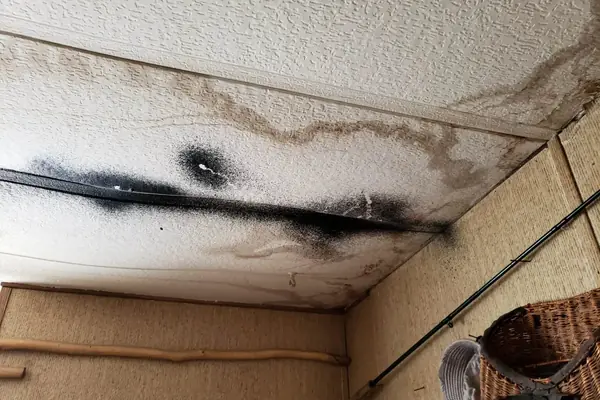
- Interior ceiling and drywall damage
- Wet insulation
- Damaged flooring and baseboards
- Mold-related conditions after delayed drying
- Electrical damage
- Water intrusion into commercial inventory
- Damage caused by broken supply lines or plumbing systems
Extreme Heat and Thermal Stress
Long periods of intense sun and high temperatures can accelerate roof aging, sealant failure, material expansion, and contraction. Heat alone may not constitute a covered loss, but it can complicate a claim after wind or hail.
For example, an older roof may already show wear, while a storm creates new creases, punctures, broken tiles, or open seams. The claim must distinguish recent event-related damage from ordinary deterioration. A detailed inspection and photographic record are especially important in these disputes.
Fire, Smoke, and Electrical Losses
Dry conditions, electrical failures, cooking incidents, equipment malfunctions, vehicle fires, and neighboring structure fires can lead to serious losses. Smoke can travel through HVAC systems and contaminate areas far from the visible fire.
A Fort Bliss fire claim may include:
- Structural repairs
- Smoke and soot cleaning
- Odor treatment
- HVAC and duct cleaning
- Electrical-system evaluation
- Contents cleaning or replacement
- Temporary relocation expenses
- Debris removal
- Code-related repairs
- Business-income losses
The visible burn area is only one part of the damage. A fire insurance adjuster should also examine how smoke, soot, heat, and firefighting efforts affected areas beyond the immediate source of the fire. Smoke residue can settle behind cabinets, above ceilings, inside mechanical systems, and throughout personal or commercial contents.
Common Insurance Claims in Fort Bliss
Hail Damage Claims
Hail damage should be documented by roof surface, elevation, building component, and affected trade. We review whether the carrier’s scope includes necessary access, removal, replacement, disposal, flashing, ventilation, underlayment, code requirements, and related interior repairs.
Water Damage Claims
Water losses can become expensive quickly. Moisture may spread beneath flooring, behind drywall, through insulation, and into adjoining rooms. Our review compares moisture records, mitigation invoices, repair estimates, photographs, and policy provisions.
Fire and Smoke Damage Claims
Fire claims often involve structural repairs, contents, temporary living arrangements, debris removal, cleaning, and code upgrades. Commercial fire claims may also include damaged equipment, inventory, and lost income.
Storm and Wind Damage Claims
A windstorm may damage roofs, windows, exterior finishes, fences, signs, awnings, and rooftop equipment. We examine the building as a connected system and document both direct storm damage and resulting interior loss.
Roof Damage Claims
Fort Bliss properties include sloped residential roofs, tile systems, metal panels, and low-slope commercial assemblies. Property owners may consider hiring a public adjuster for a roof claim when the carrier proposes spot repairs that may not restore the system properly, comply with installation requirements, or match surrounding materials.
Commercial Property Claims
The area surrounding Fort Bliss includes apartment properties, restaurants, shops, contractors, medical offices, warehouses, hotels, and military-support businesses. A commercial public adjuster can help organize building damage, business-property losses, operational records, and repair estimates. A commercial claim may involve:
- Building damage
- Tenant improvements
- Equipment and machinery
- Inventory
- Signs and exterior features
- Water mitigation
- Business interruption
- Extra expenses
- Code compliance
- Multiple buildings or roof sections
Commercial losses require disciplined recordkeeping. Delays in documenting damage, revenue, expenses, or damaged inventory can create avoidable disputes.
Why Fort Bliss Insurance Claims Become Underpaid

An underpaid claim does not always result from one obvious error. More often, several small omissions add up to a significant difference. Reviewing the most common property insurance claim mistakes can help an owner avoid missing photographs, incomplete inventories, premature repairs, and other documentation problems.
Missed or Hidden Damage
The first inspection may overlook wet insulation, damaged roof accessories, concealed moisture, smoke migration, opened membrane seams, damaged HVAC components, or deterioration caused by prolonged water exposure.
Incomplete Scope of Work
An estimate might include a damaged material without the labor and related steps needed to complete the repair. Common omissions include:
- Material removal and disposal
- Access and protection
- Detaching and resetting fixtures
- Underlayment and flashing
- Texture and paint blending
- Equipment manipulation
- Moisture testing
- Code-required work
- Contractor overhead and profit where applicable
Improper Repair Assumptions
A carrier may assume a shingle, tile, metal panel, coating, or interior finish can be repaired when availability, brittleness, installation requirements, matching concerns, or surrounding conditions make the repair impractical.
Depreciation Issues
Replacement-cost policies often involve depreciation. Some amounts may be recoverable after repairs, while others may not be. Errors occur when depreciation is applied to the wrong items, calculated inconsistently, or explained poorly.
Low Pricing or Measurement Errors
Small differences in roof dimensions, room measurements, labor rates, material quantities, waste factors, or equipment costs can materially affect a large claim.
Weak Documentation
A claim is harder to evaluate when photographs are incomplete, damaged property is discarded too early, mitigation records are missing, or the owner cannot produce an inventory of affected contents.
Concerned that your Fort Bliss insurance settlement is too low? Request a free claim and scope review from TX Public Adjusting.
Our Public Adjusting Process
Property owners who are unfamiliar with the process can first review what a public adjuster does before deciding whether professional representation fits their claim.
1. Claim Review
We review the reported cause of loss, claim status, policy information, carrier correspondence, estimates, payments, photographs, and contractor documents.
This helps us identify the central issue. The claim may involve missing damage, a disputed cause, incomplete pricing, delayed communication, or a coverage limitation that requires closer analysis.
2. Property Inspection
We inspect the affected property and document visible conditions. Depending on the loss, this may include the roof, exterior elevations, interior rooms, moisture-affected areas, contents, mechanical equipment, and commercial operations.
3. Damage Documentation
We organize photographs, measurements, inventories, reports, invoices, estimates, and supporting records. The goal is to present the claim in a clear, structured format.
4. Scope Preparation
We prepare or review the repair scope. A complete scope should explain what was damaged, what work is required, and how the requested amount was calculated.
5. Carrier Communication and Negotiation
We communicate with the insurance company, respond to questions, coordinate additional inspections when necessary, and present supporting documentation.
6. Claim Resolution
The objective is a fair settlement based on covered damage and the terms of the policy. No public adjuster can guarantee a particular result, but professional documentation can give the insurer a much clearer basis for evaluating the loss.
Why Choose TX Public Adjusting
Licensed Texas Representation
TX Public Adjusting is operated by Rise Public Adjusting LLC, Texas License #3356839. Licensing matters because public adjusting involves insurance-policy interpretation, damage documentation, claim presentation, and negotiation.
We Represent Policyholders
We do not work for the insurance carrier. Our duty is to the residential or commercial property owner who hires us.
Texas Claim Experience
Our team has reviewed thousands of property claims involving roofs, hail, water, fire, smoke, wind, and commercial losses. That experience helps us recognize missed line items, incomplete scopes, and documentation gaps.
Residential and Commercial Expertise
A family home, apartment building, retail property, restaurant, warehouse, and office complex each require a different claim strategy. We tailor the documentation to the building, policy, and type of loss.
No Upfront Fees
Property owners can begin with a free claim review. Public-adjusting fees are explained in the written agreement before representation begins.
Localized Claim Review
Fort Bliss is not interchangeable with Dallas, Houston, or the Texas Gulf Coast. El Paso County’s desert climate, roofing materials, drainage conditions, wind exposure, and building styles require local context.
Fort Bliss and Nearby Areas We Serve
Our Fort Bliss public-adjusting services extend throughout the installation area and nearby El Paso communities, including:
- Central Fort Bliss and military family housing areas
- Biggs Army Airfield vicinity
- Aero Vista
- Logan Heights
- Northeast El Paso
- Sunrise Acres
- Angel’s Triangle
- Mountain View
- Tobin Park
- Castner Heights
- Devil’s Triangle
- Central El Paso
- Five Points
- Manhattan Heights
- East El Paso
- Lower Valley
- Mission Valley
- Horizon City
- Socorro
- Anthony
- Canutillo
Local reference points include Biggs Army Airfield, the National Border Patrol Museum, the El Paso Museum of Archaeology, Franklin Mountains State Park, and the nearby Castner Range landscape. Fort Bliss’s location beside the Franklin Mountains and the developed El Paso basin influences drainage, wind exposure, and storm runoff.
Frequently Asked Questions

How can a public adjuster help with a Fort Bliss property claim?
A public adjuster inspects the damage, reviews the policy and carrier estimate, prepares supporting documentation, and negotiates from the policyholder’s side. The goal is to make sure the claim reflects the covered damage and reasonable repair requirements.
This can be especially helpful when the claim involves several rooms, multiple roof systems, commercial operations, contents, smoke contamination, or hidden water damage.
Can TX Public Adjusting work on property located inside Fort Bliss?
Access to property within a military installation may be controlled by federal or installation-specific security procedures. Our ability to inspect a particular location depends on access authorization and the property owner’s rights.
For privately insured housing, commercial operations, or properties near the installation, we can review the claim and determine the appropriate inspection process.
Is Fort Bliss a city?
Fort Bliss is primarily a United States Army installation and census-designated place rather than an incorporated Texas city. Its main post is in El Paso County, immediately adjoining El Paso, while its broader training footprint extends into New Mexico.
For insurance-claim service purposes, the Fort Bliss area includes the installation, adjacent military housing, nearby El Paso neighborhoods, and surrounding commercial districts.
What types of Fort Bliss claims do you handle?
We assist with hail, wind, roof, water, fire, smoke, plumbing, commercial-property, and business-interruption claims. We can review newly reported claims as well as some claims that have already been inspected, underpaid, or denied.
The first step is reviewing the policy, date of loss, cause of damage, and current claim status.
Can you help if the insurance company already paid my claim?
Yes. An initial payment does not always mean the claim is complete. The carrier may have issued an undisputed payment while leaving open the possibility of supplements or additional documentation.
We can compare the carrier estimate with the actual damage and repair scope to determine whether significant items appear to be missing.
What if my Fort Bliss roof claim was denied because of wear and tear?
Insurance policies generally do not cover ordinary deterioration, but a roof can have both pre-existing wear and new storm damage. The key question is whether a covered event caused distinct, documentable damage.
We review roof conditions, storm evidence, photographs, repair feasibility, and the carrier’s stated basis for denial. Representation does not guarantee that the decision will change, but it can clarify whether the claim warrants further documentation.
Does homeowners insurance cover flash-flood damage?
Standard homeowners policies often treat surface flooding differently from rain entering through storm-created openings or water released from plumbing systems. Coverage depends on the source of the water and the policy language.
A separate flood policy may be needed for rising surface water. Before assuming a loss is covered or excluded, the cause should be documented carefully.
How much does a Fort Bliss public adjuster cost?
Public adjusters commonly work under a contingency-based fee agreement, subject to Texas law and the written contract. The fee structure is reviewed before representation begins.
TX Public Adjusting offers a free initial claim review and does not charge an upfront fee for that review.
When should I contact a public adjuster?
You can contact a public adjuster shortly after a loss, while the insurance company is evaluating the claim, or after receiving an estimate that appears incomplete. Early involvement can make it easier to preserve evidence and organize documentation.
You should not wait unnecessarily if materials are being removed, repairs are beginning, or policy deadlines may apply. Our guide explains when it may be too late to hire a public adjuster and why early documentation can matter.
How long will my Fort Bliss property claim take?
The timeline depends on the severity of the loss, policy issues, inspection access, document availability, carrier response times, and whether the cause or repair scope is disputed. Property owners waiting for the carrier’s first response can also review how long an insurance adjuster has to contact you.
A small water loss may progress differently from a commercial fire, multi-building hail claim, or claim involving structural and business-income damage. We explain the likely next steps after reviewing the file.
Get a Free Fort Bliss Claim Review
A low estimate does not always account for the full cost of restoring a damaged property. Missing roof components, wet insulation, overlooked smoke contamination, incomplete interior repairs, and incorrect measurements can all reduce the initial settlement.
TX Public Adjusting helps Fort Bliss and El Paso County property owners prepare and present residential and commercial insurance claims.
TX Public Adjusting
Rise Public Adjusting LLC
Texas License #3356839
Contact us for a Free Claim Review. There are no upfront fees, and our public adjusters represent policyholders—not insurance companies.