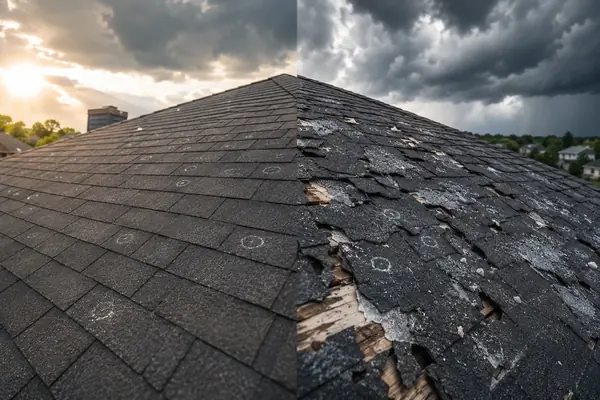
Office building claims go wrong in two places: the interior finish work that tenants paid for, and the roof equipment nobody looks at closely. A hailstorm or a failed supply line can damage drop ceilings, lighting, carpet, and server rooms across several suites. The owner's policy, each tenant's policy, and the leases decide who gets paid for which part. We start by mapping that out, then build an estimate that matches it.
Who insures what in a leased office building
In a typical multi-tenant office building, the owner insures the structure, roof, common areas, and building systems. Tenants usually insure their own furniture, computers, files, and often the build-out they paid for. Leases vary, and some make the landlord responsible for improvements while others push it to the tenant.
Often on the owner's policy
- Roof, structure, exterior walls, and windows
- Rooftop HVAC units, elevators, and fire sprinkler systems
- Lobbies, corridors, restrooms, and other common areas
- Base building finishes that came with the shell
- Lost rental income, if rental value coverage is included
Often on the tenant's policy
- Tenant improvements and betterments the tenant paid for
- Furniture, workstations, and office equipment
- Computers, servers, and network gear
- The tenant's own business income and extra expense
- Valuable papers and records, if endorsed
The column a given item falls into depends on the lease and the policy wording, not on this list. When we represent the owner, we ask for the leases early so that the owner's claim doesn't include items a tenant is supposed to insure, and doesn't leave out items the owner is responsible for.
Tenant improvements and interior finishes
Water through a hail-damaged roof or from a burst line rarely stays in one suite. It runs along the deck, drips through the ceiling grid, and spreads under demising walls. Insurer estimates often price "replace stained ceiling tiles" and stop there. A complete scope for an office suite commonly also needs:
- Ceiling grid that has rusted or sagged, not just the tiles
- Recessed and troffer light fixtures that took on water, plus electrician time to test circuits
- Insulation above the ceiling, which holds water long after the tiles dry
- Carpet tile and pad, with matching problems when the pattern is discontinued
- Drywall, wall coverings, and glass partition gaskets at the base of walls
- Moving and resetting furniture and workstations so the work can be done
We take moisture readings in walls and above the ceiling, not just at visible stains, and record where the water traveled. That map is what justifies replacing materials in the next suite over.
Rooftop HVAC units and roof equipment
Most low- and mid-rise Texas office buildings are cooled by packaged rooftop units. Hail bends condenser coil fins, cracks plastic fan shrouds, and dents cabinets. The question is whether that damage reduces the unit's function or service life, and adjusters often treat it as cosmetic or price only "fin combing." We document each unit separately with roof-level photos and model information, and where function is in question we recommend an HVAC contractor's written evaluation of airflow and coil condition. The same applies to curbs, ductwork, flashings around penetrations, and any rooftop screen walls. See cosmetic vs. functional hail damage for how carriers draw that line.
Data rooms and IT equipment
A wet server room or a power surge during a storm can be one of the most expensive parts of an office loss and one of the hardest to prove. Electronics that got wet may work for a while and then fail. Before anything is thrown away or replaced, keep the damaged equipment, photograph serial labels, and get a written assessment from your IT vendor. Data restoration costs and the labor to rebuild a network are separate from the hardware. Whether they're covered depends on the policy: some forms limit electronic data, and some businesses carry separate equipment breakdown or electronic data coverage.
Income losses: owner vs. tenants
The owner and the tenants have different income claims after the same event:
- The owner loses rent if leases allow tenants to abate rent while their suite is unusable. That is claimed under rental value or business income coverage, if the owner's policy has it, and supported with the rent roll and lease terms.
- Each tenant loses business income if they can't operate, or spends extra to keep working from temporary space. That is claimed on the tenant's own policy.
Both claims depend on how long repairs should take, so a realistic repair schedule matters to everyone in the building.
Coordinating a multi-tenant loss
Multi-tenant claims stall when contractors, tenants, and several insurers work from different information. When we represent the owner, we keep a suite-by-suite record of damage, access dates, and who has reported what, and we share building-level documentation where it helps tenants with their own claims. Joseph Dittman (Texas Public Adjuster License #3356839) inspects the building, writes the Xactimate estimate by floor and suite, and attends re-inspections with the carrier's adjuster and any engineer they send.
For water-specific steps, see our water damage claims page. For roof and HVAC hail damage, see roof and hail damage claims. If the owner's building limit looks low against today's construction costs, read about coinsurance penalties in our commercial claims overview before the estimate is finalized.
Frequently asked questions
Who pays for water-damaged tenant improvements in an office building?
It depends on the lease and both parties' policies. Many leases make the tenant insure the improvements they paid for, while the landlord insures the base building, but the specific lease language controls.
Are hail-dented rooftop AC units covered by commercial insurance?
Often, if the hail reduced the unit's function or the policy doesn't exclude cosmetic damage. A written HVAC contractor evaluation of coil and airflow condition is the strongest evidence.
Can an office building owner claim lost rent after a storm?
Yes, if the policy includes rental value or business income coverage and the leases let tenants stop paying rent while their space is unusable. The rent roll and lease terms support the claim.
Should we replace wet computers right away after an office flood?
Keep the damaged equipment until the insurer has had a chance to inspect it, and get a written assessment from your IT vendor. Photograph serial numbers and keep any replacement invoices.