

Property damage in Saginaw can turn into a complicated insurance claim within hours. A spring thunderstorm may leave hail marks across a shingle roof, tear metal flashing from a commercial building, or push wind-driven rain into an attic. A plumbing failure can damage flooring and cabinets before the leak is discovered. Fire, smoke, freezing temperatures, and fallen trees can also create losses that extend far beyond the first visible problem.
A public adjuster in Saginaw, TX represents the property owner during the insurance claim process. As a licensed Texas public adjuster, TX Public Adjusting reviews the policy, inspects the damage, documents the full scope of the loss, prepares estimates, and communicates with the insurance company on the policyholder’s behalf.
TX Public Adjusting is operated by Rise Public Adjusting LLC, Texas License #3356839. We assist residential and commercial property owners with new, delayed, denied, and underpaid claims throughout Saginaw and the surrounding Tarrant County area.
Get a Free Claim Review: If your insurer’s estimate appears low, important damage was omitted, or the claim process has stalled, contact TX Public Adjusting. There are no upfront fees for the initial claim review.
Insurance Claim Help for Saginaw Property Owners
Saginaw is a growing community in northern Tarrant County, positioned just north of Fort Worth. The city combines established residential streets, newer subdivisions, retail corridors, schools, warehouses, manufacturing facilities, and rail-served industrial properties. Saginaw’s identity is closely tied to its “Train and Grain” heritage, including the rail lines, grain elevators, and industrial facilities that remain prominent near the center of the city.
That mix of property types creates a wide range of insurance claim challenges.
A hailstorm may affect hundreds of roofs in Willow Vista, Highland Station, Heather Ridge, or Saginaw North during the same event. Wind may damage fencing, siding, vents, gutters, and rooftop equipment across a residential subdivision. The same storm can cause a much larger and more technical loss at a warehouse, food-processing facility, retail building, apartment property, or industrial site near the city’s rail corridors.
Insurance companies investigate these claims using their own adjusters, vendors, estimating procedures, and coverage interpretations. Those professionals work for the carrier. A public adjuster works for the policyholder.
Our job is to identify covered damage, develop a detailed claim presentation, and help the property owner pursue the benefits available under the policy.
Why Property Owners Hire a Public Adjuster in Saginaw
Many claims begin with a straightforward inspection but become more complicated once the insurance company issues its estimate.
The carrier may acknowledge that damage occurred while disagreeing about:
- How much of the roof was affected
- Whether repairs or replacement are required
- Which building components must be included
- Whether interior water damage is related to the storm
- The cost of labor and materials
- Code-required work
- Depreciation calculations
- Business interruption or lost income
- The amount of damaged personal or business property
- Whether prior wear contributed to the loss
A Saginaw public adjuster independently evaluates the claim from the policyholder’s perspective. We compare the insurer’s estimate with the physical conditions at the property, the policy language, available documentation, and the actual scope of work needed to restore the building. Property owners who are unfamiliar with the role can read our guide explaining what a public adjuster is and how policyholder representation differs from the carrier’s claim process.
Property owners often contact TX Public Adjusting when:
- The insurance payment is lower than expected
- The carrier inspected the property too quickly
- Roof, siding, gutter, fence, or interior damage was left out
- The claim was denied based on wear and tear
- The insurer approved spot repairs that may not restore the property properly
- Multiple contractors disagree with the carrier’s estimate
- The claim requires extensive photographs, measurements, or inventories
- A commercial claim is interfering with operations
- Communication with the insurance company has slowed
- The owner does not have time to manage a large claim
You do not have to wait until a claim is denied to request help. A public adjuster may become involved shortly after the loss, during the carrier’s investigation, after an estimate is issued, or while an underpaid claim is still eligible for further documentation.
Saginaw Storm Risks and Property Damage Patterns
Saginaw sits within the Dallas–Fort Worth region, where severe thunderstorms can bring hail, straight-line wind, heavy rain, lightning, and occasional tornado activity. Local risk sources identify hail and tornadoes among the area’s significant storm concerns, while National Weather Service forecasts regularly reflect the potential for strong thunderstorms, high heat, heavy rainfall, and gusty conditions.
Hail Damage
Hail is one of the most common reasons Saginaw property owners file roof and exterior claims. Our hail damage roof insurance claim guide explains how Texas roof claims are inspected, documented, and evaluated.
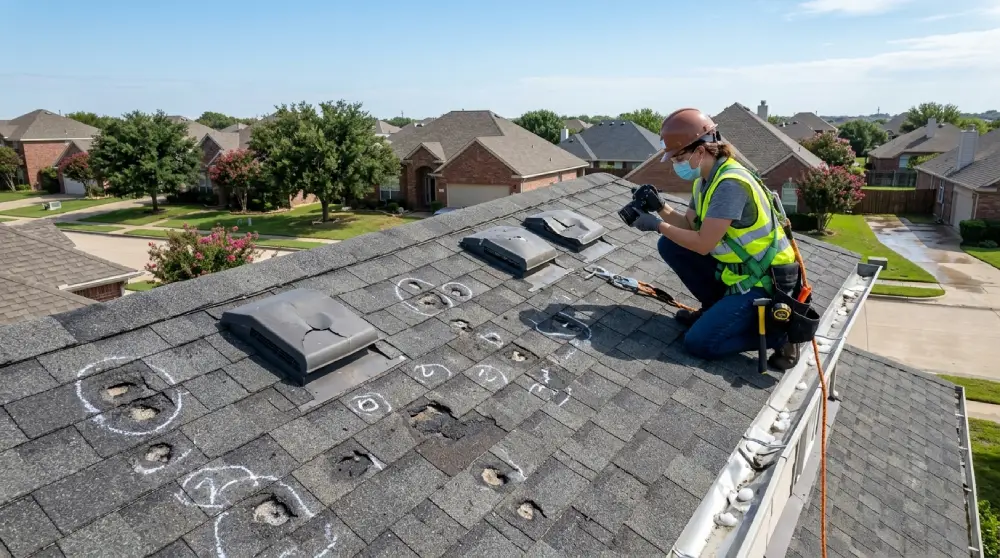
Damage is not always obvious from ground level. Hail may loosen protective granules on asphalt shingles, fracture the shingle mat, dent metal roofing, damage vents, crack skylights, bend gutters, mark fencing, and affect HVAC condenser fins.
On commercial properties, hail may damage:
- Modified bitumen and built-up roofing
- TPO or other single-ply roof membranes
- Metal roof panels
- Rooftop HVAC equipment
- Exhaust systems
- Skylights
- Roof coatings
- Exterior signs
- Loading-area components
- Vehicles and outdoor equipment
A carrier estimate may include only the most visible roof damage. A proper inspection should also consider collateral indicators and related components throughout the property.
High Wind and Severe Thunderstorms
Straight-line winds can lift shingles, loosen flashing, damage ridge caps, tear siding, break tree limbs, and push rain through openings in the building envelope.
Wind losses often become disputed because the roof may still appear intact from the street. Lifted or creased shingles can reseal after the storm, leaving damage that requires a closer inspection. Commercial roofs may experience displaced membrane sections, damaged edge metal, loosened rooftop equipment, and water intrusion around penetrations.
Tornado and Flying-Debris Damage
Saginaw and surrounding Tarrant County communities are exposed to rotating severe storms and tornado conditions. Even when a tornado does not directly cross a property, nearby circulation and intense thunderstorm winds can carry branches, roofing materials, signs, and other debris into buildings.
Tornado-related claims may involve:
- Partial or complete roof loss
- Broken windows and doors
- Structural movement
- Exterior wall damage
- Water intrusion
- Utility damage
- Fallen trees
- Damaged contents
- Temporary relocation costs
- Commercial shutdowns
These claims require careful documentation because several categories of damage may result from the same event.
Heavy Rain and Water Intrusion
Heavy thunderstorms can overwhelm drainage systems and expose weak points in roofs, windows, walls, and foundations. Water may travel behind drywall or insulation before becoming visible inside the property.
Depending on the cause and policy language, a claim may involve covered wind-driven rain, roof-opening damage, plumbing water, appliance failures, or another insured event. Flooding from surface water is generally treated differently from water that enters because a covered storm damaged the building, so identifying and documenting the cause is essential.
Winter Freeze Damage
Although severe cold is less frequent than spring thunderstorms, North Texas freeze events can cause major losses. Frozen pipes may burst in attics, walls, vacant buildings, rental properties, or commercial facilities. Water can spread through ceilings, insulation, flooring, cabinetry, electrical systems, and stored inventory.
A freeze claim should account for more than the broken pipe. The resulting water damage, demolition, drying, plumbing access, material replacement, and temporary living or operating expenses may all need to be evaluated.
Common Insurance Claims in Saginaw
Hail Damage Claims
Hail claims frequently involve disputes about whether roof marks are functional damage, cosmetic damage, manufacturing conditions, or ordinary aging.
TX Public Adjusting documents roof surfaces and related exterior components, reviews the insurer’s estimate, and identifies areas where the scope may be incomplete. Property owners can also review how to document hail damage for an insurance claim before repairs begin or storm evidence disappears. We also examine whether the estimate properly addresses roof accessories, flashing, vents, gutters, downspouts, fencing, siding, screens, windows, and interior water damage. If the carrier rejected the loss, review what to do if your hail claim was denied before assuming the insurer’s first decision is final.
Water Damage Claims
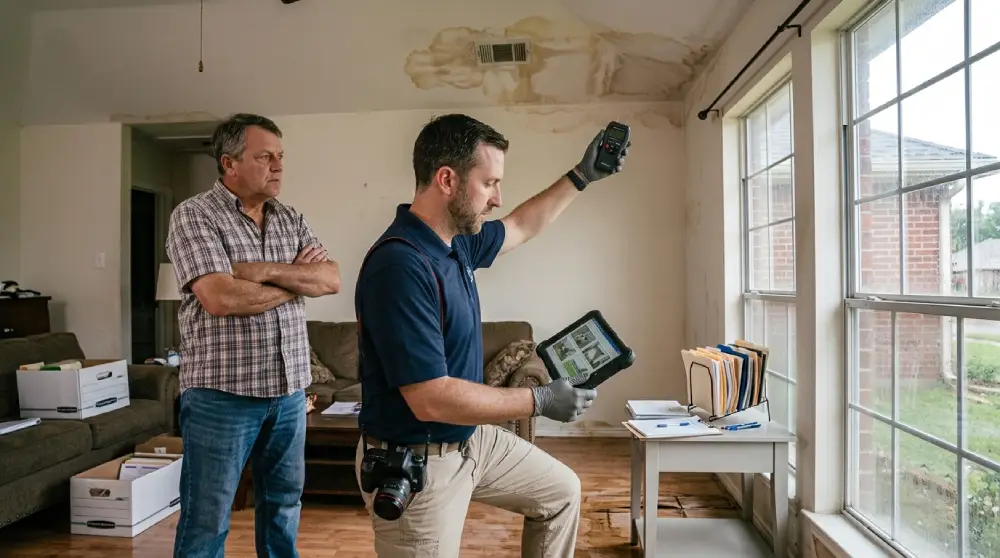
Water losses may originate from broken supply lines, appliance failures, overflowing fixtures, roof leaks, frozen plumbing, HVAC drain problems, or storm-created openings. A water damage public adjuster can review the cause of loss, affected materials, mitigation records, and the carrier’s repair scope.
The visible water stain is rarely the entire loss. Moisture may affect drywall, insulation, framing, baseboards, flooring, cabinetry, electrical components, personal property, and indoor air quality.
Our claim review considers:
- The source and timing of the water
- Emergency mitigation work
- Moisture readings
- Demolition requirements
- Material matching
- Damaged contents
- Mold-related concerns
- Repair access
- Temporary housing or business interruption
Our guide to dealing with an insurance adjuster after water damage outlines practical steps property owners can take while the claim is being investigated.
Fire and Smoke Damage Claims
Fire claims can be among the most detailed property claims because heat, smoke, soot, water, and firefighting activity may affect areas far from the point of origin. A fire insurance adjuster working for the policyholder can help document structural damage, contents, smoke contamination, and additional expenses.
A complete fire claim may involve:
- Structural repairs
- Smoke and soot cleaning
- Odor remediation
- Electrical evaluation
- HVAC cleaning or replacement
- Debris removal
- Contents inventories
- Temporary housing
- Code upgrades
- Business income loss
- Additional operating expenses
Smoke can travel through wall cavities, duct systems, attics, and adjoining rooms. The insurer’s initial inspection may not capture the full extent of contamination.
Storm Damage Claims
A single severe storm may produce overlapping hail, wind, debris, and water damage. These losses should not be evaluated as isolated issues when they stem from the same event.
For example, wind may loosen shingles, rain may enter the attic, insulation may become wet, and ceiling materials may later stain or sag. Documenting that chain of damage can be critical when the carrier approves exterior repairs but questions the interior loss.
Roof Damage Claims
Roof claims commonly become underpaid when an estimate omits essential components or assumes a repair can be completed without affecting adjacent materials. Hiring a public adjuster for a roof claim can help identify missing materials, labor, access charges, and related interior damage.
Potential scope issues include:
- Missing starter shingles
- Omitted ridge or hip materials
- Insufficient underlayment
- Missing drip edge
- Flashing omissions
- Vent replacement
- Valley material
- Steep or high charges
- Waste calculations
- Roofing code requirements
- Solar panel removal and resetting
- Interior protection during construction
When the first carrier inspection was incomplete or disputed, a roof claim second inspection may provide another opportunity to document conditions that were overlooked. We compare the carrier’s scope with the roof system, observed damage, and work reasonably required to perform covered repairs.
Commercial Property Claims
Saginaw has a more substantial industrial and commercial base than many similarly sized suburbs. Rail access, manufacturing, food production, distribution, and related businesses form an important part of the local economy.
Commercial claims may involve warehouses, retail centers, restaurants, offices, multifamily properties, schools, manufacturing buildings, and industrial facilities.
These losses can include:
- Low-slope roofing systems
- Specialized equipment
- Inventory damage
- Building improvements
- Tenant improvements
- Signage
- Refrigeration systems
- Machinery
- Business interruption
- Extra expenses
- Multiple buildings or locations
Commercial claims often require coordination among owners, tenants, contractors, accountants, engineers, restoration companies, and insurance representatives. TX Public Adjusting organizes the claim documentation and represents the policyholder throughout that process.
Why Saginaw Insurance Claims Become Underpaid
Many underpayments begin with the same common property insurance claim mistakes, including incomplete documentation, missed deadlines, and accepting an initial scope without a detailed review.
Damage Is Missed During the Inspection
Carrier inspections may be brief, especially after a widespread North Texas storm when adjusters are handling many claims. Damage on secondary roof slopes, detached structures, fences, HVAC equipment, interiors, or commercial rooftop components may not be included.
The Estimate Contains Scope Omissions
An estimate may approve a major repair but leave out the smaller components required to complete it properly. Those omissions can add up quickly.
Roof flashing, vents, edge metal, underlayment, code items, painting, manipulation of fixtures, debris removal, and access-related work are common examples.
Depreciation Is Applied Incorrectly or Misunderstood
Depreciation can significantly reduce the initial payment. Property owners may not understand which amounts are recoverable, what documentation must be submitted, or what deadlines apply.
We review the estimate and explain how depreciation is being handled under the policy and claim.
Labor and Material Pricing Is Too Low
Insurance estimating software is a tool, not a guarantee that every cost is accurate. Material shortages, contractor demand after a major storm, access limitations, specialized labor, and regional pricing can affect actual repair costs.
A detailed estimate should reflect the property and work involved, not merely a generic repair allowance. When the amount of loss remains disputed, the policy may contain an appraisal provision. Learn more about appraisal for a hail damage claim and how that process differs from ordinary claim negotiation.
Documentation Is Incomplete
Claims may be underpaid because the carrier did not receive photographs, measurements, inventories, invoices, moisture records, repair proposals, expert reports, or other support.
TX Public Adjusting helps assemble the documentation into a clear claim package rather than relying on scattered emails and disconnected estimates.
Our Public Adjusting Process
1. Claim Review
We begin by discussing the date and cause of loss, the property, the insurance company’s response, payments already issued, and the owner’s concerns.
When available, we review:
- The insurance policy
- Carrier correspondence
- Claim estimates
- Payment letters
- Denial letters
- Contractor proposals
- Photographs and videos
- Mitigation documents
- Prior repair records
This helps us determine where the claim stands and what additional work may be necessary.
2. Property Inspection
We inspect accessible areas related to the loss and document visible conditions. The inspection may include roofing, exteriors, interiors, detached structures, commercial roof systems, mechanical equipment, and affected contents.
When specialized testing or expert analysis is appropriate, we help coordinate the necessary professionals.
3. Damage Documentation
We build a claim file using photographs, measurements, estimates, inventories, invoices, reports, and supporting records.
The goal is to connect each requested item to the covered damage and explain why it belongs in the claim.
4. Scope and Estimate Preparation
We develop or review the repair scope, evaluate the carrier’s estimate line by line, and identify missing or disputed items.
For commercial claims, this may also include business-income records, extra expenses, tenant documentation, equipment information, and operational impacts.
5. Carrier Communication and Negotiation
TX Public Adjusting communicates with the insurance company, submits documentation, responds to requests, discusses disputed items, and presents the policyholder’s position.
We remain involved as the carrier reviews the additional information and the claim moves toward resolution. Property owners experiencing prolonged silence can also review how long an insurance adjuster has to contact you and what steps may help move the claim forward.
Concerned About a Low Estimate? Request a free claim review before accepting the carrier’s scope as complete. A second look may identify damage or repair components that were not included.
Why Choose TX Public Adjusting
Licensed Texas Representation
TX Public Adjusting is operated by Rise Public Adjusting LLC, Texas License #3356839.
We Represent Policyholders
Insurance-company adjusters represent the insurer. Public adjusters represent property owners. Our comparison of a public adjuster vs. independent adjuster explains who each professional represents during an insurance claim. Our responsibility is to prepare and present the policyholder’s claim—not to protect the carrier’s financial interests.
Texas Claim Experience
Our team has reviewed thousands of property claims involving residential, commercial, storm, hail, water, fire, smoke, roof, and business losses.
That experience helps us recognize common estimate omissions, documentation gaps, and coverage questions that may otherwise delay a claim.
Residential and Commercial Knowledge
A hail claim on a single-family home is different from a loss involving a warehouse, apartment complex, restaurant, retail center, or manufacturing building.
We adjust the claim strategy to the building type, policy, cause of loss, and operational impact.
Detailed Claim Preparation
Strong claims are supported by organized evidence. We focus on inspection findings, photographs, measurements, estimates, inventories, invoices, policy provisions, and clear communication.
Free Initial Claim Review
Property owners can speak with TX Public Adjusting about the claim before deciding how to proceed. The initial review carries no upfront fee.
Neighborhoods and Areas We Serve in Saginaw
TX Public Adjusting assists property owners across Saginaw’s established neighborhoods and newer residential communities.
Local subdivisions and residential areas include:
- Willow Vista
- Highland Station
- Heather Ridge
- Saginaw North
- Creekwood Estates
- Amber Meadows
- Parkwest
- Rancho North
- Whisperwood Estates
- Willow Creek
- North Fork Estates
- Innisbrook Place
These neighborhood names appear in local real estate and community directories, reflecting the mix of established and newer housing found throughout Saginaw.
We also serve properties near:
- Saginaw Boulevard
- McLeroy Boulevard
- Bailey Boswell Road
- Knowles Drive
- Blue Mound Road
- The city’s grain elevators and rail corridors
- Saginaw High School
- Willow Creek Park
- The broader Eagle Mountain–Saginaw area
The community is located only a short distance from Fort Worth, giving Saginaw property owners access to the larger Dallas–Fort Worth economy while maintaining its own residential and industrial character.
Areas We Serve Near Saginaw
Our public adjusting services are also available in nearby communities across northern Tarrant County and the Fort Worth area, including:
- Fort Worth
- North Fort Worth
- Blue Mound
- Haslet
- Lake Worth
- Sansom Park
- River Oaks
- Haltom City
- Watauga
- North Richland Hills
- Keller
- Azle
- Eagle Mountain
- White Settlement
Storms rarely stop at a city boundary. One hail-producing system may affect Saginaw, North Fort Worth, Haslet, and surrounding communities during the same afternoon.
Frequently Asked Questions
What does a public adjuster do for a Saginaw property owner?
A public adjuster represents the policyholder during a property insurance claim. The adjuster reviews the policy, inspects and documents damage, evaluates repair estimates, communicates with the insurer, and helps present the full claim.
TX Public Adjusting works for the property owner, not the insurance carrier. That distinction matters when the insurer’s estimate leaves out damage or applies a narrower repair scope.
When should I hire a public adjuster in Saginaw?
You may hire a public adjuster shortly after the loss or after the insurance company has issued an estimate. Property owners commonly seek help when a claim is large, technically complicated, delayed, denied, or underpaid.
It is usually better to request a review before signing releases, completing major repairs without documentation, or allowing important policy deadlines to pass. Our guide explains when it is too late to hire a public adjuster and why the answer depends on the claim’s status and applicable deadlines.
Can a public adjuster help after my insurer has already paid the claim?
Possibly. An initial insurance payment does not always mean every covered item has been resolved.
We can review the policy, estimate, payment documentation, and property conditions to identify whether additional covered damage or omitted work may still be presented. The available options depend on the claim status, policy terms, deadlines, and prior communications.
How much does a public adjuster cost in Texas?
Public adjusters generally work under a written agreement that explains how compensation is calculated. The fee may be based on a percentage of the insurance recovery, subject to Texas law and the terms of the contract.
TX Public Adjusting offers a free initial claim review and explains the fee arrangement before representation begins. There are no upfront fees for the initial review.
Can you help with a denied Saginaw roof claim?
Yes. We review the denial letter, policy language, inspection findings, photographs, roof conditions, weather-related evidence, and available contractor or expert information.
A denial is not automatically reversible, and no outcome can be guaranteed. However, a detailed review may reveal missing documentation, disputed causation, overlooked storm damage, or other issues that deserve further consideration.
What if my insurance company says the roof damage is wear and tear?
Wear and tear is a common point of disagreement in North Texas roof claims. A roof can have age-related conditions and also sustain new hail or wind damage.
The key issue is whether a covered event caused direct physical damage. We document storm-related conditions and compare them with the carrier’s explanation rather than assuming the roof’s age resolves the entire claim.
Do you handle commercial claims in Saginaw?
Yes. TX Public Adjusting assists owners of warehouses, retail buildings, offices, restaurants, apartment properties, industrial facilities, and other commercial buildings.
Commercial claims may involve roofing, equipment, inventory, tenant improvements, business interruption, extra expenses, and multiple repair trades. We organize those components into a coordinated claim presentation.
Can you help with water damage from a frozen or broken pipe?
Yes. A pipe failure may damage far more than the plumbing connection itself. Water can affect ceilings, walls, insulation, flooring, cabinets, electrical systems, furniture, and business contents.
We evaluate the resulting damage, mitigation documentation, repair access, material matching, and other claim components under the applicable policy.
Will hiring a public adjuster guarantee a larger payment?
No ethical public adjuster should guarantee a specific result. Every claim depends on the policy language, cause of loss, evidence, exclusions, deductibles, prior damage, and insurer’s evaluation.
Our role is to identify and document covered damage, correct incomplete scopes, and present the policyholder’s claim as thoroughly as possible.
Is TX Public Adjusting licensed in Texas?
Yes. TX Public Adjusting is operated by Rise Public Adjusting LLC, Texas License #3356839.
We provide public adjusting services for residential and commercial policyholders throughout Texas, including Saginaw and surrounding Tarrant County communities.
Request a Free Saginaw Claim Review
A damaged roof, flooded interior, fire loss, or commercial shutdown can place immediate pressure on a property owner. The insurance paperwork, inspections, estimates, inventories, and follow-up requests can quickly become a second full-time job.
TX Public Adjusting helps Saginaw policyholders take control of that process.
We review the claim, inspect the property, document the damage, identify scope omissions, and communicate with the insurance company on your behalf. Our team represents residential and commercial property owners—not insurance companies.
Contact TX Public Adjusting for a Free Claim Review.
- Licensed Texas Public Adjuster
- Rise Public Adjusting LLC
- Texas License #3356839
- Residential and commercial claims
- No upfront fee for the initial review