

Property damage in Webster can escalate quickly. A tropical system can push wind-driven rain beneath roofing materials, a stalled thunderstorm can overwhelm drainage, and a plumbing failure can affect several rooms before the source is found. When the resulting insurance estimate does not reflect the full repair scope, a public adjuster in Webster, TX can help document the loss and represent the policyholder throughout the claim.
TX Public Adjusting provides insurance claim assistance for residential and commercial property owners across Webster and the surrounding Clear Lake area. We are Rise Public Adjusting LLC, a licensed Texas public adjusting firm operating under Texas License #3356839.
Our role is different from the insurance company’s adjuster. The carrier’s representative evaluates the loss for the insurer. A public adjuster works for the policyholder, preparing the claim, identifying covered damage, reviewing estimates, and negotiating for a properly documented settlement under the policy.
Need help with a new, delayed, denied, or underpaid claim? Contact TX Public Adjusting for a free claim review. There are no upfront fees.
Property Claims in Webster Require Local Understanding
Webster is a compact but heavily developed community in Harris County, positioned along the Gulf Freeway between Houston and Galveston. Its location near Clear Lake, Galveston Bay, NASA Parkway, and the upper Texas Gulf Coast creates a distinctive mix of weather and property risks.
The city includes established residential streets, apartment communities, medical facilities, restaurants, hotels, offices, and busy retail corridors. Properties near West NASA Parkway, Bay Area Boulevard, Texas Avenue, El Camino Real, and Interstate 45 do not all experience damage in the same way. A low-slope commercial roof may collect water after a drainage obstruction, while a nearby home may sustain lifted shingles, fence damage, and interior staining from the same storm.
Webster’s local flood-planning materials describe losses connected to major Gulf Coast events. The city’s 2026 repetitive-loss analysis cites an estimated $12 million in Webster damage associated with Hurricane Ike and discusses flooding from both Galveston Bay storm surge and the prolonged rainfall of Hurricane Harvey.
That history matters during an insurance claim. Storm damage may involve more than the most obvious broken shingle or ceiling stain. A complete evaluation may need to account for roofing components, flashing, insulation, drywall, flooring, electrical systems, mechanical equipment, contents, code-related repairs, debris removal, and loss-related business expenses.
TX Public Adjusting reviews these details from the policyholder’s perspective.
Why Property Owners Hire a Public Adjuster in Webster
Insurance claims are document-driven. The final outcome often depends on how clearly the damage is inspected, measured, photographed, estimated, and connected to a covered cause of loss.
A Webster public adjuster may help when:
- The insurance company’s estimate appears too low.
- Important rooms, elevations, or building components were omitted.
- The adjuster identified cosmetic damage but overlooked functional damage.
- The carrier applied depreciation that requires closer review.
- Water traveled beyond the visible stain or wet surface.
- A roof claim was denied because the insurer attributed damage to age or maintenance.
- Repairs uncovered additional covered damage.
- The claim involves a commercial property, multiple units, or business interruption.
- The policyholder is overwhelmed by inspections, estimates, inventories, and carrier communications.
- A supplement has been submitted but remains unresolved.
- The claim has been delayed or repeatedly reassigned.
Hiring a public adjuster does not change the insurance policy. It gives the policyholder an experienced representative who can organize the evidence, explain the claimed scope, and negotiate with the insurer.
Independent Representation for the Policyholder
TX Public Adjusting does not work for the insurance company. We represent homeowners, landlords, commercial owners, investors, condominium associations, and other policyholders.
Our work can include reviewing the policy, inspecting the property, developing a repair scope, preparing supporting documentation, communicating with the carrier, and addressing discrepancies between the insurer’s estimate and the actual damage observed.
Help Before or After the Carrier’s Inspection
A public insurance adjuster in Webster can become involved at several stages:
- Shortly after the loss
- Before the insurance company’s site inspection
- After the initial estimate is issued
- During the supplement process
- After a partial denial
- After an underpayment
- When newly discovered damage complicates repairs
Early involvement can make documentation easier, but an existing claim may still benefit from a professional scope review.
Common Insurance Claims in Webster
Webster properties face Gulf Coast weather, dense urban development, aging building systems, and high commercial activity. As a result, insurance claims in the area frequently involve overlapping types of damage.
Hail Damage Claims
Webster is closer to the coast than the highest-frequency hail corridors of North Texas, but severe thunderstorms can still produce damaging hail across Harris County and the Clear Lake area. Hail may bruise or fracture asphalt shingles, dent metal roofing, damage rooftop equipment, mark siding, crack skylights, and affect gutters or soft-metal components. Property owners can review our hail damage insurance claim guide for additional information about documenting roof, siding, gutter, and exterior damage after a Texas storm.
Hail damage is not always visible from the ground. It may also be disputed when a roof has prior wear, earlier repairs, or multiple storm dates.
A hail claim review may include:
- Roof-surface conditions
- Shingle mat fractures and granule displacement
- Metal roof dents or seam damage
- Flashing and vent impacts
- Gutters and downspouts
- Window screens and exterior finishes
- Rooftop HVAC units
- Interior water entry connected to storm-created openings
A carrier estimate that includes only a few spot repairs may not address matching, repairability, access, code requirements, or affected roofing accessories.
Water Damage Claims
Water damage is one of the most disruptive claim types in Webster. Losses may result from plumbing failures, appliance supply lines, roof leaks, overflowing fixtures, damaged air-conditioning systems, sprinkler lines, or storm-created openings. Our guide to dealing with an insurance adjuster after water damage explains what policyholders should document before damaged materials are removed or repairs begin.
The visible wet area may represent only part of the loss. Water can migrate under flooring, behind cabinets, through insulation, along framing, and into adjacent rooms.
A properly documented water claim may need to consider:
- Emergency extraction
- Moisture mapping
- Drying and dehumidification
- Removal of damaged materials
- Cabinet detachment and reset
- Flooring continuity
- Insulation replacement
- Drywall and paint
- Mold-related limitations or endorsements
- Personal property damage
- Temporary relocation expenses
Property owners should also distinguish between water entering through a covered building opening and rising surface water. Standard property policies often treat flood differently from other water losses, so the source and sequence of events must be documented carefully. Harris County flood-risk guidance notes that flooding can occur outside mapped high-risk zones and that standard homeowners coverage generally does not cover flood losses.
Fire and Smoke Damage Claims
Fire claims can extend far beyond the area touched by flames. Smoke, soot, heat, water used during suppression, debris, and damaged electrical systems can affect multiple parts of a building.
A Webster fire damage claim may involve:
- Structural repairs
- Smoke and soot cleaning
- Odor treatment
- Contents inventory
- Pack-out and storage
- Electrical evaluation
- HVAC cleaning or replacement
- Roof and framing repairs
- Demolition and debris removal
- Additional living expenses
- Business income losses
A fire damage insurance claim may involve structural repairs, smoke remediation, damaged contents, temporary relocation, and debris removal. For larger or disputed losses, working with a fire insurance adjuster who represents the policyholder can help organize the full scope of damage. The scope should distinguish between materials that can be cleaned and those that require replacement. Porous finishes, insulation, textiles, ductwork, electronics, and concealed cavities may need specialized evaluation.
Hurricane and Tropical Storm Claims
Webster’s position between Houston and Galveston exposes properties to tropical storms, hurricanes, wind-driven rain, prolonged rainfall, and occasional storm-surge effects in the broader bay area.
Property owners preparing a claim can review our guide to property damage after a hurricane for examples of roof, interior, structural, equipment, and water-related losses. Our overview of the Hurricane Beryl claims process also explains important documentation steps after a major Gulf Coast storm.
Hurricane damage claims may include:
- Missing or lifted roofing
- Wind-damaged flashing
- Broken windows and doors
- Water intrusion
- Ceiling and wall damage
- Wet insulation
- Fallen-tree impacts
- Exterior cladding damage
- Signage and awning losses
- Equipment damage
- Business interruption
Hurricane Ike and Hurricane Harvey produced different flooding patterns in Webster—storm surge in one event and sustained rainfall in the other—illustrating why the cause of loss must be documented rather than assumed.
Wind and Storm Damage Claims
Strong thunderstorms can produce straight-line winds that lift shingles, loosen roof membranes, damage fences, displace exterior equipment, and drive rain through openings.
On commercial buildings, wind may damage edge metal, flashing, rooftop equipment, signage, canopies, and membrane seams. Damage at the roof perimeter can be especially significant because those areas experience high wind pressure.
The Texas Department of Insurance identifies hurricanes, tornadoes, hail, and severe winter weather among the hazards Texas properties may face.
Roof Damage Claims
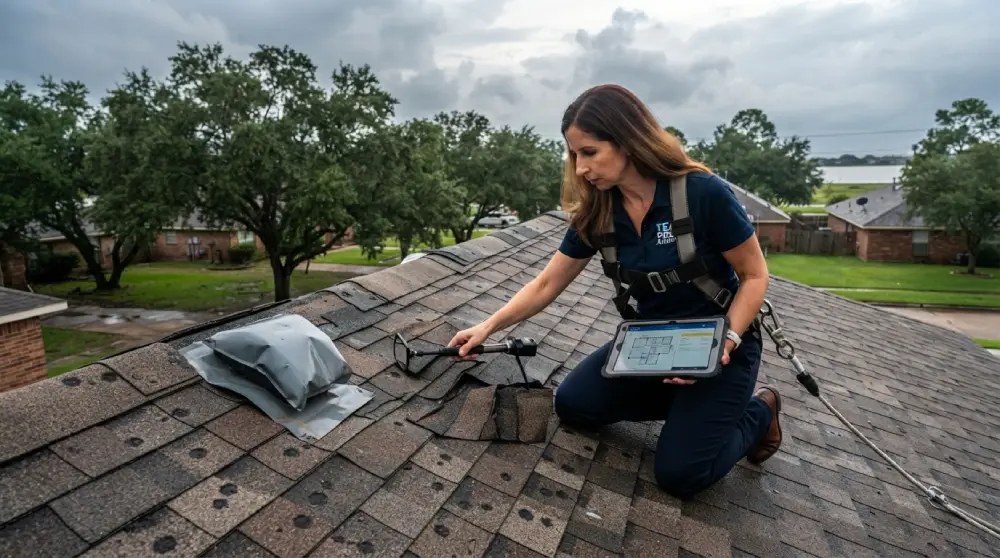
A public adjuster for a roof claim may identify scope issues when the carrier’s inspection focuses on the surface covering but excludes related roofing components, interior damage, or required repair steps.
A complete roof claim may require review of:
- Shingles, tile, metal, or membrane
- Underlayment
- Decking
- Flashing
- Drip edge
- Pipe boots and vents
- Skylights
- Gutters
- Parapets
- Roof-mounted equipment
- Interior damage caused by water entry
Webster contains a mix of pitched residential roofs and flat or low-slope commercial systems. Each requires a different inspection approach. A retail center near Bay Area Boulevard may have drainage, membrane, curb, and rooftop-unit issues that would not arise on a single-family home near Old Town Webster.
Commercial Property Claims
Webster is a regional retail, medical, hospitality, and dining center. The city identifies a substantial network of commercial areas, including Bay Area Plaza, Bay Area Square, Baybrook Gateway, Baybrook Passage, Baybrook Square, and properties along NASA Parkway and the Gulf Freeway.
Commercial claims can involve:
- Retail centers
- Medical offices
- Restaurants
- Hotels
- Apartment properties
- Warehouses
- Professional offices
- Entertainment venues
- Multifamily buildings
- Mixed-use developments
These claims may require documentation of building damage, tenant improvements, equipment, inventory, signage, code upgrades, extra expenses, lost rents, and business interruption.
Properties serving visitors to NASA’s Johnson Space Center, Space Center Houston, Baybrook Mall, and the Clear Lake medical district may also experience operational losses when a building cannot safely reopen after a storm, fire, or water event.
Commercial or residential claim in Webster? Request a free claim review from TX Public Adjusting before accepting a settlement that may not include the full documented scope.
Why Webster Insurance Claims Become Underpaid
An underpaid claim is not always the result of one dramatic error. Often, several smaller omissions reduce the estimate. Many common property insurance claim mistakes involve incomplete documentation, premature repairs, missed deadlines, or accepting an estimate before the full scope has been reviewed.
Damage Was Missed During the Initial Inspection
Carrier inspections may be brief. Concealed moisture, inaccessible roof sections, damaged flashing, wet insulation, detached finishes, and secondary rooms may not appear in the first estimate.
The Scope Covers Repair but Not the Full Repair Sequence
Replacing one component may require work on adjacent materials. A roofing repair may involve detaching gutters, replacing flashing, resetting equipment, protecting landscaping, or addressing interior finishes. An estimate that lists only the final material may omit the labor and access needed to perform the work.
Measurements or Quantities Are Too Low
Small differences in roof area, wall dimensions, flooring quantities, waste factors, or linear footage can materially reduce a large estimate.
Depreciation Was Applied Incorrectly or Misunderstood
Some policies allow recoverable depreciation after repairs are completed and documented. Others may limit payment based on actual cash value, roof age, endorsements, or specific policy language.
The declarations, endorsements, loss-settlement provisions, and carrier estimate should be reviewed together.
The Cause of Damage Is Disputed
Roof claims frequently involve disagreements over wind, hail, wear, installation defects, maintenance, or prior damage. Water claims may turn on whether water entered through a storm-created opening, escaped from a plumbing system, backed up through a drain, or rose from the ground.
The documentation should support both what was damaged and how the loss occurred.
Commercial Losses Are Incompletely Documented
A commercial estimate may address the building but omit damaged inventory, equipment, tenant improvements, extra expenses, loss of income, or restoration delays.
These categories often require records beyond photographs, including leases, sales reports, payroll information, repair schedules, invoices, and financial statements.
Our Public Adjusting Process
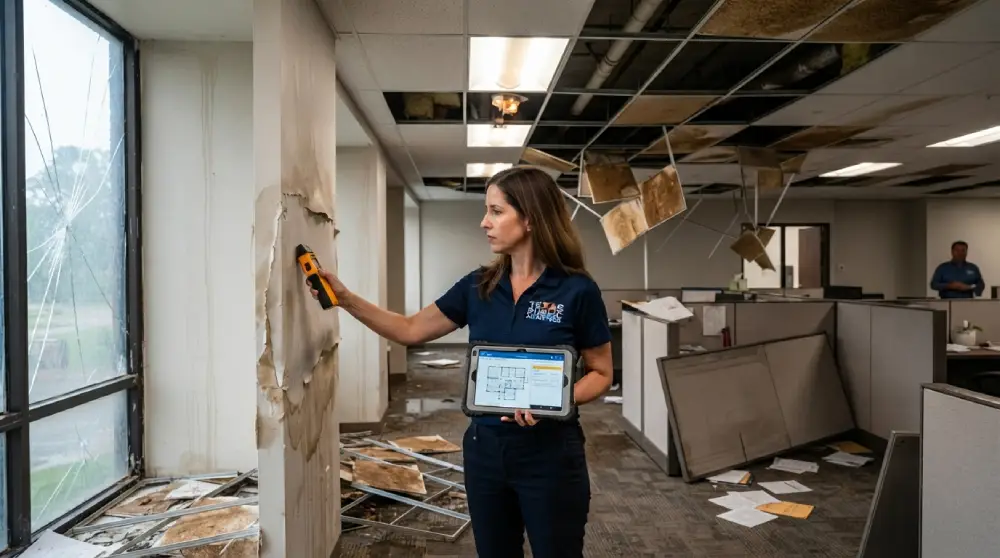
Every claim is different, but our work generally follows a structured process.
1. Free Claim Review
We begin by learning what happened, when the loss occurred, what the insurance company has done, and what concerns the policyholder has about the claim.
We may review:
- The policy and declarations
- Carrier correspondence
- The insurer’s estimate
- Payment letters
- Denial or reservation-of-rights letters
- Contractor estimates
- Photographs and videos
- Prior repair documents
- Moisture or engineering reports
2. Property Inspection
We inspect accessible areas related to the loss and identify visible damage requiring further documentation.
Depending on the claim, the inspection may include roofing, exterior elevations, interiors, mechanical systems, detached structures, contents, and commercial spaces.
3. Scope and Documentation
We organize evidence and prepare a detailed account of the claimed damage. This may involve measurements, photographs, line-item estimates, inventories, invoices, reports, and supporting policy provisions.
The goal is to present a clear, defensible claim rather than a collection of disconnected repair requests.
4. Carrier Communication and Negotiation
TX Public Adjusting communicates with the insurance company regarding inspections, documentation requests, scope differences, and settlement issues.
We identify discrepancies between the carrier estimate and the policyholder’s documented loss, then present those differences for review.
5. Settlement and Claim Resolution
We work to move the claim toward a properly documented resolution under the applicable policy. The outcome depends on the policy language, cause of loss, evidence, damage, deductibles, limits, exclusions, and carrier decisions.
We do not promise a specific result. We do provide independent representation and experienced claim preparation.
Why Choose TX Public Adjusting
Licensed Texas Public Adjuster
TX Public Adjusting is operated by Rise Public Adjusting LLC under Texas License #3356839.
Licensing gives property owners a clear credential to verify before hiring someone to represent an insurance claim.
Focused on Texas Property Losses
Texas claims involve hail, hurricanes, wind, water, fire, freezes, and large commercial losses. Our work is focused on Texas properties and the policy issues that commonly arise after these events.
Residential and Commercial Experience
We assist with single-family homes, apartment properties, retail spaces, offices, hospitality properties, and other commercial buildings.
Our experience reviewing thousands of insurance claim files helps us recognize recurring scope omissions, documentation weaknesses, and estimate discrepancies.
Independent Policyholder Representation
Insurance company adjusters and independent adjusters hired by carriers serve the insurer’s claim process. A public adjuster represents the insured property owner.
That distinction affects whose claim is being prepared, whose damages are being documented, and whose interests guide the negotiation.
Detailed Claim Preparation
A claim is stronger when the damage narrative, measurements, photographs, estimates, policy provisions, and supporting documents align.
We focus on building that connection.
No Upfront Fees
TX Public Adjusting offers a free initial claim review and does not charge an upfront fee. The engagement terms and fee structure are explained before representation begins.
Webster Neighborhoods and Commercial Areas We Serve
Webster is small geographically, but it includes varied residential and commercial environments.
We assist property owners near:
- Old Town Webster
- NASA Parkway
- West Bay Area Boulevard
- Texas Avenue
- El Camino Real
- Medical Center Boulevard
- Egret Bay Boulevard
- Interstate 45 and the Gulf Freeway corridor
- Bay Area Plaza
- Bay Area Square
- Baybrook Gateway
- Baybrook Passage
- Baybrook Square
- Flyway
- The Clear Lake medical and hospitality district
Flyway is a major Webster entertainment and hospitality development positioned between Houston and Galveston. Its expansion, along with the city’s medical, dining, and retail activity, adds to the number of commercial roofs, tenant spaces, mechanical systems, and high-traffic properties that can be affected by Gulf Coast storms.
Areas We Serve Near Webster
TX Public Adjusting also serves policyholders throughout nearby communities, including:
- Clear Lake
- Nassau Bay
- League City
- Friendswood
- Seabrook
- Kemah
- Taylor Lake Village
- El Lago
- Clear Lake Shores
- South Houston
- Pearland
- Pasadena
- La Porte
- Deer Park
- Galveston County communities
- Greater Harris County
Property owners near Baybrook Mall, Johnson Space Center, Space Center Houston, Clear Lake Regional Medical Center, and the I-45 corridor can contact us for residential or commercial insurance claim help.
Frequently Asked Questions
How much does a public adjuster cost in Webster?
Public adjusters generally work under a written agreement that explains the fee and when it is earned. The fee may be contingency-based, meaning it is connected to the amount recovered through the public adjuster’s work.
TX Public Adjusting offers a free initial claim review with no upfront fees. Our guide to public adjuster fees explains common fee arrangements and questions property owners should ask before signing an agreement.
Is a public adjuster the same as the insurance company’s adjuster?
No. The insurance company’s staff adjuster or contracted independent adjuster handles the claim for the carrier. A public adjuster is retained by the policyholder. Our guide comparing a public adjuster vs. independent adjuster explains the difference in greater detail.
TX Public Adjusting documents and presents the property owner’s claim, reviews the insurer’s estimate, and negotiates disputed scope or valuation issues on behalf of the insured.
Can you help after my Webster claim has already been underpaid?
Possibly. We can review the policy, claim correspondence, carrier estimate, payments, photographs, and contractor documentation to identify whether covered items may have been missed or under-scoped.
The available options depend on the claim’s status, policy deadlines, prior communications, and whether additional evidence supports a supplemental request.
Can a public adjuster help with a denied roof claim?
A public adjuster can review the denial, inspect accessible damage, compare the stated reason with the available evidence, and help determine whether further documentation may support reconsideration.
Some roof denials involve wear, deterioration, faulty installation, prior damage, or a disagreement about the storm date. Representation does not guarantee reversal, but a detailed review can clarify the basis of the dispute.
Does homeowners insurance cover flooding in Webster?
Standard homeowners policies generally do not cover rising surface water or storm surge. Those losses are usually addressed through a separate flood policy. However, wind-created openings, plumbing leaks, and other water events may be handled differently depending on the policy and facts.
Because Webster can experience both tropical rainfall and drainage-related flooding, owners should document where the water entered, when it appeared, and what building components were affected. Do not assume every water loss falls under the same coverage.
When should I hire a public adjuster after a storm?
A policyholder may hire a public adjuster shortly after the loss, before the carrier inspection, after receiving an estimate, or after discovering that the payment does not match the repair scope.
Earlier involvement may make it easier to preserve evidence and organize documentation. Existing claims can also be reviewed, subject to policy requirements and deadlines. Property owners with an older or unresolved claim should also review guidance on when it is too late to hire a public adjuster because policy deadlines and claim status may affect the available options.
Do you handle commercial claims near NASA Parkway and I-45?
Yes. TX Public Adjusting assists commercial property owners with storm, water, fire, roof, equipment, tenant-improvement, and business-interruption claims.
Commercial claims often involve multiple coverage categories and operational records. We work to connect physical damage documentation with the financial and operational effects of the loss.
What should I do immediately after property damage?
Protect people first. Then take reasonable steps to prevent additional damage when it is safe to do so. Photograph and record the property before cleanup, keep damaged materials when practical, save receipts, and report the claim according to the policy.
Avoid permanent repairs until the damage is properly documented unless delaying them would create a safety risk or allow additional damage.
Can you help if repairs reveal more damage?
Yes. Additional damage discovered during demolition or repair may support a supplement when it is related to the covered loss and properly documented.
Photographs, contractor notes, invoices, moisture records, and prompt notice to the carrier may be important. Do not discard removed materials before documenting them.
How long does a Webster property claim take?
There is no single timeline. Claim duration depends on the severity of the loss, inspection scheduling, documentation, coverage questions, expert involvement, repair complexity, and the carrier’s response. Our article on how long an insurance adjuster has to contact you provides additional context about carrier communication and claim-response timing.
A simple roof claim may progress differently from a commercial fire loss or a hurricane claim involving building damage, contents, and business interruption. Our goal is to keep the documentation organized and move unresolved issues forward.
Get a Free Webster Insurance Claim Review
You paid for insurance to protect your property. When the estimate leaves out damage, applies questionable quantities, or does not account for the work required to restore the building, you do not have to evaluate the claim alone.
TX Public Adjusting helps Webster homeowners and commercial property owners with:
- New insurance claims
- Underpaid claims
- Delayed claims
- Partially denied claims
- Hail and wind losses
- Hurricane damage
- Roof claims
- Water damage
- Fire and smoke losses
- Commercial property claims
Rise Public Adjusting LLC is a licensed Texas public adjusting firm operating under License #3356839. We work for policyholders—not insurance companies.
Contact TX Public Adjusting today for a free claim review. There are no upfront fees.