

Property damage in South Houston can become complicated quickly. A fast-moving Gulf Coast storm may damage shingles, siding, windows, fencing, electrical systems, and interior finishes in a matter of minutes. A broken supply line or roof opening can then allow water to spread into insulation, drywall, flooring, and personal property before the full extent of the loss is visible.
TX Public Adjusting provides professional insurance claim help for South Houston homeowners, landlords, business owners, and commercial property managers. As a licensed Texas public adjuster, we help policyholders document and present residential and commercial property claims. As an experienced public adjuster in South Houston, we represent the policyholder—not the insurance company—through the inspection, documentation, estimating, and negotiation process.
TX Public Adjusting is operated by Rise Public Adjusting LLC, Texas License #3356839. Our team has reviewed thousands of residential and commercial property claims throughout Texas.
Concerned that your claim is missing damage or has been underpaid? Request a free claim review. There are no upfront fees.
Insurance Claim Help for South Houston Property Owners
South Houston is an incorporated Harris County community located southeast of central Houston, near Pasadena, Hobby Airport, Interstate 45, and the industrial areas surrounding the Houston Ship Channel. Originally established as Dumont in 1907, the community was incorporated as South Houston in 1913. Its long history, compact residential streets, neighborhood businesses, schools, and older housing stock create claim conditions that can differ from those in newer master-planned suburbs.
A property insurance claim is not simply a request for money. It is a documented presentation of what happened, what was damaged, what repairs are reasonably required, and how the policy applies to the loss.
That process can become difficult when:
- Damage is hidden behind walls, roofing, cabinets, or flooring.
- The carrier’s estimate leaves out necessary repair operations.
- Roof damage is described as wear rather than storm damage.
- Water mitigation and reconstruction scopes do not match.
- Depreciation is applied incorrectly or without a clear explanation.
- Commercial damage disrupts operations, tenants, or inventory.
- The property owner does not have time to manage repeated inspections and document requests.
A licensed South Houston public adjuster can inspect the loss from the policyholder’s perspective, prepare a detailed scope, organize supporting evidence, and communicate with the insurer throughout the claim.
Why Property Owners Hire a Public Adjuster in South Houston
The insurance company assigns an adjuster to investigate the claim for the carrier. A public adjuster serves a different role. We work for the residential or commercial policyholder.
Property owners often contact TX Public Adjusting when they believe the insurance company’s estimate does not reflect the actual damage. Others hire us shortly after the loss because they want the claim documented correctly from the beginning.
Our work may include:
- Reviewing the insurance policy and claim correspondence
- Inspecting damaged interior and exterior areas
- Identifying conditions omitted from an initial estimate
- Preparing measurements, photographs, notes, and repair scopes
- Reviewing roofing, water, fire, and storm-related damage
- Documenting damaged contents when applicable
- Comparing contractor proposals with the insurer’s estimate
- Presenting supplemental documentation
- Communicating with the carrier’s representatives
- Negotiating disputed scope and valuation issues
This independent representation is particularly useful when a South Houston property has multiple types of damage from the same event. For example, a severe thunderstorm may affect the roof, fascia, gutters, fencing, exterior finishes, windows, electrical components, and interior ceilings. Treating each damaged component as part of one organized claim can reduce the risk of important items being overlooked.
South Houston Storm and Property Risks
South Houston is part of the humid Southeast Texas and Gulf Coast weather environment. The National Weather Service describes the region as being affected by a wide range of severe weather, including flooding, tornadoes, large hail, tropical storms, and hurricanes.
Tropical Storms and Hurricanes
South Houston’s inland location does not eliminate tropical-weather risk. Hurricanes and tropical storms can push wind-driven rain deep into Harris County, damage roofing systems, tear away exterior materials, break windows, and cause prolonged power interruptions.
Hurricane Harvey demonstrated how a Gulf Coast hurricane can produce catastrophic rainfall and widespread damage across the Houston metropolitan area. The National Weather Service notes that Harvey was the first hurricane to strike the Texas coast since Hurricane Ike affected the Houston area in 2008.
Tropical-weather claims may involve:
- Missing or lifted shingles
- Roof membrane damage
- Wind-created openings
- Water intrusion
- Ceiling and wall staining
- Wet insulation
- Damaged siding and trim
- Broken windows or doors
- Fence and detached-structure damage
- Electrical and HVAC problems
- Business interruption
Property owners dealing with property damage after a hurricane should document both exterior and interior conditions before permanent repairs begin, whenever it is safe to do so. The cause of interior water is often a major claim issue. A careful inspection should connect interior damage to the exterior storm-created opening when the physical evidence supports that conclusion.
Heavy Rain and Urban Flooding
Low-lying streets, intense rainfall, overwhelmed drainage systems, and water entering through doors, roofs, walls, plumbing systems, or backed-up drains can create serious losses.
Historical National Weather Service records show repeated flash-flood events across Harris County and other coastal counties, including storms that produced several inches of rain over short periods and widespread street flooding.
Not every form of water damage is covered under the same policy. Surface flooding, roof leaks, plumbing failures, drain backups, and wind-driven rain may be treated differently. Our role is to document the physical damage and help the policyholder understand how the facts of the loss relate to the available coverage.
Hail and Severe Thunderstorms
South Houston is also exposed to spring and summer thunderstorms capable of producing hail and strong straight-line winds. National Weather Service records include Houston-area storms with one- to two-inch hail and winds strong enough to damage roofing materials.
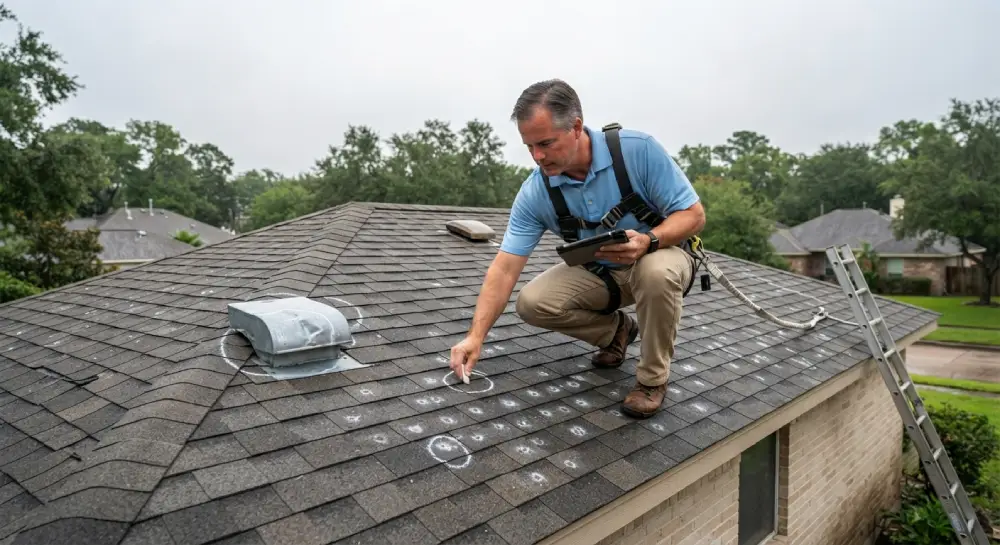
Hail damage is not always obvious from the ground. Our guide to filing a hail damage insurance claim explains how roof impacts, exterior damage, and supporting documentation may affect the claim process. It may appear as:
- Bruising or fractured asphalt shingles
- Granule displacement
- Dents in metal roofing or flashing
- Damage to vents and rooftop equipment
- Cracked skylights
- Dented gutters and downspouts
- Damaged siding or window screens
- Impact marks on fencing and outdoor equipment
A roof may continue to shed water for a period after a hailstorm while still having reduced service life or compromised materials. That is why a complete roof claim should evaluate more than active leakage.
Tornadoes and Strong Wind
South Houston is not immune to tornadoes, rotating storms, downbursts, or damaging straight-line wind. These events can create isolated but significant damage, including partially removed roofing, fallen limbs, damaged carports, broken glass, and structural movement.
Strong-wind claims often require careful documentation because damage may be concentrated on one elevation or one roof slope rather than across the entire property.
Freeze and Plumbing Damage
Although Gulf Coast winters are usually mild, a hard freeze can damage exposed plumbing, water supply lines, fire suppression equipment, exterior fixtures, and poorly insulated pipes.
A burst pipe can release a substantial amount of water before it is discovered. The visible water may be only part of the loss. Moisture can travel beneath flooring, behind baseboards, into cabinet toe kicks, through wall cavities, and between floors.
Common Insurance Claims in South Houston
Hail Damage Claims
A hail claim may involve roofing, flashing, vents, gutters, siding, windows, fencing, and outdoor equipment. We inspect the full exterior rather than limiting the review to a few shingles.
We also compare the carrier’s roof measurements, material assumptions, labor allowances, and repair methodology with observed conditions.
Water Damage Claims
Water losses may result from burst pipes, appliance failures, plumbing leaks, roof openings, HVAC condensation, or other sudden events.
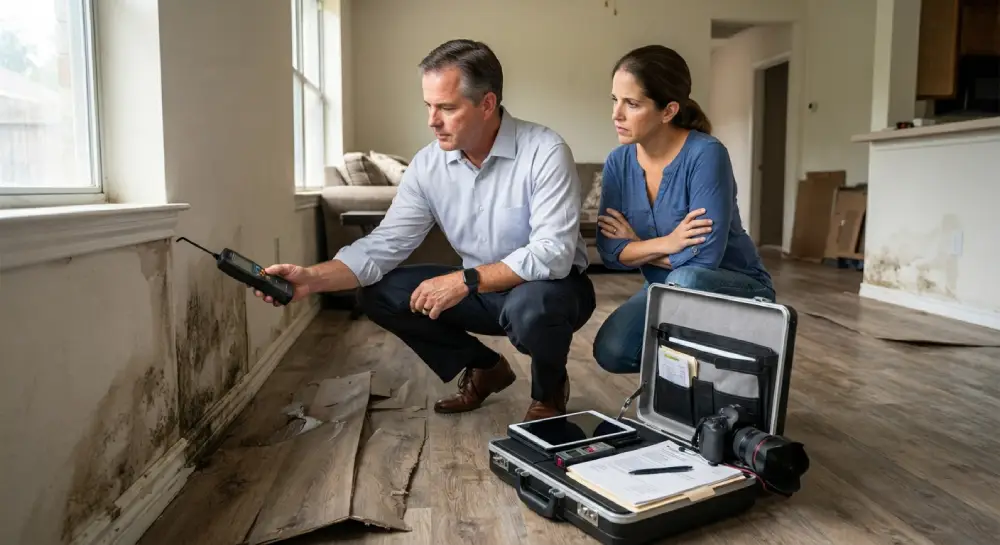
A complete water damage claim may include more than drying equipment. It can involve demolition, moisture mapping, antimicrobial treatment, insulation, drywall, texture, paint, cabinets, flooring, trim, contents manipulation, and temporary protection. Property owners who are already communicating with the carrier may also benefit from our guide to dealing with an insurance adjuster after water damage.
Fire and Smoke Damage Claims
A fire damage insurance claim can involve far more than the room where the flames originated. Smoke residue, heat, soot, firefighting water, debris, and odor may spread into adjacent rooms, attics, duct systems, contents, and concealed spaces.
Our review may address:
- Structural fire damage
- Smoke and soot contamination
- Water used during suppression
- Electrical damage
- HVAC contamination
- Damaged personal or business property
- Debris removal
- Temporary repairs
- Loss-of-use or business-interruption documentation
A licensed fire insurance adjuster can help organize structural, smoke, soot, water, contents, and business-interruption documentation into one coordinated claim presentation.
Storm Damage Claims
A single storm may cause several categories of loss. Wind may damage the roof, rain may enter the structure, and a power surge may affect equipment.
We organize the evidence so the claim reflects the complete event rather than presenting each visible symptom as an unrelated issue.
Roof Damage Claims
Roof claims are frequently disputed because age, maintenance, installation, prior repairs, and storm damage can produce overlapping conditions.
We evaluate roofing materials, accessories, penetrations, slopes, elevations, flashing, ventilation, edge metals, underlayment, and interior evidence. When repairs require related work to surrounding components, those operations should be considered in the scope. A public adjuster for a roof claim can compare the carrier’s scope with the observed roof conditions, measurements, accessories, repair requirements, and interior evidence.
Commercial Property Claims
South Houston businesses may need help with complex commercial property claims involving retail buildings, offices, warehouses, service facilities, workshops, restaurants, multifamily properties, and mixed-use locations.
Commercial claims can include:
- Roof and building-envelope damage
- Inventory or equipment loss
- Tenant improvements
- Fire and smoke contamination
- Water mitigation and reconstruction
- Code-related repair requirements
- Extra expenses
- Business-income interruption
- Temporary relocation or protection
- Multiple contractors and repair trades
Commercial policies are often more detailed than residential policies. Timely documentation is critical when damaged property is being moved, cleaned, discarded, or repaired so operations can resume.
Why Insurance Claims Become Underpaid
An underpaid claim does not always result from one dramatic mistake. More often, the difference develops through several smaller omissions.
Missed or Hidden Damage
An initial inspection may focus on the most obvious area. Moisture behind cabinets, damage beneath flooring, roof accessories, attic insulation, matching materials, and affected adjacent rooms may receive little attention.
Scope Omissions
Even when a damaged item appears in the estimate, necessary repair operations may be missing. A drywall repair may require insulation, texture blending, primer, paint, masking, contents movement, debris disposal, and protection of finished surfaces.
Low Measurements or Quantities
Incorrect roof dimensions, room measurements, linear footage, waste factors, or material quantities can affect the entire claim value.
Depreciation Issues
Policies may handle depreciation and recoverable depreciation differently. Property owners can become confused about what has been withheld, what may be recoverable after repairs, and what documentation must be submitted.
Documentation Problems
A claim supported only by a few photographs and a brief contractor quote may not explain the full loss. Strong documentation creates a clearer record of causation, scope, quantity, condition, and repair requirements. Reviewing these common property insurance claim mistakes can help property owners understand how incomplete records, premature repairs, or missing scope can affect a claim.
Damage Labeled as Wear and Tear
Carriers may attribute roof or exterior conditions to age, installation, maintenance, or deterioration. The physical evidence should be evaluated carefully before accepting that conclusion.
Pressure to Settle Quickly
A fast payment can feel like progress, but accepting a low scope before all damage is understood may leave the property owner responsible for substantial repair costs.
Already received an estimate? TX Public Adjusting can review it against the observed damage and available supporting documentation. Request a free claim review with no upfront fees.
Our Public Adjusting Process
1. Claim Review
We begin by reviewing the reported loss, policy information, insurer correspondence, estimates, photographs, contractor documents, and payments already issued.
We identify the major questions affecting the claim, including coverage concerns, missing scope, valuation differences, and documentation needs.
2. Property Inspection
We inspect accessible damaged areas of the residential or commercial property. Depending on the loss, this may include roofing, exterior elevations, interior rooms, attic spaces, mechanical systems, contents, and detached structures.
3. Damage Documentation
We create an organized claim file using photographs, measurements, notes, inventories, reports, estimates, and other supporting material.
The goal is to present the loss clearly enough that each requested repair can be understood and evaluated.
4. Estimate and Claim Presentation
We prepare or review the repair scope and compare it with the insurance company’s estimate.
When appropriate, we submit supplemental information explaining omitted damage, incorrect quantities, repair dependencies, or other disputed items.
5. Carrier Communication and Negotiation
We communicate with the insurance company’s representatives, respond to requests, coordinate additional inspections, and advocate for a fair evaluation under the policy.
6. Settlement and Claim Follow-Through
We review revisions, payments, depreciation issues, and remaining documentation requirements. The final outcome depends on the policy, facts, evidence, and carrier evaluation, but our objective is to ensure the claim is thoroughly presented.
Why Choose TX Public Adjusting
Licensed Texas Representation
TX Public Adjusting is operated by Rise Public Adjusting LLC, Texas License #3356839.
We Represent Policyholders
We do not work for the insurance company. Our responsibility is to the residential or commercial policyholder who hires us.
Texas Claim Experience
Our work focuses on Texas property losses, including hail, wind, fire, water, roof, freeze, hurricane, and commercial claims.
Thousands of Claims Reviewed
Our team has reviewed thousands of claims involving residential homes, commercial buildings, roofs, interiors, contents, and business property.
Residential and Commercial Expertise
A homeowner with a leaking roof and a warehouse owner with storm damage require different documentation strategies. We have experience handling both residential and commercial claim conditions.
Detailed Scope Reviews
We look beyond the bottom-line payment and evaluate how the estimate was built. Measurements, quantities, repair operations, material assumptions, and omitted items can all affect the result.
No Upfront Fees
Property owners can request a free initial claim review. There are no upfront fees for retaining our public adjusting services.
South Houston Neighborhoods and Local Service Areas
South Houston is a compact city rather than a collection of formally defined master-planned neighborhoods. Local properties are commonly identified by their proximity to major corridors, schools, civic facilities, and nearby communities.
We assist property owners throughout:
- Central South Houston near City Hall and Dallas Street
- Residential streets surrounding Avenue A and the South Houston Branch Library
- Properties near Spencer Highway
- Areas along College Avenue
- Homes and businesses near Old Galveston Road
- Properties near South Houston High School
- Neighborhoods bordering Pasadena
- Areas toward Hobby Airport and southeast Houston
- Commercial corridors near Interstate 45
Local landmarks and institutions include South Houston City Hall, the South Houston Branch Library at 607 Avenue A, South Houston High School, and the community’s parks and civic facilities. The Harris County Public Library confirms that its South Houston branch serves the city from Avenue A.
Areas We Serve Near South Houston
TX Public Adjusting assists policyholders in South Houston and surrounding Harris County communities, including:
- Pasadena
- Houston
- Galena Park
- Jacinto City
- Deer Park
- La Porte
- Pearland
- Friendswood
- Webster
- Clear Lake
- Channelview
- League City
- Baytown
We also handle qualifying residential and commercial property claims throughout Texas.
Frequently Asked Questions
What does a public adjuster in South Houston do?
A public adjuster represents the policyholder during a property insurance claim. Property owners who want a more detailed overview can read our guide explaining what a public adjuster does.
Unlike an insurance company adjuster, a public adjuster is hired by the property owner and does not represent the carrier.
When should I hire a South Houston public adjuster?
You may hire a public adjuster shortly after a loss, after receiving the insurance company’s estimate, or when a claim becomes delayed, denied, or underpaid.
Getting help early can make documentation easier, but a claim may still be reviewable after the carrier has issued a payment. Our guide addressing when it is too late to hire a public adjuster explains how claim status, deadlines, prior payments, and available evidence can affect timing.
Can you review a claim that has already been paid?
Yes. An initial payment does not necessarily mean every damaged item was included or valued correctly.
We can review the estimate, photographs, contractor documents, payment history, and remaining damage to determine whether there are supportable items that should be presented to the carrier.
Do South Houston public adjusters work for insurance companies?
No. TX Public Adjusting represents policyholders.
Insurance company adjusters and independent adjusters retained by carriers evaluate claims for the insurer. A public adjuster is retained by the residential or commercial property owner.
Can a public adjuster help with a denied roof claim?
A denied roof claim may be reviewed to determine why the carrier denied coverage and whether additional evidence is available.
We may examine storm evidence, roof conditions, photographs, repair history, interior damage, and the insurer’s explanation. No result can be guaranteed, but a detailed review may identify issues that were not addressed during the initial inspection.
What if the insurance estimate is lower than my contractor’s estimate?
Different estimates may use different measurements, quantities, material assumptions, labor operations, or repair methods.
We compare the documents line by line and evaluate the damaged property. A contractor’s estimate alone does not automatically establish the claim value, but it can reveal scope differences that require explanation and supporting evidence.
Do you handle commercial claims in South Houston?
Yes. We assist with commercial roof, fire, water, storm, inventory, equipment, tenant-improvement, and business-interruption claims.
Commercial losses often involve more documentation and multiple interested parties. Early organization helps preserve evidence while cleanup and emergency repairs are taking place.
Is flood damage covered by a standard property policy?
Surface flooding is commonly treated differently from water entering because of a plumbing failure or a storm-created opening. Coverage depends on the policy and cause of loss.
We document the property damage and review available policy information, but disputed legal coverage questions may require advice from a qualified insurance attorney.
How long does a South Houston property claim take?
The timeline depends on the severity of the loss, documentation, carrier response, inspection scheduling, coverage questions, repair complexity, and whether the scope is disputed.
A straightforward roof claim may progress more quickly than a major commercial fire or hurricane loss. Our role is to keep the claim organized and respond to requests as the evaluation moves forward.
How much does it cost to hire TX Public Adjusting?
The initial claim review is free, and there are no upfront fees.
Public adjusting fees are explained in the written agreement before representation begins. The specific arrangement depends on the claim and applicable Texas requirements.
Get a Free South Houston Claim Review
Property damage can place immediate pressure on your home, business, finances, and schedule. You do not have to evaluate a complicated insurance estimate by yourself.
TX Public Adjusting helps South Houston property owners document damage, identify missing scope, communicate with insurers, and pursue a fair claim evaluation.
Contact TX Public Adjusting today to request a free claim review with no upfront fees.
- Licensed Texas Public Adjuster
- Rise Public Adjusting LLC
- Texas License #3356839
- Residential and Commercial Claims
- No Upfront Fees
- Independent Policyholder Representation