

Property damage in Orchard can turn into an insurance dispute quickly. Hail can bruise shingles and damage metal roofing, straight-line winds can lift roof components or drive rain into a building, and Gulf Coast tropical systems can bring prolonged wind and water problems far inland. When the carrier’s estimate does not reflect the full scope of a loss, a Public Adjuster in Orchard, TX can represent the policyholder and help document what the property actually needs.
TX Public Adjusting, operated by Rise Public Adjusting LLC, represents residential and commercial policyholders throughout Texas. We review insurance policies, inspect damaged property, document covered losses, prepare detailed claim scopes, and communicate with the insurance company on behalf of our clients.
We are a Licensed Texas Public Adjuster — License #3356839.
If your Orchard property claim has been delayed, underpaid, disputed, or simply feels incomplete, contact TX Public Adjusting for a Free Claim Review. There are no upfront fees, and we can review the circumstances of your loss before you decide how to proceed.
Orchard sits in western Fort Bend County near FM 1489 and State Highway 36, about 13 miles west of Richmond. Unlike larger Fort Bend communities filled with master-planned subdivisions, Orchard has a distinctly rural pattern of homes, agricultural property, acreage, small businesses, and outbuildings. That property mix creates claim issues that can look very different from a typical suburban loss.
Why Property Owners Hire a Public Adjuster in Orchard
An insurance company’s adjuster works for the carrier. A public adjuster works for the policyholder. If you are unfamiliar with what a public adjuster does, the biggest distinction is that the public adjuster represents your interests during the property claim.
That distinction matters when a property has suffered significant damage.
After a severe thunderstorm or other loss, an insurance inspection may happen quickly. The resulting estimate might address obvious roof damage while leaving out collateral damage, interior moisture, exterior components, detached structures, code-related work, or other items that require additional investigation.
An Orchard public adjuster can independently evaluate the damage and compare it with the carrier’s scope.
Property owners frequently seek insurance claim assistance when:
- The insurance estimate appears too low.
- Damage was omitted from the original scope.
- The carrier says some damage is old or unrelated.
- A roof claim includes repairs instead of replacement.
- Water entered the property after wind damaged the exterior.
- Depreciation significantly reduced the initial payment.
- A commercial claim includes equipment, inventory, or business-related losses.
- Multiple structures on an acreage property were damaged.
- The claim has stalled or communication has become difficult.
- The owner does not have time to manage inspections, estimates, documentation, and carrier correspondence.
Our job is not to guarantee an outcome. It is to build a thoroughly documented claim based on the policy, physical evidence, repair requirements, and the facts of the loss.
Local Claim Conditions in Orchard
Orchard’s location creates its own insurance-loss profile.
Fort Bend County’s current hazard planning identifies severe weather as a high-risk hazard for Orchard, while hurricanes/tropical storms and tornadoes are ranked as medium risks. County records also document thunderstorm wind events that have caused property damage in Orchard itself.
That makes roof and exterior inspections especially important after major storm cells move across western Fort Bend County.
A storm loss here can involve more than a house. Depending on the property, our inspection may need to consider:
- The primary residence
- Detached garages
- Shops and storage buildings
- Barns or agricultural structures
- Metal roofs
- Fencing
- Exterior equipment
- HVAC systems
- Siding and trim
- Gutters and downspouts
- Windows and screens
- Interior rooms affected by wind-driven rain
Small-town and rural properties should not be treated as though every loss fits a standard suburban template.
Common Insurance Claims in Orchard, TX
Hail Damage Claims
Hail is one of the most common reasons Texas property owners need a careful second look at a hail damage insurance claim.
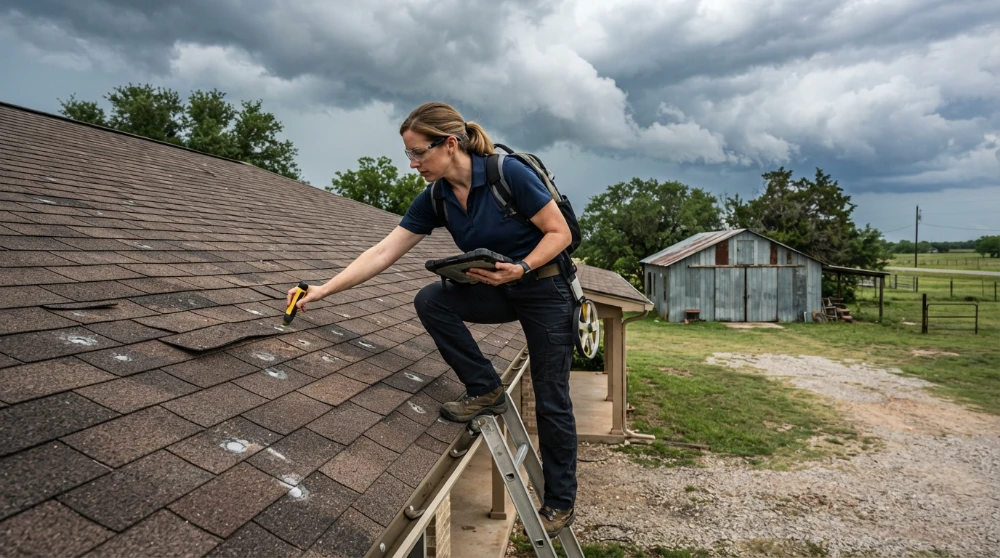
Damage is not always obvious from the ground. Asphalt shingles may show impact marks, granule displacement, fractures, or bruising. Metal components can show dents or impact patterns. Gutters, vents, flashing, HVAC fins, fences, siding, and other exterior surfaces can provide additional evidence that a storm affected the property.
The problem begins when an insurance estimate recognizes only part of that damage.
A proper hail claim review may involve:
- Roofing materials and accessories
- Flashing
- Ridge and hip components
- Roof vents
- Gutters and downspouts
- Window screens
- Siding
- Exterior paint or finishes
- HVAC equipment
- Metal structures
- Detached buildings
TX Public Adjusting documents the complete observed loss and compares that information with the insurance company’s estimate.
Water Damage Claims
Water losses can become complicated because the cause of the water often matters just as much as the resulting damage.
A plumbing failure is different from wind-driven rain. A roof opening caused by a covered storm can present different coverage questions than groundwater entering a structure.
For Orchard property owners, our first priority is understanding what happened.
We examine the reported cause of loss, damaged building materials, moisture migration, affected rooms, demolition requirements, and the carrier’s scope. When appropriate, documentation may include drywall, insulation, flooring, cabinetry, trim, paint, electrical components, and other affected materials.
Hidden moisture can turn a small-looking claim into a much larger repair project. Our guide to dealing with a water damage insurance claim explains what property owners should watch for when the carrier’s inspection or estimate does not appear to reflect the full extent of the loss.
Fire Damage Claims
A fire damage insurance claim often involves far more than replacing what burned. Smoke, soot, heat, water used during firefighting, electrical damage, demolition, debris removal, contents, and temporary protection measures can all become part of the loss.
Smoke, soot, heat, water used during firefighting, electrical damage, demolition, debris removal, contents, and temporary protection measures can all become part of the loss.
A fire claim involving a rural Orchard residence, workshop, garage, or commercial building may also require careful separation of building damage from contents and equipment damage.
TX Public Adjusting helps organize these losses so important components are not overlooked simply because the carrier’s first estimate focused on the most visible fire damage.
Storm and Wind Damage Claims
Western Fort Bend County can experience powerful thunderstorms, straight-line wind, hail, and occasional tornado conditions. Orchard’s local hazard assessment specifically ranks severe weather as a high risk.
Wind claims can involve:
- Lifted or missing shingles
- Damaged flashing
- Open roof seams
- Wind-driven rain
- Damaged siding
- Broken windows
- Fence damage
- Fallen trees or limbs
- Detached structure damage
- Commercial roof systems
- Exterior signage or equipment
An important question is not simply whether the roof is still present. It is whether the storm compromised roofing components enough to require covered repair or replacement under the policy.
Roof Damage Claims
Roof claims are among the most frequently disputed property claims because the difference between a small repair and a larger roofing scope can be substantial.
An insurer may identify only several damaged shingles. A contractor may identify broader concerns. The policyholder is then left trying to determine what the insurance company actually owes.
A public adjuster for a roof claim can independently document the roof conditions, compare the carrier’s scope with the observed damage, and identify repair items that may require further evaluation.
For Orchard properties, that may mean inspecting asphalt shingle roofs, standing-seam or exposed-fastener metal roofing, commercial systems, detached garages, workshops, and other covered structures.
Commercial Property Claims
Orchard may be small, but commercial and agricultural-area losses can become complex.
A business property claim can include more than the building envelope. Depending on coverage and the cause of loss, issues may involve:
- Roofing
- Interior finishes
- Equipment
- Inventory
- Fixtures
- Electrical systems
- HVAC
- Exterior structures
- Debris removal
- Business-related loss documentation
TX Public Adjusting handles both residential and commercial property claims and can help organize the documentation required for larger losses.
Why Orchard Insurance Claims Become Underpaid
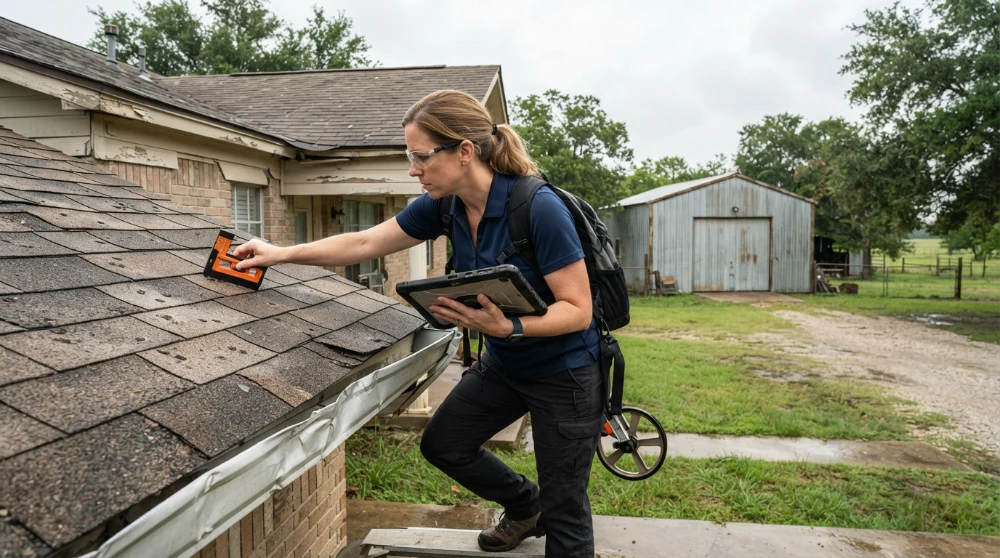
A low insurance payment does not always result from one major disagreement. Frequently, the gap develops through several smaller omissions.
Missed Damage
Some storm damage is easy to see. Other damage requires a roof-level inspection, interior moisture evaluation, or close review of exterior components.
If an inspection focuses only on one part of the building, additional covered damage can remain outside the estimate.
Scope Omissions
A repair estimate is made up of individual tasks and materials.
The carrier may include shingles but omit flashing. It may include drywall but exclude insulation, texture, paint blending, trim work, or necessary detach-and-reset operations.
A complete scope should reflect the work reasonably required to restore covered damage.
Depreciation Issues
Many replacement-cost policies involve depreciation.
Understanding the difference between replacement cost, actual cash value, recoverable depreciation, and nonrecoverable depreciation can be confusing for property owners.
We review how the carrier calculated the claim and identify questions that may need to be raised.
Low Estimates
Insurance estimates are not automatically the final word.
Differences can arise over measurements, quantities, labor operations, material requirements, repair methodology, or the extent of storm damage.
A detailed independent scope gives the policyholder a basis for discussing those differences.
Documentation Problems
Claims depend heavily on documentation.
Photos alone may not explain when damage occurred, how water entered, what materials need replacement, or why an omitted operation is necessary.
Organized evidence makes the claim easier to evaluate and harder to dismiss without explanation. Incomplete documentation is also one of several common property insurance claim mistakes that can make a legitimate loss harder to evaluate or support.
Our Public Adjusting Process
Every property loss is different, particularly in a community like Orchard where one property may include a residence, detached garage, shop, fencing, and other improvements.
1. Claim Review
We begin by reviewing the claim status, available policy information, carrier estimates, correspondence, photographs, contractor documentation, and other relevant records.
We want to understand what has already happened before recommending the next step.
2. Property Inspection
We inspect the damaged areas and identify conditions that should be documented.
Depending on the loss, the inspection may include roofing, exterior elevations, interior rooms, detached structures, equipment, or commercial components.
3. Documentation and Scope
We organize the evidence supporting the claim.
That may include photographs, measurements, estimates, inventories, repair information, and a detailed scope of damage.
The objective is to show the carrier not only that damage exists, but what work is required to address covered damage.
4. Insurance Company Communication and Negotiation
TX Public Adjusting communicates with the insurer regarding the claim and presents supporting documentation.
When the carrier disputes an item, valuation, quantity, or scope component, we can address that issue directly instead of leaving the property owner to handle the discussion alone.
5. Claim Resolution
We continue working through the adjustment process toward resolution of the covered claim.
The final outcome depends on the policy, facts, evidence, carrier evaluation, and circumstances of the loss. No public adjuster can legitimately promise a specific settlement before reviewing those factors.
Already have an estimate from your insurance company? A second review can reveal whether important damage or repair items were left out. Contact TX Public Adjusting for a Free Claim Review.
Orchard Storm Risks and Property Damage
Orchard’s western Fort Bend County location deserves more specific attention than a generic “Texas storms” paragraph.
The community is positioned near FM 1489 and State Highway 36, surrounded by a mixture of rural land and smaller developed parcels. Orchard also developed along the historic Atchison, Topeka and Santa Fe rail line, giving the community a different development pattern from Richmond, Rosenberg, Sugar Land, or newer Fort Bend subdivisions.
Severe Thunderstorms and Hail
Fort Bend County’s mitigation planning ranks severe weather as Orchard’s highest natural-hazard category.
Thunderstorms can bring multiple types of damage during a single event: wind affects the roof, hail damages exterior materials, and rain enters through newly created openings.
That combination is one reason post-storm inspections should look beyond a single damaged component.
Tropical Storm and Hurricane Effects
Orchard is inland, but inland does not mean immune from Gulf Coast tropical systems.
Tropical systems can bring extended rainfall, high winds, tree damage, power interruptions, and roof leaks well beyond the immediate coastline. Property owners dealing with property damage after a hurricane should document both exterior and interior conditions as soon as it is safe to do so.
Coverage can depend heavily on the actual cause of the damage. Wind-related water intrusion and surface flooding, for example, are not automatically treated the same way under an insurance policy.
Tornado and Straight-Line Wind Risk
Tornado risk is also rated medium for Orchard, while broader severe weather is rated high.
Even without a tornado touchdown, severe thunderstorm winds can damage shingles, metal panels, trees, fences, sheds, exterior equipment, and other property.
County storm records specifically identify a severe-wind event in which Orchard sustained documented property damage, reinforcing that wind losses here are not theoretical.
Winter Weather and Freeze Losses
Hard freezes are less frequent than thunderstorms, but Texas freeze events can create plumbing failures, interior water damage, damaged fixtures, and business interruptions.
A burst pipe can affect walls, ceilings, cabinets, flooring, insulation, and personal property in multiple rooms before the water supply is shut down.
Property Claims Across Orchard
Orchard is not divided into the large, branded master-planned neighborhoods found farther east in Fort Bend County. Local property references are better understood around central Orchard, Kibler Street, FM 1489, State Highway 36, and the surrounding rural and acreage properties.
That matters for a genuinely local claim page. A house near the center of town may have a different construction type and set of detached structures than acreage property outside the compact street grid.
The Orchard water tower and the town’s railroad heritage remain recognizable local features, while the wider western Fort Bend landscape connects Orchard closely with Rosenberg, Richmond, Wallis, Simonton, Fulshear, Beasley, and other nearby communities.
Why Choose TX Public Adjusting
Property owners hire us because they want someone representing their side of the insurance claim.
Licensed in Texas
TX Public Adjusting operates through Rise Public Adjusting LLC.
Texas Public Adjuster License #3356839
Independent Policyholder Representation
We do not work for the insurance company.
A public adjuster’s role is to represent the policyholder’s interests in the adjustment of the covered property claim.
Texas-Focused Experience
Texas claims have their own recurring issues: hail, severe wind, hurricanes, freezes, water losses, roofing disputes, depreciation questions, and large commercial scopes.
Our focus on Texas property claims gives us practical familiarity with those losses.
Residential and Commercial Claims
We work with homeowners, business owners, commercial property owners, and other insureds dealing with property damage.
Detailed Claim Documentation
Insurance disputes are often won or lost on the quality of the documentation.
We focus on identifying the physical damage, establishing a defensible scope, organizing supporting evidence, and communicating the claim clearly.
Experience Reviewing Thousands of Claims
Our experience includes the review of thousands of property claims across residential and commercial losses. That volume provides perspective when a carrier’s estimate appears incomplete or inconsistent with the property conditions.
Areas We Serve Near Orchard
TX Public Adjusting serves property owners throughout Fort Bend County and surrounding Texas communities, including:
- Rosenberg
- Richmond
- Wallis
- Simonton
- Fulshear
- Beasley
- Needville
- Pleak
- Katy
- Sugar Land
- Missouri City
- Other communities throughout Fort Bend County and the greater Houston region
Orchard is part of western Fort Bend County, while Richmond and Rosenberg serve as larger nearby population and commercial centers. Fort Bend County itself forms part of the Houston metropolitan area.
Frequently Asked Questions About Public Adjusters in Orchard, TX
What does a public adjuster in Orchard do?
A public adjuster represents the policyholder during a property insurance claim. That can include reviewing the policy and carrier estimate, inspecting the property, documenting damage, preparing a claim scope, and communicating with the insurance company.
TX Public Adjusting works for the insured property owner rather than the insurance carrier.
When should I hire a public adjuster after property damage in Orchard?
Many owners contact a public adjuster after receiving an estimate that appears low, but you do not always have to wait for a dispute.
A public adjuster may also become involved early in a substantial hail, fire, water, wind, roof, or commercial claim when the documentation burden is significant. Timing can matter, especially once inspections, payments, or claim decisions have already occurred. Our guide explains when it is too late to hire a public adjuster and why policy deadlines and claim status should be reviewed before waiting too long.
Can you review an insurance claim that has already been paid?
Potentially, yes. Receiving an initial insurance payment does not automatically mean every claim issue has been resolved.
We can review the existing estimate, documentation, policy information, and status of the claim to determine whether there are apparent omissions or unresolved items. Claim deadlines and policy conditions matter, so waiting unnecessarily can create problems.
What types of Orchard storm claims do you handle?
We handle claims involving hail, wind, roof damage, storm-related water intrusion, fire, plumbing losses, and other covered property damage.
This is particularly relevant in Orchard because Fort Bend County’s hazard assessment identifies severe weather as a high local risk and tropical systems and tornadoes as medium risks.
Can a public adjuster help if the insurance company only wants to repair my roof?
A public adjuster can inspect the roof and review the carrier’s reasoning.
The appropriate scope depends on actual damage, repairability, roofing materials, policy provisions, applicable requirements, and other claim-specific factors. We document those conditions and present the supporting information rather than assuming every roof automatically requires replacement.
Do you handle metal roof and rural property claims around Orchard?
Yes. Orchard’s rural development pattern means claims can involve metal roofing, detached buildings, workshops, garages, fences, and other structures in addition to the primary residence.
We evaluate covered structures relevant to the reported loss rather than limiting the inspection to the main building.
Can you help with a water damage claim caused by a storm?
Yes, when appropriate under the policy.
The cause of the water is critical. Water entering through storm-created roof or exterior damage can raise different coverage issues from surface flooding. We review the facts of the loss and available policy information before developing the claim.
Do you handle commercial property claims in Orchard?
Yes. TX Public Adjusting handles residential and commercial claims.
Commercial losses may involve roofing, interiors, equipment, inventory, fixtures, exterior components, and other business property. Larger commercial losses often benefit from detailed organization because many separate claim components can be involved.
How much does it cost to hire TX Public Adjusting?
We offer a Free Claim Review and there are no upfront fees.
Public adjusting services are generally handled under a written agreement explaining the fee structure and terms. We review those terms before representation begins so the property owner understands the arrangement.
Why hire a public adjuster instead of relying only on the insurance company’s adjuster?
The insurance company’s adjuster represents the carrier’s interests in evaluating the claim. A public adjuster represents the policyholder.
For a significant Orchard property loss, having your own licensed professional review the damage, scope, and claim documentation can provide an independent assessment of what has been included and what may have been missed.
Get a Free Orchard Insurance Claim Review
If your Orchard home, business, roof, acreage property, or other insured structure has suffered damage, you do not have to evaluate the insurance company’s estimate alone.
TX Public Adjusting can review your claim, inspect the loss, identify potential scope issues, document covered damage, and communicate with the carrier on your behalf.
Rise Public Adjusting LLC
Texas Public Adjuster License #3356839
Free Claim Review
No upfront fees
Residential & Commercial Property Claims
Contact TX Public Adjusting to discuss your Orchard property damage claim.