

Property damage can turn into a complicated insurance dispute faster than many Live Oak property owners expect. A spring hailstorm may damage shingles, flashing, gutters, fencing, and exterior finishes across the same property. A plumbing failure can spread water behind cabinets and walls before anyone notices it. Strong winds can loosen roofing materials without producing an obvious leak until the next heavy rain.
TX Public Adjusting provides insurance claim help to residential and commercial property owners in Live Oak, Texas. We inspect covered damage, prepare detailed claim documentation, identify missing items, and negotiate with the insurance carrier on behalf of the policyholder. Property owners who are unfamiliar with the process can also review our guide explaining what a public adjuster does.
TX Public Adjusting is operated by Rise Public Adjusting LLC, Texas License #3356839. We represent property owners—not insurance companies.
Request a Free Claim Review. There are no upfront fees for our public adjusting services. We can review an active, delayed, denied, or potentially underpaid property claim and explain what options may be available.
Local Insurance Claim Help for Live Oak Property Owners
Live Oak sits in northeastern Bexar County near the intersection of Interstate 35 and Loop 1604. Its location places residents close to San Antonio while giving the city its own mix of established neighborhoods, newer residential development, medical facilities, shopping centers, apartments, restaurants, and commercial properties.
That variety matters after a property loss.
An older home near an established section of Live Oak may have multiple roofing layers, discontinued construction materials, prior repairs, or interior finishes that are difficult to match. A newer home in Auburn Hills at Woodcrest may have modern roofing assemblies, builder-installed materials, and neighborhood-specific construction characteristics. Commercial properties near The Forum at Olympia Parkway, Pat Booker Road, Judson Road, or the I-35 corridor may face business interruption, equipment damage, tenant concerns, and complicated repair scopes.
A public adjuster in Live Oak helps the policyholder organize those details into a documented insurance claim. Our role is not simply to point out visible damage. We review the loss as a whole, compare the carrier’s estimate with observed conditions, and present the claim using photographs, measurements, estimates, inventories, reports, and policy-based support.
Licensed Representation for the Policyholder
The insurance carrier assigns an adjuster to investigate the loss for the insurance company. A public insurance adjuster works for the policyholder. For a clearer comparison of the different roles involved in a property claim, read our guide to a public adjuster vs. independent adjuster.
That distinction is important when the carrier’s estimate leaves out damaged components, applies unexpected depreciation, limits the repair scope, or does not fully account for interior and exterior damage. TX Public Adjusting independently evaluates the claim and communicates with the carrier regarding the documented loss.
Our team has reviewed thousands of residential and commercial claims involving storm, hail, water, roof, fire, and other property damage. We understand how small estimating omissions can become large differences when they affect multiple rooms, roof slopes, elevations, building sections, or units.
Why Property Owners Hire a Public Adjuster in Live Oak
Some claims are resolved without a significant disagreement. Others become difficult because the damage is widespread, concealed, technically complicated, or poorly documented during the first inspection.
Live Oak property owners often contact a public adjuster when:
- The insurance estimate appears too low for the required repairs.
- The carrier inspected the property quickly and may have missed damage.
- The claim payment does not match contractor estimates.
- Roof damage was classified as wear, deterioration, or maintenance.
- Interior water damage was limited to a small visible area.
- Depreciation was applied incorrectly or is difficult to understand.
- The carrier requested additional documents or proof of loss.
- A commercial claim includes business personal property or operational losses.
- The claim has stalled without a clear resolution.
- A previous claim decision needs to be reviewed.
Hiring a public adjuster does not guarantee a particular settlement. It gives the property owner independent claim representation and a more organized process for documenting covered damage.
When to Request a Claim Review
It is usually helpful to request a review before accepting a final settlement or beginning extensive permanent repairs. Early involvement allows the public adjuster to inspect conditions before damaged materials are removed.
However, it may not be too late simply because the insurance company has already issued a payment. Claims can sometimes be supplemented or reopened when additional covered damage is discovered, subject to the policy, deadlines, prior claim activity, and Texas law. Our guide explains the factors that determine when it is too late to hire a public adjuster.
Live Oak Storm Risks and Property Damage Patterns
Live Oak is part of the San Antonio–New Braunfels metropolitan area, but its property risks are shaped by its specific position in northeast Bexar County. Thunderstorms moving across South-Central Texas can produce hail, strong straight-line winds, intense rain, lightning, and occasional tornado activity. Although Live Oak is inland, Gulf weather systems can still contribute to severe rain and wind across the region. Property owners preparing for larger tropical-weather losses can review our guide to property damage after a hurricane.
The city’s combination of mature trees, residential roofs, apartment communities, retail centers, medical properties, and heavily traveled commercial corridors creates several distinct claim patterns.
Hail Damage
Hail is one of the most common reasons a Live Oak homeowner may need insurance claim assistance.
Hail damage is not always obvious from the ground. Depending on the size, density, and wind direction of the hail, a storm may affect:
- Asphalt shingles
- Metal roof panels
- Tile roofing
- Roof vents and flashing
- Gutters and downspouts
- Window screens
- Garage doors
- Fencing
- Siding and exterior finishes
- HVAC condenser fins
- Commercial rooftop equipment
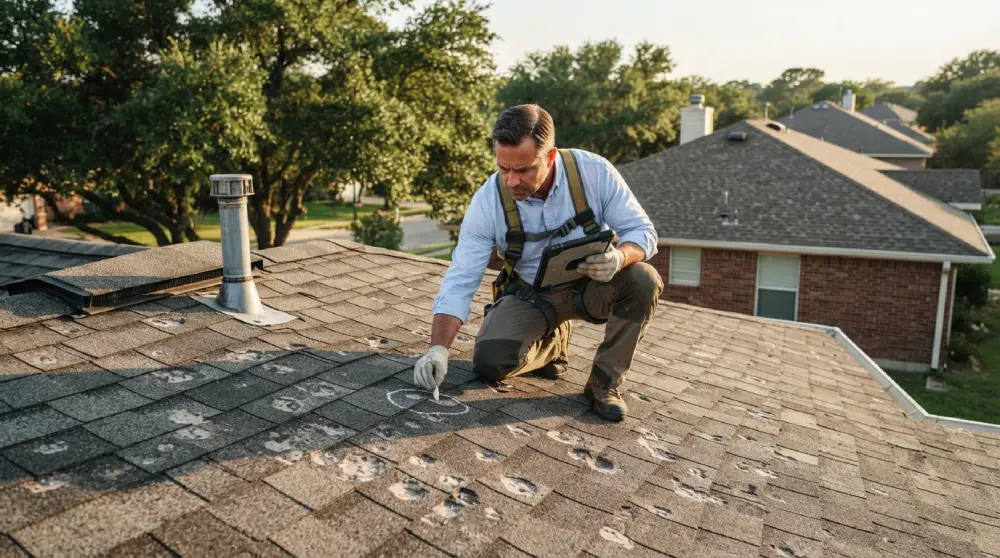
A carrier inspection may identify damage on one roof slope while overlooking collateral damage elsewhere. Our guide to Texas hail damage insurance claims explains the documentation, inspection, and claim issues property owners should consider after a severe hailstorm. It may also characterize shingle impacts as blistering, age-related wear, foot traffic, or manufacturing conditions.
A strong hail claim should document the storm direction, roof components, test areas, soft-metal impacts, exterior elevations, and related interior leaks. The inspection should also separate new storm damage from pre-existing conditions.
Wind and Tornado Damage
Strong winds can lift shingles, crease tabs, loosen flashing, detach ridge materials, damage siding, and drive rain beneath roofing components. Tree limbs may fall onto roofs, fences, detached structures, vehicles, and utility lines.
Tornadoes are less frequent than ordinary thunderstorms, but the San Antonio area can experience rotating storms and isolated tornado damage. Recent severe-weather events in the broader region have included damaging winds, flooding, hail, and tornado activity.
Wind claims often become disputed because some damage is difficult to see during a ground-level inspection. Lifted shingles may settle back into place, leaving creases or weakened seals that are only visible during a close roof assessment.
Heavy Rain and Water Intrusion
Live Oak’s Main City Park, Lakeside areas, and Woodcrest Park reflect the city’s connection to local drainage and water-management systems. Woodcrest Park also functions in part as a flood-control amenity for the Woodcrest and Auburn Hills at Woodcrest subdivisions.
Heavy rain can still create property problems even when a structure is not located in a mapped high-risk flood area. Common losses include:
- Wind-driven rain through roof openings
- Water entering around windows or doors
- Overflow from blocked drainage systems
- Roof leaks following hail or wind damage
- Ceiling and wall damage
- Wet insulation
- Flooring damage
- Cabinet and millwork damage
- Mold or microbial growth after delayed drying
Standard property policies often treat storm-created openings differently from surface flooding or groundwater. Coverage depends on the cause of loss and the policy language. A detailed inspection can help distinguish roof-related water intrusion from excluded flood conditions.
Freeze and Plumbing Damage
The San Antonio region can experience sudden winter freezes that place stress on plumbing systems. Frozen or cracked supply lines may release water into walls, ceilings, attics, kitchens, bathrooms, and mechanical spaces.
The visible water may be only part of the loss. Moisture can travel beneath flooring, behind cabinets, through insulation, and into adjacent rooms. Proper claim documentation should address both emergency mitigation and the repairs needed to restore affected materials.
Fire, Smoke, and Electrical Losses
House fires, kitchen fires, electrical failures, appliance incidents, and lightning-related losses can create multiple categories of damage at once.
A fire claim may involve:
- Burned structural materials
- Smoke and soot contamination
- Water from firefighting efforts
- Damaged electrical systems
- Debris removal
- Personal property inventories
- Temporary housing expenses
- Code-related repairs
- Odor treatment
- HVAC cleaning or replacement
Smoke can travel far beyond the room where the fire began. Because these losses can involve structural damage, contents, smoke contamination, and temporary living expenses, working with a public fire insurance adjuster may help the policyholder organize the full claim. A limited scope that addresses only visibly burned materials may not account for contamination in adjoining rooms, ducts, insulation, textiles, or contents.
Common Insurance Claims in Live Oak
| Claim type | Common damage concerns | Items that may be missed |
| Hail damage | Roof impacts, gutters, vents, screens, fencing | Collateral damage, soft metals, multiple elevations |
| Wind damage | Lifted shingles, detached materials, tree impact | Creased tabs, compromised seals, wind-driven rain |
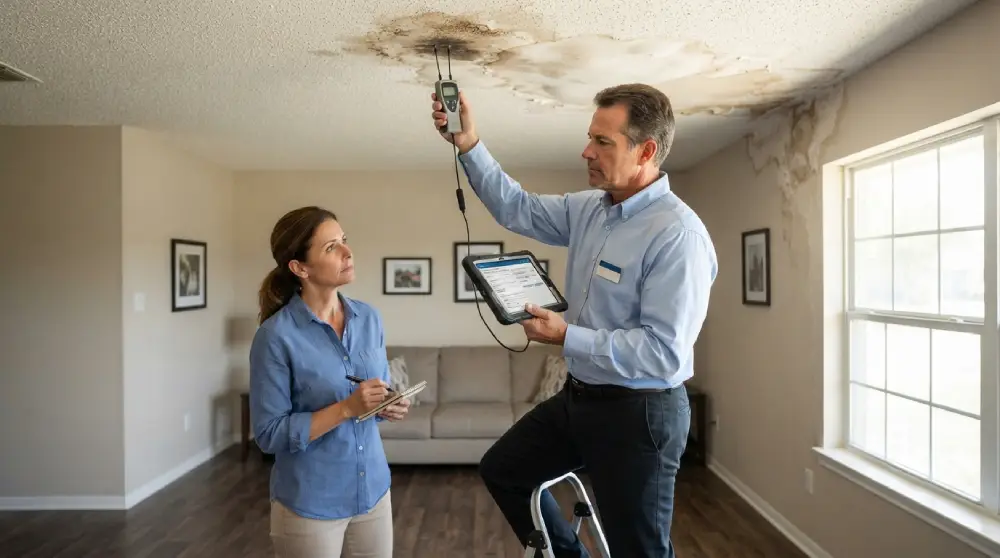
| Water damage | Wet drywall, flooring, cabinets, insulation | Moisture behind walls and under finished surfaces |
| Fire damage | Structural damage, smoke, soot, contents | HVAC contamination, odor treatment, code upgrades |
| Roof claims | Shingles, underlayment, flashing, decking | Accessories, steep charges, waste, matching issues |
| Commercial claims | Building, equipment, inventory, operations | Tenant improvements and business-related expenses |
Roof Damage Claims
Roof claims are among the most disputed property claims in Live Oak. The disagreement may involve whether damage was caused by hail or age, whether spot repairs are reasonable, or whether matching materials are available.
A complete roof scope may need to address shingles or panels, underlayment, flashing, vents, drip edge, ridge materials, valley components, gutters, satellite equipment, solar-related detachments, steep roofing conditions, and code requirements. Commercial owners with low-slope or layered roofing systems can also review our guide to built-up roof repair and the claim issues those systems may present.
Water Damage Claims
Water damage claims require attention to the source, duration, affected materials, and mitigation work. A small plumbing leak can damage cabinetry, flooring, baseboards, drywall, insulation, and personal property.
We review moisture documentation, mitigation invoices, demolition scopes, photographs, and repair estimates to determine whether the carrier’s scope reflects the full affected area. Property owners facing a disputed or delayed loss may also benefit from our guide to dealing with an insurance adjuster after water damage.
Fire Damage Claims
Fire damage insurance claims often require extensive coordination because the building damage must be evaluated alongside smoke contamination, contents, debris removal, temporary repairs, and additional living expenses. The building damage must be evaluated alongside smoke contamination, contents, debris removal, temporary repairs, and additional living expenses.
Commercial fire losses may also involve equipment, tenant improvements, inventory, records, and operational disruption.
Commercial Property Claims
Live Oak includes significant retail, healthcare, restaurant, office, multifamily, and service-sector properties. The Forum at Olympia Parkway is a major outdoor shopping destination, while Methodist Hospital Northeast and nearby medical facilities form an important healthcare corridor.
Commercial claims may involve:
- Roofing systems
- Exterior cladding
- Interior buildouts
- Mechanical equipment
- Business personal property
- Inventory
- Signage
- Multiple tenants
- Emergency mitigation
- Ordinance and law considerations
- Business-income documentation
These claims can become difficult when several buildings, units, roof sections, or business operations are affected by the same event.
Concerned that your Live Oak insurance claim is incomplete? Request a Free Claim Review from TX Public Adjusting. We evaluate residential and commercial losses with no upfront fees.
Why Insurance Claims Become Underpaid
An underpaid claim is not always the result of one large error. It may result from dozens of smaller omissions. Many of these problems begin with incomplete inspections, weak documentation, premature repairs, or misunderstandings about the carrier’s estimate. Review these common property insurance claim mistakes before making decisions that could affect the claim.
Missed or Hidden Damage
The carrier may document the obvious ceiling stain but not the wet insulation, damaged decking, flooring transitions, or adjoining materials. On a hail claim, the estimate may include shingles but omit vents, gutters, screens, fencing, and exterior finishes.
Scope Omissions
Repair estimates depend on the scope of work. Missing line items may involve:
- Material removal
- Disposal
- Access requirements
- Protection of unaffected areas
- Labor minimums
- Equipment detach and reset
- Painting transitions
- Texture matching
- Roofing accessories
- Permits
- Code-related work
When those items are repeated across a property, the total difference can be substantial.
Depreciation Issues
Insurance estimates may include recoverable or nonrecoverable depreciation. Property owners sometimes receive an initial payment without understanding what documentation is required to recover withheld amounts.
We review how depreciation was calculated, how it relates to the policy, and whether the estimate accurately describes the damaged property.
Low Repair Pricing
Carrier estimates may use labor rates, material pricing, or repair assumptions that differ from the actual work required in Live Oak. A contractor’s estimate and the carrier’s estimate may also be based on different scopes, making a simple price comparison misleading.
The first step is determining what work is required. Pricing can then be evaluated against that scope.
Weak Documentation
A legitimate claim can become difficult when photographs are incomplete, damaged materials are discarded too soon, personal property inventories lack detail, or repair estimates do not explain why certain work is necessary.
Strong documentation connects the observed damage to the claimed work.
Our Public Adjusting Process
1. Claim Review
We review the insurance claim, available policy documents, carrier correspondence, estimates, photographs, payments, and prior inspection information.
We also discuss what happened, when the loss occurred, what emergency work has been completed, and which areas remain damaged.
2. Property Inspection
Our team inspects the property and documents visible damage. Depending on the loss, the inspection may include roofing, exterior elevations, interior rooms, building systems, personal property, or commercial areas.
3. Damage Documentation
We organize photographs, measurements, repair scopes, estimates, inventories, reports, and supporting records. When specialists are needed, the claim may also involve contractors, engineers, hygienists, mitigation professionals, or other qualified experts.
4. Claim Presentation
We present documented claim information to the insurance carrier and respond to relevant questions or requests. Our goal is to clearly show the nature and extent of the covered loss.
5. Negotiation and Resolution
We negotiate from the policyholder’s position and address differences between the carrier’s scope and the documented damage.
The outcome depends on the policy, cause of loss, available evidence, coverage, exclusions, deadlines, and carrier decisions. We do not promise a specific payment, but we do provide organized and independent representation throughout the process.
Why Choose TX Public Adjusting
Texas-Focused Claim Experience
Texas properties face a demanding combination of hail, wind, heavy rain, freezes, fire, and extreme heat. Our work is focused on claims throughout Texas, including the construction methods and storm patterns common across Bexar County and the San Antonio region.
Licensed Public Adjuster
TX Public Adjusting is operated by Rise Public Adjusting LLC, Texas License #3356839.
Property owners should verify the licensing and identity of anyone offering public adjusting services. A licensed public adjuster has a different role from a contractor, roofer, insurance agent, or carrier-employed adjuster.
Independent Policyholder Representation
We work for the policyholder. We do not represent the insurance carrier, and we do not prepare the claim to protect the carrier’s financial interests.
Residential and Commercial Experience
Our team has experience reviewing thousands of claims involving homes, apartments, commercial buildings, roofing systems, water losses, fires, storms, and business property.
Detailed Claim Preparation
A claim should tell a clear story: what happened, what was damaged, what work is needed, and how the requested amount was calculated. We focus on building that record.
No Upfront Fees
We offer a Free Claim Review, and there are no upfront fees for our public adjusting services. Any fee arrangement is explained in writing before representation begins.
Live Oak Neighborhoods and Property Areas We Serve
Live Oak is compact, but its properties are not all alike. We serve homes, multifamily communities, retail properties, offices, healthcare facilities, and other insured buildings throughout the city.
Woodcrest
Woodcrest includes established residential properties near Woodcrest Park and wooded sections of Live Oak. Mature trees can increase the risk of limb impact during strong winds, while older roofs and prior repairs can complicate storm claims.
Auburn Hills at Woodcrest
Auburn Hills at Woodcrest contains newer residential construction near the eastern and southeastern portions of Live Oak. Claims in newer neighborhoods can involve builder materials, matching concerns, fencing, garage doors, roof accessories, and exterior finishes.
Live Oak Main City Park and Lakeside Areas
Main City Park is one of the city’s best-known community landmarks, with parkland, trails, recreational amenities, playgrounds, and lake access. The city maintains more than 100 acres of parkland across Main City Park, Lakeside, and Woodcrest Park.
Homes near wooded and low-lying areas may experience tree damage, drainage problems, wind-driven rain, and roof leaks during severe storms.
The Forum and Olympia Parkway
The Forum at Olympia Parkway is a major commercial area serving Live Oak, Selma, Universal City, and surrounding communities. Retail claims in this corridor may involve large roof surfaces, rooftop equipment, signage, inventory, customer areas, and tenant improvements.
Judson Road and Methodist Hospital Northeast
The Judson Road corridor includes healthcare, professional, apartment, and service properties. Losses involving medical or commercial facilities often require careful documentation because operations, specialized equipment, and interior buildouts may be affected.
Areas We Serve Near Live Oak
TX Public Adjusting serves property owners throughout Live Oak and nearby communities, including:
- Universal City
- Selma
- Converse
- Schertz
- Cibolo
- Windcrest
- Kirby
- Garden Ridge
- Northeast San Antonio
- New Braunfels
- Other communities across Bexar, Guadalupe, and Comal counties
A storm rarely stops at a city boundary. We can review claims involving homes, commercial buildings, apartments, churches, offices, warehouses, restaurants, retail properties, and other insured structures across the region.
Frequently Asked Questions
What does a public adjuster in Live Oak do?
A public adjuster represents the property owner during an insurance claim. The adjuster inspects damage, reviews the insurance company’s estimate, prepares supporting documentation, communicates with the carrier, and negotiates regarding the covered loss.
TX Public Adjusting works for the policyholder rather than the insurance company.
How much does a public adjuster cost in Live Oak?
Public adjusters are commonly paid through a fee connected to the claim recovery rather than an upfront charge. The exact fee structure depends on the representation agreement and applicable Texas requirements.
TX Public Adjusting provides a Free Claim Review and explains the fee agreement in writing before services begin. There are no upfront fees.
Can you help after the insurance company has already paid my claim?
Possibly. An initial payment does not always mean the claim is fully resolved. Additional covered damage may be documented through a supplement, depending on the policy, deadlines, prior settlement documents, and facts of the loss.
We can review the carrier’s estimate, payment information, and current property conditions to determine whether further action may be reasonable.
Can a public adjuster help with a denied Live Oak roof claim?
A public adjuster can review the denial letter, policy information, inspection findings, photographs, and available storm evidence. The review may identify factual disagreements, missing documentation, or policy issues that need to be addressed.
A denial cannot always be reversed. The available options depend on why the claim was denied and whether supporting evidence exists.
What if my contractor’s estimate is higher than the insurance estimate?
The two estimates may differ because they include different work, quantities, materials, labor assumptions, or code requirements.
We compare the scopes line by line. The goal is to identify what is missing or disputed rather than relying only on the difference between the bottom-line totals.
Do you handle hail claims in Live Oak?
Yes. We handle residential and commercial hail damage claims involving roofs, exterior surfaces, gutters, windows, fencing, HVAC equipment, and interior leaks caused by storm-created openings.
Hail damage should be documented promptly, especially when more than one storm may have affected the property.
Do you handle commercial property claims?
Yes. TX Public Adjusting works with owners of retail, office, multifamily, healthcare, restaurant, warehouse, religious, and other commercial properties.
Commercial claims may require documentation for the building, tenant improvements, inventory, equipment, mitigation expenses, and business-related losses.
Should I make emergency repairs before the inspection?
Take reasonable steps to protect the property from additional damage. This may include emergency tarping, water extraction, board-up work, or shutting off a damaged plumbing system.
Photograph the conditions before and after emergency work when safely possible. Keep invoices, contracts, drying records, removed materials, and related documentation.
How long does a Live Oak insurance claim take?
The timeline depends on the size of the loss, type of damage, carrier response, policy requirements, inspections, requested documents, and disagreements over coverage or scope. Texas property owners can also review our explanation of how long an insurance adjuster has to contact you after a claim is reported.
A smaller roof claim may move differently from a commercial fire or widespread water loss. We keep the claim organized and respond to the carrier as documentation becomes available.
Is TX Public Adjusting licensed in Texas?
Yes. TX Public Adjusting is operated by Rise Public Adjusting LLC, Texas License #3356839.
We provide independent public adjusting services for policyholders with residential and commercial property claims throughout Texas.
Get a Free Live Oak Insurance Claim Review
A low estimate, delayed response, partial denial, or confusing scope does not have to be the end of the claim.
TX Public Adjusting can review your property damage, insurance estimate, claim correspondence, and available policy information. We will explain what we see, identify potential documentation gaps, and discuss the next reasonable step.
Contact TX Public Adjusting for a Free Claim Review. Property owners who need a broader overview of the steps following a loss can review our property loss recovery guide before requesting assistance.
- Licensed Texas public adjuster
- Residential and commercial claims
- Independent policyholder representation
- No upfront fees
- Rise Public Adjusting LLC
- Texas License #3356839