

Property damage in White Settlement can happen quickly. A spring thunderstorm can drive hail into an aging roof, straight-line winds can lift shingles along the edge of a commercial building, and a plumbing failure can spread water through several rooms before the source is found. When the resulting insurance estimate does not account for the full loss, a licensed public adjuster in White Settlement can help the property owner document the damage and present the claim more effectively.
TX Public Adjusting represents residential and commercial policyholders—not insurance companies. Property owners who are unfamiliar with the process can first learn more about what a public adjuster does and how policyholder representation differs from the carrier’s claim review. Our team reviews policies, inspects damaged property, prepares detailed claim documentation, identifies missing or undervalued items, and communicates with the carrier regarding the scope of the loss.
TX Public Adjusting is operated by Rise Public Adjusting LLC, Texas License #3356839. Property owners in White Settlement can contact us for a free claim review with no upfront fees.
Need help with a denied, delayed, or underpaid insurance claim? Contact TX Public Adjusting for a free review of your White Settlement property claim.
Why Property Owners Hire a Public Adjuster in White Settlement
White Settlement is a residential community on the western edge of Fort Worth in west-central Tarrant County, near Interstate 820 and major routes connecting the area with Fort Worth, Lake Worth, Benbrook, and communities farther west. Its location places local homes, rental properties, shops, offices, churches, warehouses, and other buildings within the active North Texas storm corridor.
After a covered loss, the insurance company normally assigns an adjuster to investigate the claim. That adjuster works for the carrier and evaluates the loss according to the carrier’s procedures. A public adjuster takes a different role: representing the policyholder’s financial interests during the property insurance claim.
White Settlement property owners commonly hire a public adjuster when:
- The insurance estimate appears too low.
- Important rooms, materials, or building components were omitted.
- The carrier attributed storm damage to age or wear.
- The claim was denied after a brief inspection.
- Repairs uncovered additional hidden damage.
- Depreciation was applied incorrectly or not clearly explained.
- A commercial loss includes inventory, equipment, or business-interruption issues.
- The property owner does not have time to manage repeated inspections and document requests.
- The claim has stalled or communication has become difficult.
- The policyholder wants an independent review before accepting a settlement.
Insurance claims are built on evidence. Photographs help, but photographs alone may not establish the complete repair scope. A properly documented claim may also require measurements, material identification, moisture readings, repair estimates, inventories, invoices, expert findings, code-related considerations, and a careful comparison between the observed damage and the carrier’s estimate.
Our work is focused on assembling that information into a clear, supportable claim presentation.
White Settlement Storm Risks and Property Damage Concerns
White Settlement shares the severe-weather exposure found across the Fort Worth side of the Dallas–Fort Worth region. Local properties may experience large hail, damaging wind, lightning, tornado-producing storms, sudden heavy rain, and winter freeze conditions.
Historical storm reporting for the White Settlement area includes thunderstorms capable of producing approximately 60 mph winds and hail, with expected damage to roofs, siding, trees, and vehicles.
Hail Damage
Hail is one of the most frequent reasons White Settlement homeowners and commercial property owners contact a public adjuster. Our hail damage roof insurance claim guide explains how roof impacts, exterior damage, documentation, and carrier estimates may affect a Texas hail claim. Damage is not always obvious from ground level.
Hail may affect:
- Asphalt shingles
- Metal roofing and rooftop panels
- Roof vents and flashing
- Gutters and downspouts
- Window screens
- Exterior siding
- HVAC condenser fins
- Skylights
- Fences, sheds, and detached structures
- Commercial roof membranes
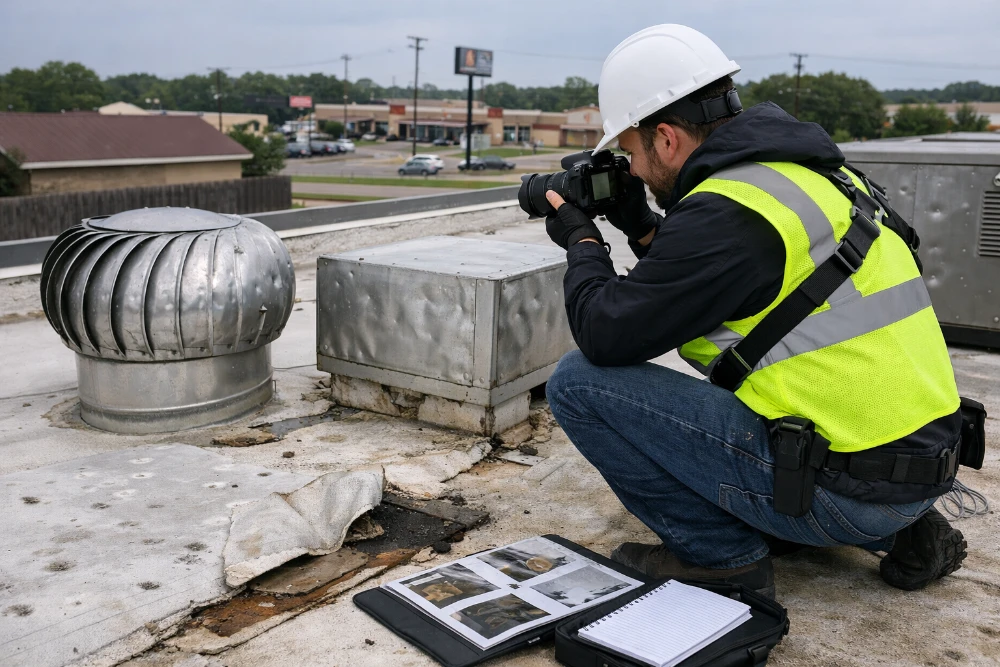
Property owners should also know how to document hail damage for an insurance claim before repairs or weather conditions alter the visible evidence. A carrier’s inspection may identify some impact marks while overlooking damage on less accessible roof slopes, soft-metal components, rooftop equipment, fencing, or exterior elevations. There can also be disagreement over whether the observed conditions resulted from hail, ordinary aging, mechanical damage, or installation issues. When the carrier rejects the loss, review the practical steps outlined in what to do if a hail claim was denied.
A White Settlement public insurance adjuster can document the complete exterior system, compare the findings with the claimed date of loss, and review whether the carrier’s scope reflects the damage throughout the property.
Straight-Line Wind and Tornado Damage
North Texas thunderstorms can produce powerful straight-line winds even when no tornado is confirmed. Wind may lift shingles, loosen flashing, detach siding, damage fencing, break tree limbs, and allow rain to enter through compromised roofing or exterior openings.
Wind claims can become disputed when the most visible damage is limited to one section of the structure. The insurer may propose spot repairs, while the contractor or property owner believes broader work is required to return the building to its pre-loss condition.
The correct scope depends on the policy, the damaged materials, repairability, matching considerations, installation method, and the physical condition of adjoining components. Those issues should be supported with evidence rather than assumptions.
Heavy Rain and Interior Water Intrusion
Heavy thunderstorms may expose roof openings, damaged flashing, failed seals, and drainage problems. Water entering through a storm-created opening can damage:
- Ceilings and insulation
- Drywall and texture
- Paint and trim
- Flooring
- Cabinets
- Electrical components
- Personal property
- Commercial inventory
The source of water matters. Property policies often treat storm-created openings, plumbing failures, groundwater, rising water, backups, and maintenance-related seepage differently. A thorough investigation should distinguish the cause of loss and document the path the water followed through the building.
Flash-Flood and Drainage Concerns
White Settlement developed along the Farmer’s Branch Creek area, and the city continues to identify the creek as part of its local geography and history. Low-lying areas and properties with inadequate drainage can experience ponding or rapid runoff during intense rain.
Standard property policies commonly distinguish between covered interior water damage and excluded or separately insured flood conditions. Policyholders should avoid assuming that every water loss is either covered or excluded without reviewing the actual policy language and physical evidence.
Winter Freeze and Pipe Damage
A prolonged North Texas freeze can rupture supply lines, damage water heaters, affect fire-suppression systems, and cause plumbing failures inside walls or ceilings. Water may travel far beyond the visible leak.
Freeze claims can include emergency plumbing, water extraction, drying, demolition, insulation, drywall, flooring, cabinetry, contents, and temporary relocation costs. When documentation is incomplete, an estimate may include the broken pipe area but miss the wider restoration work.
Common Insurance Claims in White Settlement
Hail Damage Claims
Hail claims may involve far more than replacing shingles. A complete inspection should consider the roof covering, underlayment where exposed, ridge materials, vents, flashing, gutters, screens, exterior finishes, HVAC equipment, and detached structures.
TX Public Adjusting reviews the carrier’s estimate alongside the observed damage to determine whether relevant components, quantities, labor operations, and related repairs were omitted.
Water Damage Claims
Water losses can grow rapidly. A water damage public adjuster can help document the source, affected rooms, damaged materials, mitigation work, and repair scope when a supply-line break, roof opening, appliance failure, or plumbing leak damages a White Settlement property.
Water-damage documentation can include moisture mapping, mitigation records, photographs, demolition details, material samples, personal-property inventories, and repair estimates.
Fire and Smoke Damage Claims
A structure fire may create several categories of damage at the same time:
- Direct flame damage
- Smoke and soot contamination
- Water damage from suppression efforts
- Heat damage
- Electrical damage
- Debris-removal costs
- Personal-property damage
- Temporary living or operating expenses
A fire insurance adjuster working for the policyholder can review direct fire damage as well as smoke, soot, water, debris-removal, contents, and additional-expense issues. Smoke can travel through HVAC systems and concealed spaces, affecting areas that were not directly touched by flames. A fire claim should consider the entire building and the appropriate cleaning, testing, removal, and replacement methods for affected materials.
Storm Damage Claims
A severe storm can produce overlapping hail, wind, rain, tree, and electrical damage. Claims sometimes become fragmented when the roof is inspected separately from the interior or when exterior damage is documented without tracing the resulting water intrusion.
We organize the different parts of the loss so the carrier receives a coordinated description of what happened and what is required to repair the property.
Roof Damage Claims
Roof disputes often center on repairability and scope. A public adjuster for a roof claim can compare the carrier’s estimate with the observed storm damage, roof measurements, material requirements, and proposed repair method. The insurance estimate may call for replacing a small number of shingles, patching a membrane, or repairing one slope. The property owner may receive a contractor assessment recommending more extensive work.
A public adjuster does not automatically assume that every roof requires replacement. We examine the roof, the policy, the damaged materials, the proposed repair method, and the supporting evidence. The goal is an accurate scope—not an exaggerated one.
Commercial Property Claims
White Settlement’s proximity to Loop 820, Fort Worth, Naval Air Station Joint Reserve Base Fort Worth, and major commercial corridors supports a mix of retail, service, industrial, office, multifamily, and institutional properties.
Commercial claims may involve:
- Flat or low-slope roof systems
- Interior buildouts
- Tenant improvements
- Machinery and equipment
- Inventory and stock
- Electronic systems
- Signs and exterior lighting
- Loss of business income
- Extra expenses
- Multiple buildings or locations
Commercial losses require close coordination. The physical-damage claim may affect repair schedules, tenants, operations, vendor relationships, and financial reporting. Our team works to document both building damage and other covered losses identified by the policy.
Why White Settlement Insurance Claims Become Underpaid
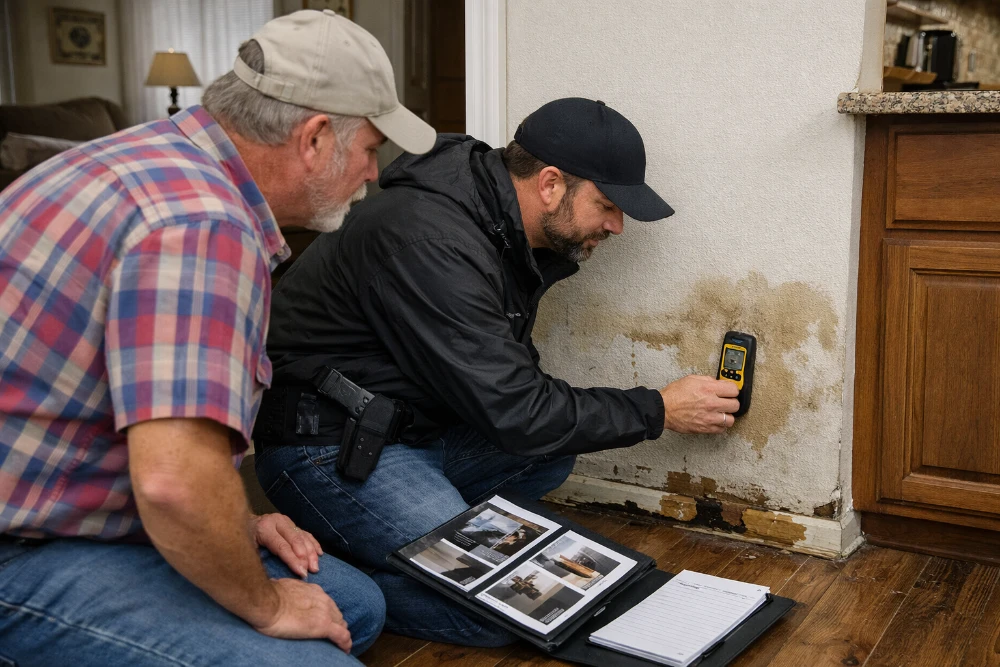
An underpaid claim does not always begin with an intentional refusal to pay. Many payment disputes begin with familiar common property insurance claim mistakes, including incomplete documentation, missing measurements, overlooked damage, or accepting an estimate before reviewing the full scope. In many cases, the initial inspection or estimate simply does not capture the complete loss.
Missed or Hidden Damage
Some materials cannot be fully evaluated until drying, demolition, or repairs begin. Moisture may remain behind cabinets or inside wall systems. Wind can loosen roofing without removing it completely. Smoke residue can spread beyond the fire room.
When additional damage is discovered, it should be documented promptly and presented through the appropriate claim process.
Scope Omissions
A carrier’s estimate may list the primary damaged material but leave out related work such as:
- Removing and resetting fixtures
- Detaching and reinstalling trim
- Protecting unaffected areas
- Debris hauling
- Access work
- Equipment setup
- Surface preparation
- Painting adjoining materials
- General contractor coordination
- Permit or code-related items when applicable
Small omissions across many rooms or components can create a substantial gap between the carrier estimate and the actual cost of restoration.
Measurement and Quantity Errors
Incorrect roof measurements, missing wall sections, underestimated flooring areas, or overlooked detached structures can reduce a claim. Measurements should be verified rather than accepted automatically.
Depreciation Issues
Replacement-cost policies may initially pay actual cash value and hold back recoverable depreciation until repairs are completed and documented. Other policies may settle certain items on an actual-cash-value basis.
Confusion over depreciation can cause policyholders to believe the claim is closed or that additional funds are unavailable. We review the settlement documents and applicable policy terms to clarify how the carrier calculated the payment.
Low Repair Pricing
Estimating software is only as accurate as the information entered into it. Labor rates, material selections, equipment charges, access conditions, and required repair operations may not reflect the actual project.
A strong claim submission connects the physical scope with realistic repair requirements and supporting documentation.
Cause-of-Loss Disputes
A roof claim may be denied as wear and tear. Interior staining may be attributed to long-term seepage. Cracking may be described as settling rather than storm-related movement.
Not every disagreement can be resolved by a public adjuster, and coverage decisions ultimately depend on the policy and facts. However, a detailed inspection and organized evidence can help ensure that the carrier evaluates the full information rather than relying on an incomplete initial record.
Our Public Adjusting Process
1. Free Claim Review
We begin by discussing the date and cause of loss, damaged areas, claim status, carrier communications, inspections, estimates, and payments already received.
We may request documents such as:
- The insurance policy
- Carrier estimates
- Coverage letters
- Payment summaries
- Photographs
- Contractor estimates
- Mitigation invoices
- Repair proposals
- Relevant correspondence
The initial review helps determine whether public adjusting services may benefit the claim.
2. Property Inspection
Our team inspects the affected property and documents visible damage. The inspection may include roofing, exterior elevations, interior rooms, detached structures, commercial spaces, equipment, or contents, depending on the loss.
We look beyond the single area identified in the carrier’s estimate and consider how the covered event affected the property as a connected system.
3. Documentation and Scope Preparation
We organize photographs, measurements, inventories, estimates, reports, invoices, and other supporting records. When necessary, the policyholder may also need appropriate contractors, engineers, hygienists, mitigation specialists, or other professionals.
Our role is to present the policyholder’s claim accurately and thoroughly within the authority of a licensed Texas public adjuster.
4. Claim Presentation and Communication
We submit relevant documentation and communicate with the insurance carrier regarding the scope and valuation of the claim. This may include responding to questions, discussing omitted items, coordinating inspections, and presenting supplemental information.
5. Settlement Review
When the carrier issues an estimate, coverage determination, or additional payment, we review the documents with the policyholder. The objective is to ensure that covered damage has been evaluated based on the available evidence and applicable policy terms.
No public adjuster can guarantee a particular payment or outcome. Every claim depends on the policy, cause of loss, condition of the property, documentation, carrier evaluation, and other facts.
Mid-Claim Help for White Settlement Property Owners
You do not always have to hire a public adjuster immediately after the loss. TX Public Adjusting may be able to assist after:
- An initial payment has been issued
- The insurance estimate came in below contractor pricing
- The claim was partially denied
- Supplemental damage was discovered
- Communication with the carrier slowed down
- A second inspection was requested
- The carrier closed the claim
The timing of the request still matters. Our guide on when it is too late to hire a public adjuster explains why policy deadlines, claim status, prior payments, and available evidence should be reviewed promptly. Timing still matters. Policies can contain duties, reporting requirements, repair deadlines, suit limitations, and other time-sensitive conditions.
Before accepting a low estimate or abandoning a disputed claim, request a free claim review from TX Public Adjusting. There are no upfront fees.
Why Choose TX Public Adjusting
Licensed Texas Public Adjuster
TX Public Adjusting operates through Rise Public Adjusting LLC, Texas License #3356839. Licensing provides property owners with a clear, verifiable credential when selecting someone to assist with an insurance claim.
Representation for the Policyholder
Insurance-company adjusters and independent adjusters hired by carriers serve the insurance company’s claim process. Public adjusters represent policyholders.
Our responsibility is to document and present the property owner’s claim—not to protect the carrier’s financial interests.
Texas-Focused Claim Experience
Texas claims present recurring issues involving hail, wind, freeze damage, water intrusion, roof systems, commercial properties, and storm-related losses. Our team has reviewed thousands of residential and commercial claims and understands the documentation required to present complicated property losses.
Residential and Commercial Expertise
We assist homeowners, landlords, business owners, commercial property owners, investors, and other policyholders. Our experience includes residential buildings as well as more complex commercial losses involving larger roof systems, tenant areas, equipment, inventory, and operational concerns.
Detailed Independent Review
We do not simply compare the bottom-line totals of two estimates. We examine the scope line by line and consider quantities, repair methods, affected materials, related operations, documentation, depreciation, and policy provisions relevant to the loss.
No Upfront Fees
Property owners can begin with a free claim review. Our fee arrangement is explained before services begin so the policyholder understands the terms.
Areas We Serve Near White Settlement
TX Public Adjusting assists property owners throughout White Settlement and the western Fort Worth area, including properties near:
- Downtown White Settlement
- Farmers Branch Creek
- Las Vegas Trail
- Cherry Lane
- White Settlement Road
- Clifford Street
- Loop 820
- Raymond Park
- John Griggs Park
- Memorial Park
- Veterans Park
- Central Park
Local community facilities include Raymond Park, John Griggs Park, Cherry Lane Dog Park, and Memorial Park. These references are not just points on a map. They reflect the compact residential and commercial layout of a city where one severe storm can affect roofs and buildings across multiple nearby streets.
We also serve surrounding communities such as:
- Fort Worth
- Westworth Village
- Westover Hills
- River Oaks
- Sansom Park
- Lake Worth
- Benbrook
- Lakeside
- Saginaw
- Azle
- Aledo
- Weatherford
Property owners outside the immediate White Settlement area can contact us to confirm service availability anywhere in Texas.
Frequently Asked Questions
How does a public adjuster help with a White Settlement insurance claim?
A public adjuster reviews the property damage from the policyholder’s perspective. This may include inspecting the property, reviewing the policy and carrier estimate, documenting omitted damage, preparing a repair scope, organizing evidence, and communicating with the insurance company.
In White Settlement, this is especially useful for hail, wind, roof, water, freeze, and commercial property claims where the initial estimate does not account for all affected areas.
Does the insurance company’s adjuster represent me?
The insurance company’s adjuster investigates the claim for the carrier. Even when that adjuster is professional and courteous, the adjuster’s assignment comes from the insurance company.
A licensed public adjuster represents the policyholder. TX Public Adjusting works for the property owner and prepares the claim from that perspective. Property owners can read our comparison of a public adjuster vs. independent adjuster for a clearer explanation of the different roles.
When should I hire a public adjuster in White Settlement?
Consider speaking with a public adjuster when the damage is extensive, the claim involves several rooms or building systems, the insurer’s estimate appears too low, the claim was denied, or additional damage was discovered.
You can also request a review before filing when you are uncertain about the extent of the damage. However, urgent steps to protect the property and comply with policy duties should not be delayed.
Can you help after my insurance company has already paid?
Possibly. An initial payment does not always mean every covered item has been resolved. Additional damage, estimating omissions, measurement errors, depreciation questions, and supplemental repair costs may still need review.
We examine the carrier’s documents, the condition of the property, the policy, and relevant deadlines before determining whether we can assist.
Can a public adjuster reopen a closed claim?
Some closed claims may still be reviewed or supplemented, but the answer depends on the reason for closure, policy language, deadlines, prior releases, repairs, and state law.
A closed status in the carrier’s system does not necessarily answer every question. Have the documents reviewed promptly rather than assuming that no options remain.
What should I do after hail hits my White Settlement property?
Photograph the exterior from a safe location, note the storm date and approximate time, protect openings from further water intrusion, and keep receipts for emergency work. Do not walk on a wet, steep, or damaged roof.
Arrange for a qualified inspection and avoid signing broad repair or claim-assignment documents without understanding them. Damage to shingles, flashing, vents, gutters, screens, fencing, siding, and HVAC equipment should all be considered.
Can you help if the insurer says my roof damage is only wear and tear?
Yes, we can review the claim and available evidence. Roofs often have pre-existing aging, but that does not automatically establish that every observed condition resulted from wear.
The evaluation should consider impact evidence, wind effects, storm timing, material condition, repairability, photographs, and other relevant information. Coverage cannot be guaranteed, but the decision should be based on a complete record. In some disputed losses, the policy’s appraisal provision may also become relevant, although it is not appropriate for every coverage disagreement. Learn more about appraisal for a hail damage claim.
Do you handle commercial claims in White Settlement?
Yes. TX Public Adjusting assists commercial property owners with roof, hail, wind, fire, water, equipment, inventory, tenant-improvement, and other covered property losses.
Commercial claims may require additional documentation because building repairs can affect tenants, operations, revenue, and contractual responsibilities.
How much does a public adjuster charge?
Public adjusting fees are normally based on the written agreement with the policyholder and are subject to applicable Texas requirements. The exact fee should be explained before the contract is signed.
TX Public Adjusting offers a free initial claim review and does not charge upfront fees.
How long does a property insurance claim take?
There is no universal timeline. A relatively straightforward claim may move quickly, while a large fire, commercial loss, disputed roof claim, or multi-building storm claim can require additional inspections, estimates, expert findings, and negotiations.
The property owner can help avoid unnecessary delays by preserving evidence, responding to reasonable information requests, keeping receipts, and maintaining organized records. For more detail about early carrier communication, see our guide explaining how long an insurance adjuster has to contact you.
Get a Free White Settlement Insurance Claim Review
A low estimate can leave a property owner paying for covered repairs out of pocket. A poorly documented claim can also become harder to correct as time passes and evidence disappears.
TX Public Adjusting helps White Settlement homeowners and commercial property owners understand the claim, document the damage, and present a detailed request to the insurance carrier.
Rise Public Adjusting LLC
Texas License #3356839
Residential and Commercial Property Claims
Free Claim Review
No Upfront Fees
Contact TX Public Adjusting today for insurance claim assistance in White Settlement, Texas.