

Property damage in Red Oak can turn into a complicated insurance claim quickly. A fast-moving North Texas thunderstorm can leave hail strikes across a roof, damage exterior siding, break windows, and allow rainwater into the building—all within a few minutes. Plumbing failures, kitchen fires, electrical damage, and commercial roof leaks can create equally disruptive losses.
A public adjuster in Red Oak, TX helps the policyholder document the damage, understand the insurance policy, prepare the claim, and negotiate with the insurance company. Unlike an adjuster assigned by the carrier, a public adjuster represents the property owner’s financial interests.
TX Public Adjusting provides insurance claim assistance for residential and commercial property owners throughout Red Oak and surrounding Ellis County communities. Our firm is operated by Rise Public Adjusting LLC, a licensed Texas public adjusting company under License #3356839.
Concerned that your property damage was overlooked, your estimate is too low, or your claim has stalled? Contact TX Public Adjusting for a free claim review. There are no upfront fees for the initial review.
Licensed Texas Public Adjuster | Residential and Commercial Claims | Free Claim Review
Insurance Claim Help for Red Oak Property Owners
Red Oak sits along Interstate 35E in northern Ellis County, close enough to the Dallas-Fort Worth metroplex to experience the region’s strong spring and summer storm systems while retaining its own mix of established homes, new subdivisions, schools, retail properties, churches, warehouses, and growing commercial developments.
The city’s location creates a distinctive property-loss environment. Red Oak property owners may face large hail, straight-line winds, tornado activity, flash flooding, wind-driven rain, plumbing leaks, fire losses, and freeze-related pipe damage. Ellis County’s emergency management information identifies tornadoes, flash flooding, large hail, and damaging winds among the recurring severe-weather concerns across North Central Texas.
Damage is not always limited to what can be seen from the ground. Hail may fracture or bruise roofing materials without creating an immediate interior leak. Wind may loosen flashing, vents, membrane seams, gutters, or roof edges. Water can travel behind drywall and beneath flooring long before staining becomes visible.
A Red Oak public adjuster examines the loss from the policyholder’s perspective. The goal is to identify covered damage, build a defensible repair scope, and present the insurance company with organized evidence of the full claim.
Request a Free Claim Review
TX Public Adjusting can review:
- New property insurance claims
- Open claims with low initial estimates
- Claims involving missed or disputed damage
- Underpaid residential and commercial claims
- Claims requiring additional documentation
- Denied claims that may warrant further evaluation
- Supplemental claims for damage omitted from the carrier’s scope
Contact our team before accepting a settlement that may not account for the complete loss.
Why Property Owners Hire a Public Adjuster in Red Oak
An insurance claim is more than a repair estimate. It may involve policy language, coverage limitations, deductibles, depreciation, repair methods, material matching, code-related work, damaged contents, temporary protection, debris removal, business interruption, and multiple contractor trades.
The insurance company assigns professionals to evaluate the loss on its behalf. Red Oak policyholders are permitted to hire their own licensed representative.
A public adjuster may help by:
- Reviewing the applicable insurance policy
- Inspecting the property for visible and concealed damage
- Photographing and documenting the loss
- Preparing a detailed scope of damage
- Identifying items missing from the insurer’s estimate
- Organizing contractor reports and supporting records
- Preparing damaged-content inventories
- Communicating with the carrier’s representatives
- Addressing questions about pricing, quantities, and repair methods
- Negotiating the claim on behalf of the policyholder
This support can be especially valuable when the loss affects several parts of a property. A Red Oak hailstorm, for example, may damage shingles, metal roof components, gutters, fencing, window screens, garage doors, exterior lighting, HVAC fins, and detached structures. An estimate focused only on shingles may not reflect the full event.
Red Oak Storm Risks and Property Damage Patterns
Red Oak is located along the northern edge of Ellis County, approximately 18 miles south of downtown Dallas along Interstate 35E. Nearby communities include Glenn Heights, Lancaster, Ferris, Pecan Hill, Waxahachie, and Oak Leaf. Its position in North Texas places the city in the path of severe thunderstorms capable of producing hail, damaging wind, lightning, heavy rainfall, and tornadoes. Property owners dealing with a major weather loss can also review our Texas hurricane and storm damage guide for additional claim-documentation guidance.
The City of Red Oak and Ellis County maintain hazard-mitigation planning intended to identify local natural hazards, vulnerabilities, and measures that may reduce future losses.
Large Hail
Hail is one of the most consequential insurance risks for Red Oak roofs. Large hail can damage:
- Asphalt shingles
- Standing-seam and exposed-fastener metal roofs
- Tile roofing
- Modified bitumen and other low-slope systems
- Roof vents and flashing
- Gutters and downspouts
- Skylights
- Window screens
- Siding
- Garage doors
- Exterior HVAC equipment
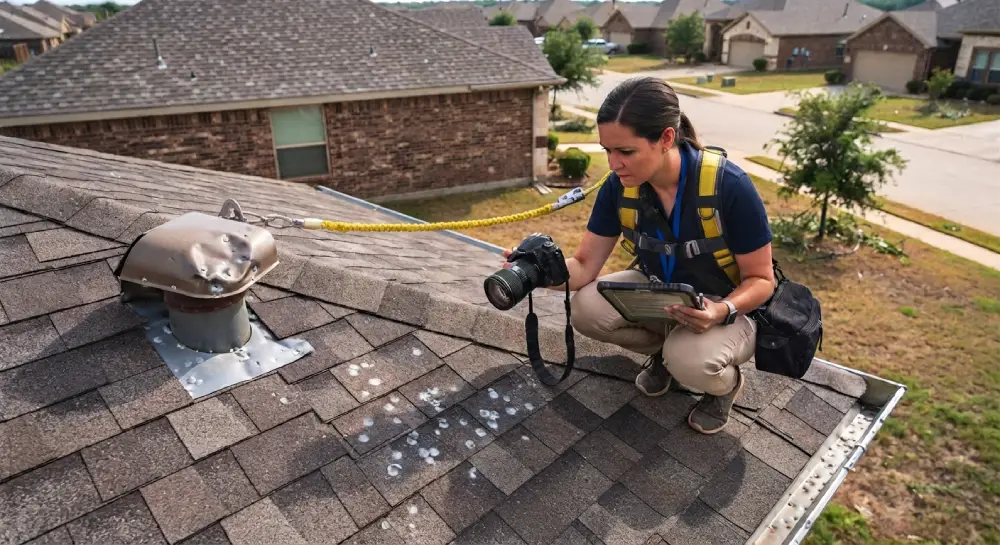
Hail damage can be subtle. Our hail damage insurance claim in Texas resource explains how roof impacts, exterior damage, documentation, and insurance scope disputes may affect a claim. Granule loss alone is not the only concern. Impacts can fracture the reinforcement layer inside a shingle, dent soft-metal roof accessories, damage coatings, loosen seals, or compromise waterproofing components.
A thorough hail claim should distinguish storm-related damage from age, wear, installation issues, or pre-existing conditions. Clear photographs, weather data, test areas, roof measurements, collateral observations, and repair analysis can all become important.
Damaging Winds and Tornado Activity
Strong winds may lift shingles, crease tabs, pull fasteners, detach gutters, damage fences, topple trees, and create openings around roof edges or wall systems. Tornadoes and rotating thunderstorms can produce more severe structural losses.
Wind claims often become disputed when the most visible evidence disappears after shingles settle back into place. Interior water intrusion may also be blamed on maintenance even when a storm-created opening allowed rain into the structure.
Red Oak’s official communications have warned residents about severe-weather systems capable of producing very large hail, damaging winds, and tornadoes. Property owners should photograph exterior conditions as soon as it is safe and preserve damaged materials when emergency repairs are required.
Heavy Rain and Flash Flooding
Heavy rain can overwhelm drainage systems, enter through storm-damaged roofing, back up around doors, or collect near foundations. Localized flooding may affect streets and low-lying properties even when a building is not located next to a major river.
Coverage for water damage depends heavily on the source of the water and the policy. Property owners can learn more about dealing with an insurance adjuster after water damage before accepting a scope that may not include concealed moisture or all affected materials. Wind-driven rain entering through a covered storm opening may be treated differently from surface water entering at ground level. A standard property policy may exclude flood unless separate flood coverage applies.
Because cause matters, documentation should establish how the water entered, what building components were affected, and whether mitigation work exposed additional damage.
Winter Freeze Damage
North Texas cold snaps can freeze plumbing in exterior walls, attics, vacant units, commercial buildings, and inadequately heated spaces. Once a pipe thaws, water may affect ceilings, insulation, cabinets, flooring, walls, electrical components, and personal property.
Freeze claims often involve emergency extraction, plumbing access, demolition, drying, reconstruction, and contents handling. A carrier estimate that includes only the broken pipe or a small drywall patch may omit much of the resulting damage.
Common Insurance Claims in Red Oak
Hail Damage Claims
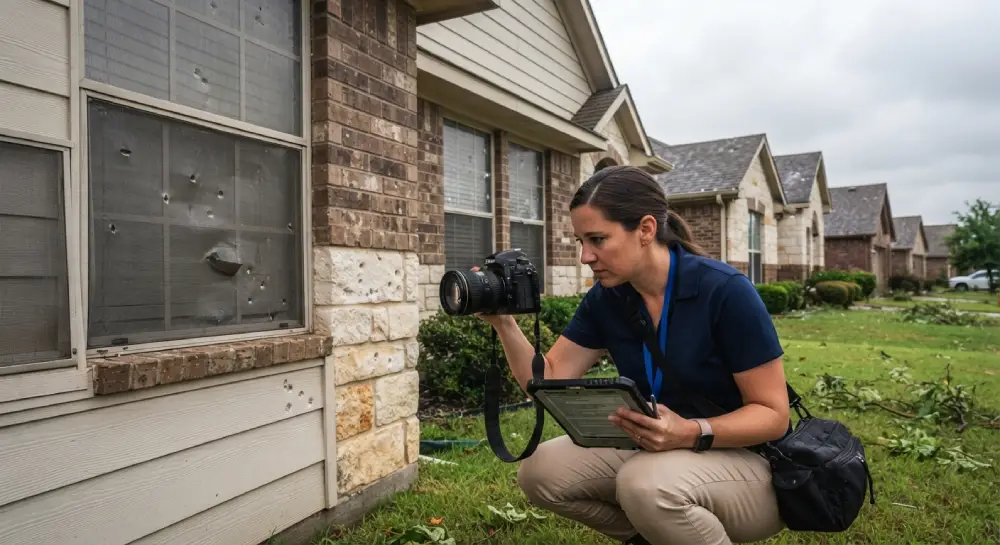
Hail claims are common across North Texas, but the quality of the claim presentation can vary considerably. A complete assessment should examine the roof and exterior elevations, not just a few shingles near the ladder.
TX Public Adjusting evaluates the damage pattern, collateral impacts, roofing system, repair feasibility, and items omitted from the insurance company’s estimate. We can also review claims in which the carrier approved a minor repair while the contractor believes the affected roofing system requires a broader scope.
Water Damage Claims
Water losses may result from:
- Burst or leaking pipes
- Failed water heaters
- Appliance supply-line failures
- Plumbing backups
- Roof leaks
- HVAC condensation
- Fire-suppression systems
- Wind-driven rain
- Overflowing fixtures
Our guide to water damage insurance claim help provides additional information about documenting moisture, mitigation work, damaged materials, and carrier estimates. Water may travel through wall cavities, subfloors, insulation, cabinetry, and adjoining rooms. Moisture readings, drying records, plumber reports, mitigation invoices, and demolition photographs can help establish the actual extent of the loss.
Fire and Smoke Damage Claims
A fire claim can affect far more than the room where flames were visible. Our fire damage insurance claim guide explains how smoke, soot, heat, water used during suppression, and damaged contents may become part of the loss. Smoke residue may travel through HVAC systems, attics, wall openings, and adjoining areas. Heat can damage wiring, finishes, windows, appliances, roof components, and structural materials.
A Red Oak fire claim may include:
- Emergency board-up
- Structural repairs
- Smoke and soot cleaning
- Odor treatment
- Contents cleaning or replacement
- Debris removal
- Electrical evaluation
- HVAC cleaning
- Temporary housing
- Code-related repairs
- Business interruption
A licensed fire insurance adjuster can help organize the building, contents, cleaning, temporary-use, and repair portions of a complex fire claim. The claim should account for the full restoration process, not merely the visibly burned materials.
Storm and Wind Damage Claims
Severe thunderstorms can produce several types of damage during the same event. Wind may disturb the roof while rain enters the interior. Hail may damage exterior surfaces. Lightning or power fluctuations may affect electrical systems and equipment.
When several causes overlap, the claim needs a clear event timeline and documentation tying the observed damage to the storm.
Roof Damage Claims
Roof claims commonly become underpaid because essential components are missing from the scope. A public adjuster for a roof claim can compare the carrier’s scope with the roofing system, observed storm damage, repair requirements, and contractor findings. Depending on the roof and damage, those items may include:
- Underlayment
- Flashing
- Drip edge
- Valley materials
- Pipe jacks
- Roof vents
- Ridge components
- Detach-and-reset labor
- Starter materials
- Waste
- Steep or high charges
- Access requirements
- Code-required work
- Interior repairs caused by roof leakage
Repairability also matters. A proposed spot repair may not be practical when materials are brittle, discontinued, mechanically interlocked, or impossible to match without disturbing surrounding components.
Commercial Property Claims
Red Oak’s continued growth has brought new businesses, neighborhoods, and community facilities. Commercial losses may affect retail centers, offices, industrial facilities, restaurants, churches, multifamily properties, schools, warehouses, and service businesses along the I-35E corridor and surrounding roads.
Commercial claims may involve:
- Flat or low-slope roof damage
- Mechanical equipment
- Inventory and stock
- Tenant improvements
- Signage
- Exterior building systems
- Water mitigation
- Loss of income
- Extra expenses
- Temporary operations
- Multiple tenant spaces
- Specialized equipment
Because a commercial loss can disrupt revenue as well as damage the building, early organization is critical.
Why Red Oak Insurance Claims Become Underpaid
An insurance company estimate may be lower than the actual repair cost for several reasons. A low estimate does not automatically prove improper handling, but it should be reviewed carefully before the claim is closed. Property owners can also review these common property insurance claim mistakes before submitting documents, authorizing repairs, or closing the claim.
Missed Damage
The initial inspection may be brief, limited by weather, or completed before contractors open damaged assemblies. Roof damage, moisture behind finishes, affected insulation, damaged decking, hidden smoke residue, or compromised building components may not appear in the first estimate.
Scope Omissions
The carrier may acknowledge the loss but omit necessary work. Common omissions include setup labor, protection, access, permits, matching concerns, debris handling, equipment manipulation, overhead-related work, and repairs to adjacent materials disturbed during reconstruction.
Depreciation Issues
Replacement-cost policies frequently involve depreciation. Some depreciation may be recoverable after repairs, while other amounts may be treated differently under the policy.
Problems arise when depreciation is excessive, applied to questionable items, or not clearly explained. Policyholders should understand what was withheld, what documentation is required, and the deadline for requesting recoverable depreciation.
Low Pricing or Incomplete Estimates
A carrier estimate may use quantities, labor assumptions, or unit pricing that do not align with the actual project. Red Oak contractors may identify material costs, access needs, labor requirements, or construction details that were not reflected during the first inspection.
A contractor’s total alone may not resolve the disagreement. The difference should be supported with measurements, photographs, line-item analysis, invoices, and an explanation of why the work is necessary.
Documentation Problems
Claims can lose momentum when records are incomplete. Missing photographs, discarded materials, unclear mitigation invoices, undocumented contents, and inconsistent descriptions can make it harder to prove the loss.
A public adjuster helps organize the claim so the evidence is presented coherently rather than in scattered emails, estimates, and phone calls.
Our Public Adjusting Process
1. Claim Review
We begin by discussing what happened, the current status of the claim, and the concerns you have with the insurer’s response.
When available, we review:
- The insurance policy
- Carrier estimates
- Payment letters
- Coverage correspondence
- Contractor proposals
- Photographs
- Engineering reports
- Mitigation documents
- Proof-of-loss materials
- Claim-related emails
This review helps us determine whether our services may benefit the Red Oak property owner.
2. Property Inspection
We inspect the affected property and document the condition of the building. The inspection may include roof surfaces, exterior elevations, interior rooms, detached structures, commercial systems, contents, and areas affected by water or smoke.
The scope of the inspection depends on the type and size of the loss.
3. Damage Documentation
We organize the evidence needed to support the claim. This can include photographs, measurements, repair estimates, inventories, invoices, expert findings, contractor observations, and a detailed explanation of the loss.
Good documentation gives the insurance carrier a clear basis for evaluating the requested amount.
4. Claim Preparation and Communication
TX Public Adjusting prepares the claim presentation and communicates with the insurance company’s representatives. We address questions, explain disputed items, coordinate requested inspections, and respond to estimate differences.
You remain informed while we handle the day-to-day claim work.
5. Negotiation and Settlement
We negotiate for a settlement supported by the policy, documented damage, and reasonable repair requirements. No public adjuster can guarantee a particular outcome, but experienced representation can help ensure the carrier receives a thorough and organized claim.
Mid-Claim Help Is Available
You do not always need to hire a public adjuster before the insurance company inspects the property.
TX Public Adjusting may be able to assist when:
- The carrier has already issued an estimate
- You received a partial payment
- Your contractor found additional damage
- The claim has been delayed
- Important line items were omitted
- The insurer approved a repair you believe is impractical
- Your commercial claim is affecting operations
- You do not understand the settlement documents
The best time to seek help depends on the condition of the claim, but our guide explains when it is too late to hire a public adjuster and why policyholders should act before deadlines or settlement decisions limit their options. The timing of available options can depend on the policy, claim history, deadlines, and prior settlement activity. Request a free review as soon as concerns arise.
Why Choose TX Public Adjusting
Texas-Focused Claim Experience
Texas property claims have their own patterns. Hail, wind, freeze events, hurricanes, plumbing losses, fire damage, and commercial interruptions can create complex questions about causation, repair scope, and documentation.
TX Public Adjusting focuses on Texas policyholders and has experience reviewing thousands of residential and commercial claims.
Licensed Representation
TX Public Adjusting operates through Rise Public Adjusting LLC, Texas License #3356839.
Licensing matters. Property owners should confirm that the person offering public adjusting services is legally authorized to represent policyholders in Texas.
Independent Policyholder Advocacy
A public adjuster works for the policyholder—not the insurance company. Property owners who want a fuller explanation can read our guide to what a public adjuster does.
Our responsibility is to document and present your claim based on the policy and the evidence. We do not choose contractors for the carrier or determine what is financially convenient for the insurer.
Residential and Commercial Knowledge
A residential roof claim requires a different approach from a commercial fire, multifamily water loss, or warehouse hail claim. Our experience includes both residential and commercial properties, allowing us to adapt the claim process to the building and business involved.
Detailed Claim Preparation
Strong claims are built with detail. We focus on measurements, photographs, policy review, repair requirements, contents documentation, estimate comparisons, and organized communication.
Areas We Serve Near Red Oak
TX Public Adjusting assists property owners throughout Red Oak and nearby areas of Ellis and southern Dallas counties.
Our service area includes:
- Oak Leaf
- Glenn Heights
- Ovilla
- Pecan Hill
- Ferris
- Lancaster
- DeSoto
- Waxahachie
- Midlothian
- Palmer
- Wilmer
- Cedar Hill
Within Red Oak, we assist properties near the I-35E corridor, Ovilla Road, Red Oak Road, Hampton Road, the municipal center, Red Oak High School, Watkins Park, Pearson Park, and growing residential areas throughout ZIP code 75154. The city’s official website highlights local places such as Watkins Park, Pearson Park, the Red Oak Baseball Complex, and the Municipal Lake and Windmill.
Frequently Asked Questions
What does a public adjuster in Red Oak do?
A public adjuster represents the property owner during an insurance claim. The adjuster reviews the policy, inspects the loss, documents covered damage, prepares estimates and inventories, communicates with the carrier, and negotiates the claim.
The insurance company’s adjuster represents the carrier. A Red Oak public adjuster works for you as the policyholder. Our comparison of a public adjuster vs. independent adjuster explains who each professional represents during the claim process.
When should I hire a public adjuster after property damage?
You may hire a public adjuster soon after the loss or later if problems develop. Early involvement can help preserve evidence and organize the claim before repairs begin.
You may also seek assistance after receiving a low estimate, partial payment, denial, repair-only determination, or request for additional documentation. Waiting too long can reduce available options, so it is best to request a review promptly.
Can a public adjuster help with a Red Oak hail claim?
Yes. A public adjuster can inspect the roof and exterior, document hail impacts, compare the carrier’s estimate with the observed damage, and prepare a claim for omitted or disputed items.
This can be valuable when the insurer acknowledges some damage but does not include all affected slopes, roof accessories, exterior components, interior leakage, or necessary construction work.
What if the insurance company already inspected my property?
You may still be able to hire a public adjuster. Many policyholders contact TX Public Adjusting after the first inspection because the carrier’s estimate appears incomplete or the payment is lower than expected.
We can review the inspection results, estimate, payment documents, and remaining damage to determine whether further claim work may be justified.
Can you help if my roof claim was denied?
A denied claim can be reviewed, although no reversal is guaranteed. We examine the denial letter, policy language, reported date of loss, inspection findings, photographs, maintenance history, and contractor documentation.
The review helps determine whether additional evidence, clarification, or another policy-based claim step may be appropriate.
Does homeowners insurance cover flooding in Red Oak?
Standard homeowners policies commonly distinguish between water entering from above or from a damaged plumbing system and surface water entering from outside at ground level. Flood caused by rising or accumulating surface water is generally handled through separate flood insurance, subject to the actual policy.
Because water sources can overlap during severe weather, Red Oak property owners should document where and how the water entered before cleanup removes the evidence.
How much does a public adjuster cost in Texas?
Public adjusters commonly work for a percentage of the insurance recovery, subject to the written agreement and Texas requirements. Our article about public adjuster fees in Texas explains common fee structures and questions property owners should ask before signing an agreement. The fee structure should be clearly explained before you sign a contract.
TX Public Adjusting offers a free initial claim review and does not charge an upfront fee for that review.
Can a public adjuster help with commercial property damage?
Yes. TX Public Adjusting handles residential and commercial property claims. Commercial losses may include building damage, inventory, equipment, tenant improvements, extra expenses, and business-income concerns.
Commercial property owners should begin documenting operations and financial impacts early, especially when the building cannot be used normally after the loss.
How long does a Red Oak property claim take?
The timeline depends on the type of damage, complexity of the claim, carrier response, documentation, inspections, expert involvement, and whether coverage or repair scope is disputed.
A smaller water claim may progress differently from a large commercial fire or widespread hail event. We keep the policyholder informed as the claim moves through inspection, documentation, carrier review, and negotiation.
Why should I choose a licensed Texas public adjuster?
A licensed Texas public adjuster is regulated and authorized to represent policyholders in property insurance claims. Licensing gives property owners a verifiable credential and helps distinguish legitimate public adjusting services from unlicensed claim solicitation.
TX Public Adjusting operates through Rise Public Adjusting LLC under Texas License #3356839.
Get a Free Red Oak Insurance Claim Review
Property damage is stressful enough without wondering whether the insurance estimate includes everything required to restore your home or business.
TX Public Adjusting helps Red Oak property owners document their losses, evaluate insurer estimates, identify missed damage, and present organized property claims. We represent policyholders—not insurance companies.
Contact TX Public Adjusting for a free claim review.
- No upfront fee for the initial review
- Licensed Texas public adjuster
- Residential and commercial claim assistance
- Hail, wind, water, fire, roof, and storm claims
- Representation by Rise Public Adjusting LLC
- Texas License #3356839
Contact TX Public Adjusting today to discuss your Red Oak property damage claim.