

Property damage in San Elizario can create a difficult insurance claim long after the storm, leak, or fire is over. A damaged roof may allow water into ceilings and walls. Wind can loosen exterior materials without leaving obvious signs from the ground. A sudden downpour can overwhelm local drainage and send water toward homes, storefronts, and agricultural properties. When the insurer’s estimate does not reflect the full scope of the loss, a licensed public adjuster in San Elizario can help document the damage and present the policyholder’s claim.
TX Public Adjusting represents residential and commercial property owners—not insurance companies. Our team reviews policies, inspects damaged property, prepares supporting documentation, identifies missing claim items, and communicates with the carrier throughout the adjustment process.
TX Public Adjusting operates through Rise Public Adjusting LLC, Texas License #3356839. We have experience reviewing thousands of property claims involving roofs, interiors, commercial buildings, water intrusion, fire losses, wind damage, and other covered events.
Concerned that your San Elizario insurance claim was delayed, denied, or underpaid? Request a free claim review. There are no upfront fees.
Insurance Claim Help for San Elizario Property Owners
San Elizario is a historic community in El Paso County along the Mission Trail and the Rio Grande valley. Its properties range from established adobe-style residences and older masonry buildings near the Historic District to newer homes, agricultural structures, small businesses, churches, rental properties, and commercial spaces along the Socorro Road corridor.
That variety matters during an insurance claim.
An older structure near the San Elizario Historic District may require a different inspection approach than a newer home closer to the city’s outer residential areas. Traditional stucco, plaster, masonry, flat roofing, wood components, and older electrical systems can make estimating repairs more complicated. Damage to a commercial building, church, gallery, restaurant, or agricultural property may also involve business equipment, inventory, code-related work, temporary protection, and loss-of-income concerns.
San Elizario’s location creates its own weather-related challenges. Sudden desert thunderstorms can produce strong wind, blowing debris, lightning, hail, and concentrated rainfall. Local and regional planning documents have also identified recurring flooding concerns around portions of Socorro Road, including intersections near San Antonio Street and Main Street.
A claim may appear straightforward at first. The roof is damaged, a room is wet, or exterior materials were struck by wind. The difficulty often begins when the initial estimate addresses only the most visible repair and leaves out related work needed to restore the property properly.
Why Property Owners Hire a Public Adjuster in San Elizario
The insurance company assigns an adjuster to investigate the loss for the carrier. A public adjuster performs a different role: representing the policyholder’s financial interest in the property claim.
The insurance company assigns an adjuster to investigate the loss for the carrier. A public adjuster performs a different role: representing the policyholder’s financial interest in the property claim. Property owners who are comparing the two roles can review our guide to public adjuster vs. independent adjuster.
For a broader explanation of claim representation, documentation, and negotiation, read more about what a public adjuster does.
That distinction is especially important when:
- The insurer’s estimate appears too low
- The claim contains several types of damage
- The carrier has omitted rooms, materials, or repair operations
- The cause of damage is disputed
- The claim has been delayed
- The policyholder does not understand the insurer’s scope
- Depreciation has been applied incorrectly
- Emergency repairs were completed before a thorough inspection
- A commercial loss involves inventory or business interruption
- A reopened or supplemental claim requires additional evidence
A public insurance adjuster in San Elizario can review the policy, inspect the property, organize photographs and records, prepare a detailed repair scope, and communicate with the insurer about covered damage.
The goal is not to exaggerate a loss. It is to present a complete, supportable claim based on the policy and the actual condition of the property.
San Elizario Storm Risks and Property Damage
San Elizario does not face the same coastal hurricane exposure as Houston or Corpus Christi. Its claim risks are shaped by the Chihuahuan Desert, seasonal thunderstorms, extreme temperatures, localized drainage limitations, and the construction characteristics of properties in the Lower Valley.
Sudden Heavy Rain and Localized Flooding
Rainfall totals in West Texas are generally lower than in eastern parts of the state, but desert storms can release large amounts of water over a short period. Hard, dry ground may absorb water slowly, allowing runoff to collect around roads, low-lying lots, entrances, foundations, and drainage channels.
San Elizario has experienced serious flooding in the past. During a major 2013 event, streets were inundated and numerous local roads were closed.
Property damage after intense rainfall may include:
- Water entering beneath exterior doors
- Saturated drywall and insulation
- Damaged flooring and baseboards
- Moisture behind cabinets
- Roof leaks exposed during wind-driven rain
- Electrical damage
- Foundation or soil movement concerns
- Contamination from surface water
- Damage to detached structures and stored property
Homeowners should understand that standard property policies often distinguish between water entering through storm-created openings and surface flooding. Coverage depends on the policy language, the cause of loss, and any applicable flood policy. A careful investigation is needed before assuming a water loss is covered or excluded.
Wind and Blowing Debris
Strong thunderstorm outflows can lift roof materials, damage flashing, bend metal components, break fencing, loosen stucco, and drive debris into exterior walls and windows. A roof does not need to be torn off to sustain claim-worthy damage.
Wind claims in San Elizario often require close inspection of:
- Shingles, tiles, membranes, or metal roofing
- Parapet walls and roof edges
- Flashing and roof penetrations
- HVAC components
- Fences and gates
- Windows and exterior doors
- Stucco and exterior finishes
- Carports, awnings, and detached structures
- Solar equipment and rooftop fixtures
Damage may be scattered across several elevations. If the inspection focuses only on one obvious area, the insurer’s scope can miss related repairs.
Hail Damage
Hail can occur when strong thunderstorms move through the El Paso County region. Storm reports near San Elizario have included severe thunderstorm hazards involving strong wind and hail.
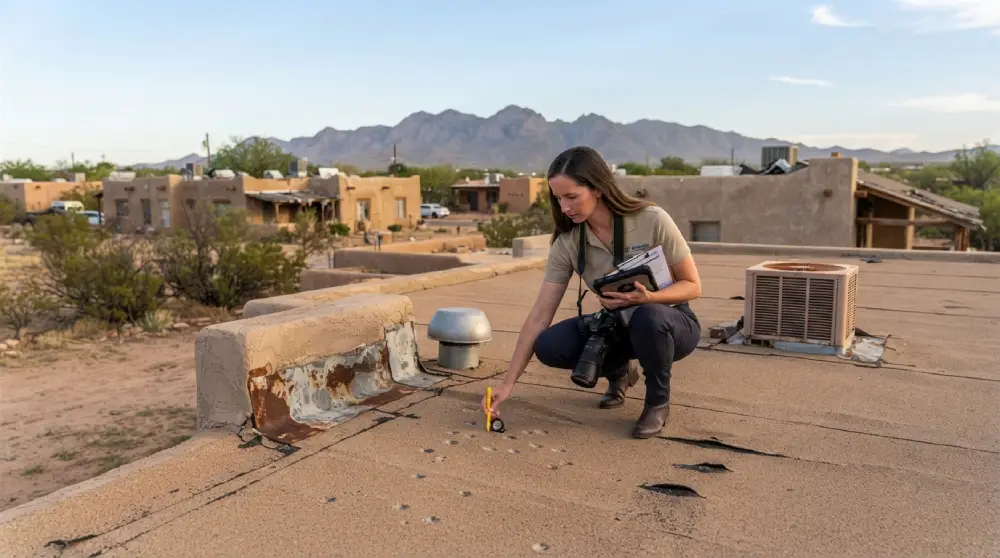
Hail damage may affect asphalt shingles, metal panels, tile roofing, vents, gutters, exterior lighting, air-conditioning equipment, windows, screens, and painted surfaces. On flat or low-slope commercial roofs, impact damage may be subtle but still affect the membrane or underlying insulation.
A proper hail inspection should document the size, shape, distribution, and functional effect of the impacts. Cosmetic marks alone may be treated differently under some policies, especially when endorsements limit coverage for metal surfaces. The policy must be reviewed before the claim is valued.
Extreme Heat and Thermal Stress
Long periods of intense heat can accelerate deterioration in roofing materials, sealants, coatings, and exterior finishes. Heat alone may not constitute a covered loss, but it can complicate the investigation after a storm.
For example, an insurer may characterize roof damage as age-related wear when the policyholder believes wind or hail caused the failure. Separating long-term deterioration from sudden storm damage requires clear photographs, weather information, material analysis, and a careful inspection.
Winter Freezes and Pipe Damage
San Elizario can also experience freezing temperatures. When pipes freeze or plumbing connections fail, water can spread through walls, ceilings, cabinets, and flooring before the source is controlled.
Freeze-related claims may involve more than replacing a broken pipe. The full scope could include water extraction, drying, demolition, insulation, drywall, paint, cabinetry, flooring, contents handling, and plumbing access.
Common Insurance Claims in San Elizario
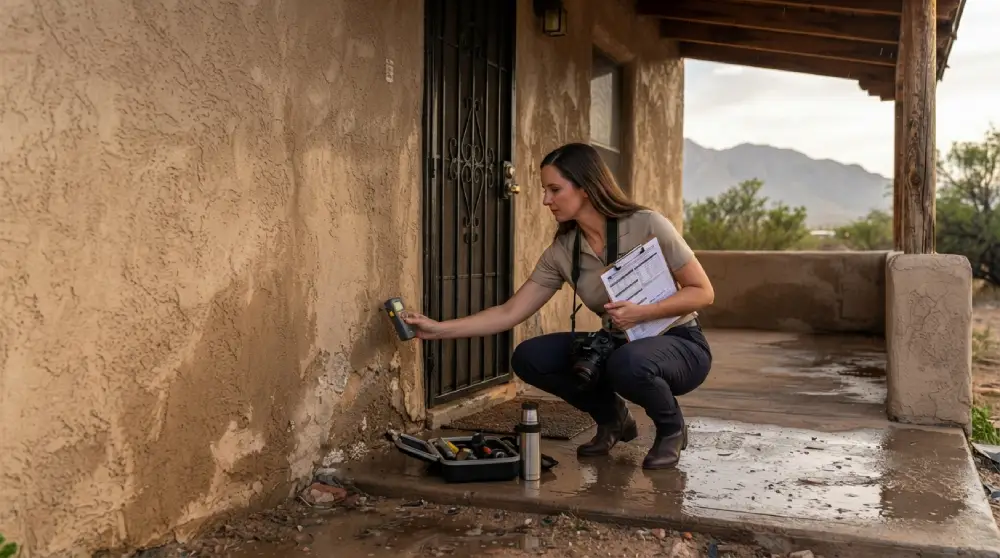
Hail Damage Claims
Hail claims are frequently under-scoped when the initial inspection documents only the roof covering. Related components such as vents, flashing, gutters, soft metals, HVAC fins, fencing, coatings, and interior water damage may also require evaluation.
TX Public Adjusting reviews the carrier’s estimate against the physical evidence and the repair work reasonably associated with the covered damage. Hail losses can involve much more than visible shingle marks. For additional guidance on inspections, documentation, and carrier estimates, review our guide to a hail damage insurance claim in Texas.
Water Damage Claims
Water can travel far beyond the area where staining first appears. A roof leak may begin above one room but move along framing or insulation before becoming visible elsewhere.
A water damage claim may require moisture mapping, photographs, contractor records, drying documentation, material testing, and a room-by-room repair scope. We also review whether the insurer included necessary tear-out, access, matching, painting, and related finish work. Water claims can become disputed when the insurer limits the repair area or overlooks hidden moisture. Property owners can learn more about dealing with an insurance adjuster after water damage.
Fire and Smoke Damage Claims
A residential or commercial fire can affect structural materials, contents, electrical systems, HVAC equipment, finishes, and indoor air quality. Smoke and soot may spread into rooms that were not touched by flames.
Fire claims in San Elizario can be especially complicated in older homes or buildings where plaster, adobe, masonry, custom woodwork, or nonstandard construction methods are present. Restoring these properties may require specialized labor and careful documentation. A residential or commercial fire can affect structural materials, contents, electrical systems, HVAC equipment, finishes, and indoor air quality. Our guide to a fire damage insurance claim explains several coverage and documentation issues that may arise after a loss.
Storm and Wind Damage Claims
Wind-driven rain and debris can create damage across the roof, exterior walls, windows, fencing, and interior. Because San Elizario properties may include flat roofs, pitched roofs, stucco systems, metal components, or additions built at different times, a complete storm inspection should address every affected construction type.
Property owners dealing with widespread wind and rain damage may also find our guide to property damage after a hurricane useful for understanding roof openings, interior water intrusion, debris impacts, and documentation needs. Although San Elizario is not exposed to direct coastal hurricane landfalls, many of the same wind-and-water claim principles apply after severe storms.
Roof Damage Claims
Roof claims are often disputed over cause, repairability, age, matching, and the extent of replacement required.
Common issues include:
- The estimate includes spot repairs that may not be practical
- Underlayment and flashing are omitted
- Interior leak damage is excluded from the scope
- Access or tear-off labor is undervalued
- Roofing accessories are not counted
- Code-related items are not evaluated
- Different roof sections are treated inconsistently
Our role is to document the roof system and present the claim based on the observed damage and applicable policy provisions. Roof claims frequently involve disputes over storm causation, repairability, matching, and overlooked accessories. Learn more about hiring a public adjuster for a roof claim when the carrier’s estimate does not appear to cover the full repair scope.
Commercial Property Claims
San Elizario businesses may face losses involving the building, tenant improvements, equipment, stock, furnishings, signs, refrigeration, electrical systems, and business operations.
A commercial claim near Socorro Road, the Mission Trail, or the Historic District may require coordination among owners, tenants, contractors, accountants, restoration companies, and the insurer. We help organize that information into a claim presentation the carrier can evaluate.
Commercial claim assistance may include:
- Building damage estimates
- Equipment and inventory documentation
- Emergency service records
- Tenant improvement review
- Business-income documentation
- Extra-expense evaluation
- Code and permitting considerations
- Claim correspondence and negotiation
Insurance Concerns for Historic and Older San Elizario Properties
The San Elizario Historic District preserves more than three centuries of regional history and includes nationally recognized cultural resources along El Camino Real de Tierra Adentro. The Presidio Chapel of San Elizario, nearby museums, galleries, and historic structures make the area distinct from a typical suburban community.
Historic character can also create insurance estimating challenges.
Older buildings may contain materials or construction methods that are difficult to replace with standard modern items. Repairing damaged plaster, masonry, woodwork, tile, roofing, or exterior finishes may require skilled labor. A basic estimating database may not capture the full cost of specialty work.
Claims involving historic or older properties should consider:
- Material availability
- Custom fabrication
- Skilled-trade labor
- Protection of undamaged finishes
- Matching adjacent materials
- Code-triggered upgrades
- Engineering or architectural services
- Permitting requirements
- Contents protection during repairs
The policy may limit or extend coverage for certain code-related or replacement-cost expenses. Those provisions should be reviewed before the repair scope is finalized.
Why San Elizario Insurance Claims Become Underpaid
An insurance estimate is not automatically a complete measure of the loss. It is one adjuster’s assessment based on the inspection, information available at the time, and the carrier’s interpretation of coverage.
Damage Was Missed
Some damage is hidden behind walls, beneath roofing materials, inside insulation, or in areas that were not inspected. Other damage becomes visible only after demolition begins.
The Scope Leaves Out Necessary Work
An estimate may include a damaged material but omit the labor and related operations required to remove and reinstall surrounding components. It may also leave out protection, debris handling, access, masking, sealing, texture, painting, or finish transitions.
Depreciation Was Applied Incorrectly
Depreciation may be recoverable or nonrecoverable depending on the policy and damaged item. Questions can arise over age, condition, useful life, and whether the insurer depreciated labor.
Pricing Is Too Low
Labor and material costs vary. Specialty work, remote sourcing, small-job minimums, and local contractor availability can make a repair more expensive than a generic estimate suggests.
Documentation Is Incomplete
A valid claim can lose momentum when photographs, receipts, inventories, contractor reports, moisture readings, or repair estimates are missing. Insurers need support for requested additions, especially when a supplement is submitted after the original adjustment. Documentation gaps, incomplete inspections, and misunderstood policy requirements are among the most common reasons claims lose value. Reviewing these common property insurance claim mistakes can help San Elizario property owners avoid problems that may delay or weaken a claim.
Cause of Loss Is Disputed
The carrier may attribute damage to wear, maintenance, deterioration, improper installation, or a pre-existing condition. The property owner may believe the damage resulted from wind, hail, fire, water, or another covered event.
A public adjuster can help assemble the evidence and explain how the observed damage relates to the reported loss. Coverage decisions remain governed by the policy and insurer, but a properly developed claim gives the policyholder a stronger factual presentation.
Our Public Adjusting Process
1. Free Claim Review
We begin by discussing what happened, when the damage occurred, what the carrier has done, and what concerns you have about the claim.
We may review the policy, insurer estimate, payment letters, photographs, contractor documents, repair proposals, and claim correspondence.
After a claim is reported, response times and required notices may depend on Texas law, policy conditions, and the circumstances of the loss. Our guide explains how long an insurance adjuster has to contact you and what property owners can do when communication stalls.
2. Property Inspection
We inspect the accessible areas of the property and document visible damage. Depending on the loss, this may include the roof, exterior elevations, interior rooms, detached structures, mechanical systems, commercial areas, and affected contents.
3. Claim Documentation
Our team organizes photographs, measurements, repair requirements, inventories, invoices, reports, and other relevant records. We prepare a claim scope that addresses the covered damage we identify.
4. Estimate and Scope Review
We compare the insurer’s estimate with the observed conditions. Missing quantities, rooms, materials, trades, or repair operations are identified and supported.
5. Carrier Communication and Negotiation
TX Public Adjusting communicates with the insurance company regarding the documented claim. We respond to requests, submit supporting information, attend inspections when appropriate, and advocate for a fair evaluation under the policy.
6. Settlement and Claim Resolution
When the insurer completes its review, we help the policyholder understand the revised estimate, payment breakdown, depreciation, deductible, and any remaining claim requirements.
Mid-Claim Help Is Available
You do not always need to hire a public adjuster on the first day of a loss.
TX Public Adjusting may be able to assist after:
- The first carrier inspection
- An initial payment
- A low estimate
- A partial denial
- A contractor discovers additional damage
- The claim stops progressing
- A supplement is rejected
- The insurer requests more documentation
Deadlines and policy conditions can affect your options. Property owners should seek help promptly rather than allowing unresolved damage or claim disputes to remain inactive.
Request a free San Elizario claim review. We will examine the available information and explain whether public adjusting assistance may be appropriate.
Why Choose TX Public Adjusting
Licensed in Texas
TX Public Adjusting operates through Rise Public Adjusting LLC, Texas License #3356839.
We Represent Policyholders
Insurance company adjusters work on behalf of the carrier. Our public adjusters represent residential and commercial policyholders during covered property claims.
Texas Property Claim Experience
Our work focuses on Texas losses, including hail, wind, water, fire, roof, freeze, storm, and commercial property claims.
Residential and Commercial Knowledge
We understand that a home claim and a commercial claim require different documentation. Commercial losses may involve tenants, inventory, equipment, business-income records, and operational expenses in addition to physical repairs.
Thorough Claim Reviews
Our team has reviewed thousands of claims. We look beyond the total shown at the bottom of the carrier’s estimate and examine quantities, materials, pricing, depreciation, repair operations, and supporting documentation.
No Upfront Fees
There is no upfront fee for the initial claim review. Public adjusting fees and terms are explained before representation begins and documented in the agreement.
Areas We Serve Near San Elizario
TX Public Adjusting assists policyholders throughout San Elizario and surrounding El Paso County communities.
Our service area includes properties near:
- San Elizario Historic District
- Presidio Chapel of San Elizario
- Main Street and the Historic Art District
- Socorro Road
- San Antonio Street
- The Mission Trail
- Lower Valley agricultural areas
- Nearby residential subdivisions and colonias
We also serve nearby communities such as Socorro, Clint, Fabens, Horizon City, Sparks, Agua Dulce, Tornillo, Morning Glory, and the greater El Paso area. We also assist policyholders throughout the greater El Paso area. Property owners with damage elsewhere in the county can visit our El Paso public adjuster service page for additional regional claim information.
Frequently Asked Questions
What does a public adjuster in San Elizario do?
A public adjuster represents the property owner during an insurance claim. The adjuster reviews the policy and existing claim documents, inspects damage, prepares supporting evidence, identifies omissions, and communicates with the insurer.
TX Public Adjusting works for the policyholder rather than the insurance company. Our role is to help present an accurate, well-supported claim based on the loss and the applicable policy.
When should I hire a public adjuster after San Elizario property damage?
A public adjuster may be helpful when the damage is extensive, the claim involves several rooms or building systems, the insurer’s estimate appears too low, or the carrier disputes the cause or extent of loss.
You may also seek help after receiving payment. A claim review can determine whether visible damage, repair operations, or documentation may have been overlooked.
Can you help if my San Elizario claim was already paid?
Potentially. An initial payment does not necessarily mean every claim issue has been resolved. Many policies and claim procedures allow additional documented damage to be considered, subject to deadlines and policy terms.
We review the insurer’s estimate, payment letters, deductible, depreciation, photographs, and repair information to determine whether a supplemental claim may be appropriate.
Can a public adjuster help with damage to an older or historic property?
Yes. Older and historic properties often involve nonstandard materials, specialty craftsmanship, matching concerns, and repair methods that may not be reflected accurately in a basic estimate.
The policy still controls what is covered, but detailed documentation can help explain why the repair scope or cost differs from that of a newer building.
Does homeowners insurance cover flooding in San Elizario?
Standard homeowners policies commonly exclude surface flooding, while a separate flood policy may provide coverage. However, water entering through a storm-created opening or resulting from a covered plumbing failure may be evaluated differently.
Because the cause and path of water matter, property owners should avoid assuming that all rain-related damage is excluded. Review the policy and document the conditions before removing damaged materials whenever it is safe to do so.
What if the insurance company says my roof damage is wear and tear?
Carriers may deny roof claims when they conclude the condition results from age, deterioration, maintenance, or installation problems rather than a covered storm.
A public adjuster can inspect the roof, review storm information, document impact or wind patterns, and present evidence supporting the policyholder’s position. This does not guarantee coverage, but it can provide a more complete basis for reconsideration.
Can you handle commercial insurance claims in San Elizario?
Yes. TX Public Adjusting assists owners of commercial buildings, retail spaces, restaurants, offices, churches, rental properties, agricultural structures, and other insured facilities.
Commercial claims may include building repairs, equipment, inventory, tenant improvements, extra expenses, and business-income concerns. Each category requires separate records and supporting calculations.
How much does a public adjuster cost in Texas?
Public adjusters typically work under a written fee agreement based on the claim recovery or another permitted arrangement. The exact fee depends on the circumstances and applicable Texas requirements.
TX Public Adjusting explains the fee before representation begins. The initial claim review is free, and there are no upfront fees for that review.
How long does a San Elizario property claim take?
The timeline varies according to the severity of the loss, the insurer’s investigation, access to the property, documentation needs, contractor involvement, and whether coverage or scope is disputed.
A small claim may move more quickly than a commercial fire, major water loss, or contested roof claim. Our team works to keep the documentation organized and respond promptly as the carrier evaluates the loss.
What should I bring to a free claim review?
Provide the insurance policy if available, the carrier’s estimate, payment letters, denial or reservation-of-rights correspondence, photographs, videos, contractor proposals, receipts, emergency service invoices, and a timeline of events.
Do not worry if the file is incomplete. We can begin by reviewing the materials you have and identifying what additional records may be useful.
Get a Free San Elizario Insurance Claim Review
A low estimate can leave a property owner paying for necessary repairs out of pocket. Missing roof components, incomplete water mitigation, overlooked interior damage, excessive depreciation, and unsupported pricing can all affect the amount offered by the insurer.
TX Public Adjusting helps San Elizario homeowners and business owners understand what the insurance company included, what may be missing, and what documentation may support a supplemental or disputed claim.
Rise Public Adjusting LLC is a licensed Texas public adjusting firm, License #3356839. We represent policyholders—not insurance companies—and assist with residential and commercial property claims throughout El Paso County and Texas.
Contact TX Public Adjusting today for a free claim review. There are no upfront fees.