

Property damage in Lakeway can become expensive quickly. A spring hailstorm can bruise shingles and dent metal roofing, wind can lift roof edges on exposed Hill Country lots, and heavy rain can push water through damaged flashing, windows, or low-lying drainage areas. When the insurer’s estimate does not reflect the full loss, a public adjuster in Lakeway can help document the damage and present the claim from the policyholder’s side.
As a licensed Texas public adjuster, TX Public Adjusting represents homeowners, business owners, property managers, and commercial policyholders—not insurance companies. Our firm, Rise Public Adjusting LLC, is licensed in Texas under License #3356839. We review new, delayed, denied, and underpaid property claims involving roofs, interiors, contents, exterior finishes, commercial buildings, and other covered property.
Lakeway sits in western Travis County along the south shore of Lake Travis, roughly 25 miles west of Downtown Austin. The city’s mix of waterfront properties, hillside homes, golf-course communities, marinas, greenbelts, and newer luxury developments creates property-loss issues that require careful inspection and detailed documentation.
Request a free claim review from TX Public Adjusting. There are no upfront fees for the initial review.
Why Property Owners Hire a Public Adjuster in Lakeway
An insurance company assigns an adjuster to investigate a claim on the carrier’s behalf. A licensed public adjuster performs a different role. We work for the policyholder and prepare the claim with the property owner’s interests in mind.
Lakeway claims can involve much more than one visibly damaged roof surface. A storm may affect:
- Asphalt shingles, standing-seam metal, tile, or specialty roofing
- Gutters, downspouts, flashing, vents, and other soft metals
- Stucco, stone veneer, siding, paint, windows, and screens
- Boat docks, detached structures, fences, and outdoor living areas
- Interior drywall, insulation, flooring, cabinetry, and trim
- Mechanical equipment and commercial rooftop systems
- Personal property, furnishings, and business contents
Homes around Rough Hollow, Serene Hills, Flintrock Falls, The Hills, Old Lakeway, Cardinal Hills, and the Lake Travis shoreline vary widely in design and construction. A lakefront residence with multiple roof elevations, balconies, exterior stone, and custom windows requires a different claim approach than a single-story home farther inland. Commercial properties near Ranch Road 620 may also involve tenant improvements, equipment, inventory, signage, and business-interruption questions.
A Lakeway public insurance adjuster helps organize these moving parts into a documented claim rather than relying on a brief carrier inspection or a narrow estimate.
Property Risks Unique to Lakeway and the Lake Travis Area
Lakeway’s location in the Texas Hill Country gives residents scenic views and easy access to Lake Travis, but the terrain and climate also produce distinct property risks.
Hail and Severe Thunderstorms
Central Texas thunderstorms can bring hail, straight-line wind, lightning, and intense rainfall. Hail damage is not always obvious from the ground. Shingles may retain their general shape while losing granules or developing impact fractures. Metal roofing, gutters, vents, window screens, and exterior fixtures may show clearer evidence. Property owners who discover storm impacts can review our guide to handling a hail damage roof insurance claim in Texas, including common damage indicators and claim documentation issues.
After a hailstorm, the insurance carrier may approve isolated repairs while overlooking related damage across multiple roof slopes or exterior components. That can create disputes over repairability, matching, access, labor, and whether a limited repair will restore the property properly.
Wind Damage on Exposed Hill Country Properties
Homes on ridges, hillsides, golf-course lots, and open areas can experience strong wind pressure. Wind may loosen shingles, damage flashing, lift roof edges, affect patio covers, or drive rain behind exterior systems. The damage may appear minor until the next storm allows water into the structure.
Lakeway’s rolling topography and elevated residential areas make it especially important to inspect roof perimeters, transitions, ridges, penetrations, and walls facing the prevailing storm.
Flash Flooding and Water Intrusion
Travis County’s hazard planning identifies flooding and wildfire among the county’s natural hazards. In Lakeway, steep grades, creeks, drainage channels, rocky soil, and rapid runoff can contribute to localized flooding and water movement during heavy rain.
Not every form of rising water is covered by a standard property policy. However, a storm can also cause covered damage through wind-created openings, roof failure, plumbing problems, or sudden interior water intrusion. Determining the source and sequence of the water is critical because coverage may depend on how the damage occurred.
Hurst Creek runs through Lakeway and empties into Lake Travis, while several residential areas sit near coves, drainage paths, or sloped terrain. These conditions make moisture mapping, photographs, emergency-service records, and cause-of-loss documentation especially valuable.
Wildfire, Smoke, and Brush Exposure
Lakeway includes greenbelts, mature vegetation, wooded lots, and undeveloped Hill Country terrain. During hot, dry, and windy periods, brush and wildfire exposure can become a concern. A fire claim may include direct structural damage, smoke contamination, soot, odor, water used during suppression, damaged contents, and temporary-living expenses.
Smoke can travel beyond the immediate burn area. Even when flames do not destroy the main structure, porous materials, HVAC systems, insulation, fabrics, and personal property may require specialized evaluation.
Freeze and Plumbing Losses
Lakeway properties are not immune to hard freezes. Frozen plumbing, failed supply lines, damaged outdoor kitchens, pool equipment, irrigation systems, and water heaters can cause substantial interior damage. Larger homes may contain multiple plumbing zones, wet bars, guest suites, and complex mechanical systems, increasing the number of areas that must be inspected.
Common Insurance Claims in Lakeway
Hail Damage Claims
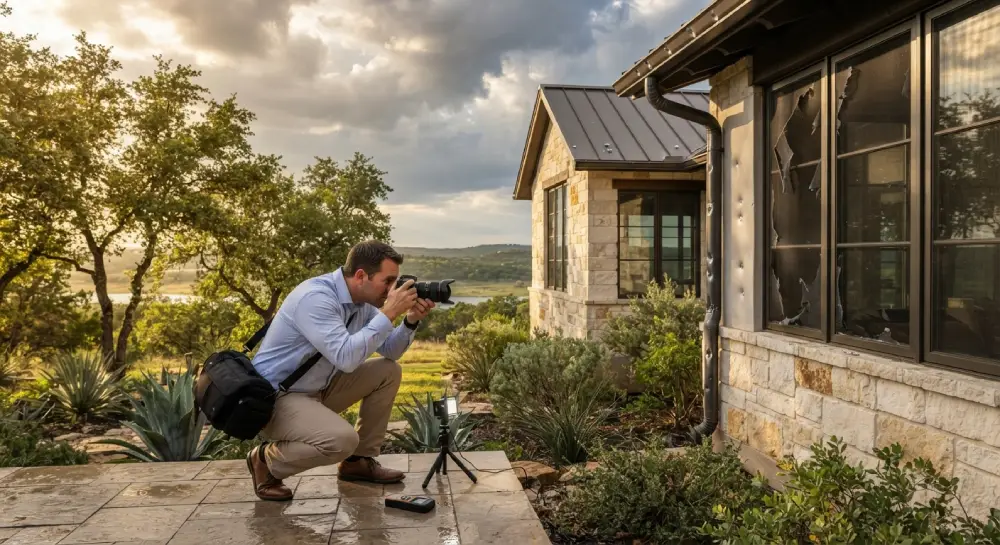
A hail damage claim may include more than shingles. We inspect and document roofing, gutters, metal components, skylights, exterior finishes, windows, fencing, detached structures, and signs of resulting water intrusion. Taking clear photographs, preserving storm records, and recording damage by roof slope and exterior elevation can strengthen the file. Our guide explains how to document hail damage for an insurance claim before repairs alter the evidence.
Common claim disputes include:
- The carrier identifies cosmetic damage but not functional damage
- Only one roof slope is included
- Gutters, flashing, vents, or window screens are omitted
- The estimate assumes spot repairs that may not be practical
- Interior staining is treated separately from the storm
- The insurer’s measurements or quantities are incomplete
A denial does not always mean the damage should no longer be reviewed. Lakeway property owners can learn what to do if their hail claim was denied before deciding on the next step.
Water Damage Claims
Water losses may come from burst pipes, appliance failures, plumbing leaks, roof openings, failed supply lines, or wind-driven rain. These claims often require documentation of moisture behind walls, beneath flooring, inside cabinetry, and in adjoining rooms. A water damage public adjuster can examine whether the carrier’s scope accounts for moisture migration, demolition, drying, flooring continuity, cabinetry, paint, and related restoration work.
The visible stain is rarely the entire scope. A Lakeway water damage claim may involve emergency mitigation, drying equipment, removal of wet materials, flooring continuity, cabinet detach-and-reset work, paint blending, contents handling, and testing.
Fire and Smoke Damage Claims
Fire claims can involve the structure, personal property, smoke residue, electrical systems, HVAC components, odor treatment, debris removal, and additional living expenses. Commercial fire claims may also include damaged inventory, machinery, tenant improvements, and interrupted operations. A fire insurance adjuster working for the policyholder can help organize structural damage, smoke contamination, contents, debris removal, additional living expenses, and other documented portions of the loss.
A complete inventory and a room-by-room damage record are often essential. TX Public Adjusting helps policyholders organize those details and communicate them clearly to the carrier.
Storm and Wind Damage Claims
Wind may damage shingles, roof edges, flashing, fences, trees, outdoor structures, siding, windows, and lake-facing improvements. Storm claims frequently become underpaid when the carrier focuses only on the most visible area.
We examine how the storm affected the property as a system, including the roof assembly, exterior envelope, and resulting interior damage.
Roof Damage Claims
Lakeway includes a broad mix of roof types, from architectural shingles to metal, tile, and low-slope commercial systems. Each material shows storm damage differently.
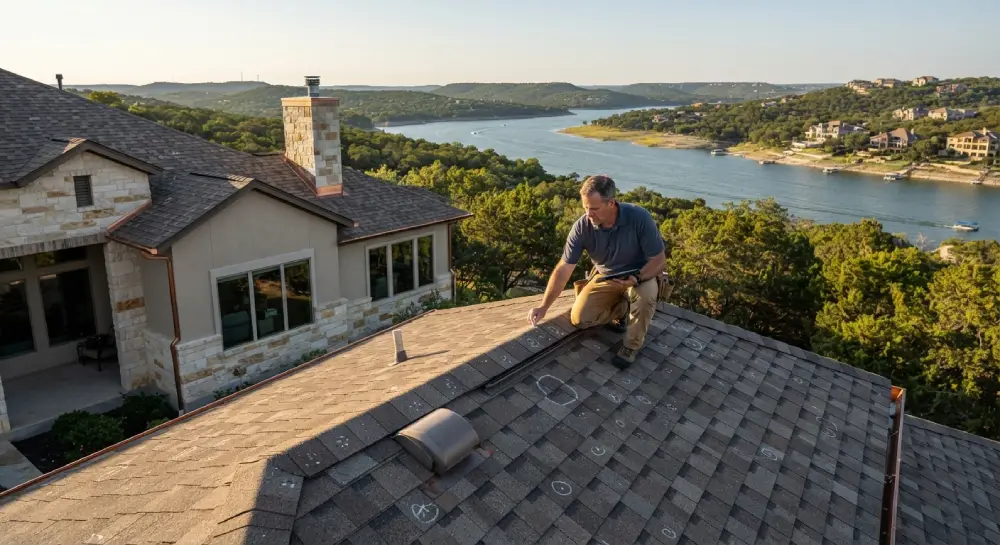
Property owners dealing with missing scope items or an impractical repair estimate can learn when to hire a public adjuster for a roof claim. A proper roof claim review may include:
- Roof measurements and slope verification
- Photographs of each elevation and roof plane
- Test squares or documented hail impacts
- Inspection of vents, flashing, gutters, and penetrations
- Review of repair feasibility and material availability
- Interior inspection for related water damage
- Comparison of the insurer’s estimate with the observed scope
Commercial Property Claims
Commercial claims may involve offices, retail spaces, medical facilities, restaurants, multifamily properties, marinas, hospitality businesses, and mixed-use buildings.
Properties near Ranch Road 620 and the greater Lakeway commercial corridor may contain flat or low-slope roofing, rooftop HVAC equipment, signage, tenant buildouts, specialized finishes, and multiple responsible parties.A commercial public adjuster helps coordinate the building claim, supporting documentation, estimates, inspections, and carrier communications.
Why Lakeway Insurance Claims Become Underpaid
A claim may be underpaid without the property owner realizing it. The carrier may issue a detailed-looking estimate, but the document can still omit necessary work. Some underpayments begin with avoidable documentation or communication problems. Reviewing these common property insurance claim mistakes can help owners protect the claim while it is still being investigated.
Missed or Hidden Damage
Storm impacts may be spread across several elevations, roof slopes, rooms, or detached structures. Water may travel behind walls or beneath flooring. Fire residue may extend into rooms that appear visually clean.
A short inspection can miss damage that becomes apparent only after moisture testing, closer roof access, or a room-by-room review.
Incomplete Scope of Work
An estimate may include replacement materials but omit associated labor and access. Examples include:
- Removing and reinstalling gutters
- Detaching fixtures or rooftop equipment
- Replacing flashing and underlayment
- Protecting finished surfaces
- Moving and resetting contents
- Matching continuous flooring
- Painting adjoining walls or ceilings
- Cleaning HVAC systems after smoke exposure
- Hauling debris and performing final cleanup
Depreciation and Payment Confusion
Many policies calculate depreciation based on the age and condition of damaged property. Some withheld depreciation may be recoverable after repairs, depending on the policy and claim.
Property owners can have difficulty determining which amounts were paid, withheld, excluded, or applied to the deductible. We review the estimate and payment documents so the owner understands how the claim was calculated.
Low Pricing or Incorrect Quantities
Carrier estimates may rely on quantities, material assumptions, or labor inputs that do not match the property. This is especially important for custom Lakeway homes with steep roofs, specialty finishes, limited access, large windows, exterior masonry, or high-end interior materials.
Weak Documentation
Even legitimate damage can be disputed when the file lacks clear photographs, measurements, inventories, invoices, moisture readings, repair estimates, or a consistent explanation of how the loss occurred.
Our job is to build the documentation before important evidence disappears or repairs begin.
Our Public Adjusting Process
1. Free Claim Review
We begin by learning what happened and reviewing the information available. That may include the policy, carrier estimate, payment letters, photographs, contractor bids, mitigation documents, and correspondence.
We also identify deadlines, requested documents, and unresolved questions.
2. Property Inspection
We inspect the reported damage and look for related conditions the initial claim may have missed. Depending on the loss, the inspection may include the roof, exterior elevations, interior rooms, detached structures, contents, commercial spaces, and building systems.
3. Claim Documentation
We organize photographs, measurements, damage descriptions, inventories, estimates, invoices, and other supporting records into a clear claim presentation.
For water and fire losses, documentation may be arranged by room or category. For storm claims, it may be organized by roof slope, elevation, exterior component, and interior impact.
4. Scope and Estimate Review
We compare the observed damage with the insurer’s scope. We look for missing quantities, excluded components, unsupported repair assumptions, depreciation issues, and inconsistencies between the carrier’s findings and the property conditions.
5. Carrier Communication and Negotiation
TX Public Adjusting communicates with the insurance company regarding the documented scope. We submit supporting materials, respond to claim questions, attend appropriate inspections, and negotiate the property-damage portion of the claim.
6. Settlement Support
We help the policyholder understand the carrier’s response, claim payments, recoverable depreciation requirements, and remaining claim issues. The goal is a properly supported resolution based on the policy and documented loss.
Already received a low estimate? A claim can often be reviewed before you accept the insurer’s scope as complete. Contact TX Public Adjusting for a free claim review.
Why Choose TX Public Adjusting
Licensed Texas Representation
TX Public Adjusting is operated by Rise Public Adjusting LLC, Texas License #3356839. We focus on property claims for Texas policyholders.
We Represent the Policyholder
The insurance company’s adjuster or independent adjuster works on behalf of the carrier. A public adjuster represents the insured property owner. Understanding the difference between a public adjuster vs. independent adjuster can help Lakeway policyholders determine whose interests each professional represents.
Residential and Commercial Experience
Our experience includes reviewing thousands of residential and commercial claim files involving hail, wind, water, roof, fire, smoke, and other property damage.
We understand that a custom Lakeway residence requires different documentation than a shopping center, apartment property, restaurant, office, or marina-related business.
Detailed Claim Preparation
A strong claim is not based on one photograph or one contractor number. It is supported by a consistent record of the cause, damage, quantities, repair requirements, and applicable policy provisions.
Independent Review of Underpaid Claims
You do not have to assume the first estimate is the final word. We can review the carrier’s scope and explain whether significant property damage or repair work may have been missed.
Clear Communication
Insurance documents can be difficult to interpret. We explain what the carrier included, what appears to be missing, and what steps may be available.
Lakeway Neighborhoods and Communities We Serve
TX Public Adjusting assists property owners throughout Lakeway and the surrounding Lake Travis area, including:
- Rough Hollow
- Serene Hills
- Flintrock Falls
- The Hills of Lakeway
- Old Lakeway
- Cardinal Hills
- Lakeway Highlands
- Bella Colinas
- The Preserve at Lakeway
- North Lakeway
- Lake Travis waterfront and cove properties
Rough Hollow is known for its resort-style residential development and access to Lake Travis, while established sections of Old Lakeway contain homes with mature trees, varied rooflines, and decades of additions or renovations.
Local landmarks such as Lakeway City Park, Lakeway Resort and Spa, Lakeway Airpark, and the Lakeway golf courses help define the community. Lakeway City Park sits along Hurst Creek Cove and is accessible from Lake Travis, reflecting how closely many local properties are connected to the water and surrounding terrain.
Areas We Serve Near Lakeway
Our service area extends beyond the Lakeway city limits to nearby Travis County and western Austin-area communities, including:
- Bee Cave
- The Hills
- Briarcliff
- Hudson Bend
- Steiner Ranch
- Spicewood
- West Lake Hills
- Rollingwood
- Barton Creek
- Dripping Springs
- Southwest Austin
- Greater Austin
Properties near Lake Travis may use a Lakeway, Austin, Spicewood, or Bee Cave mailing address even when they are located outside the city boundary. We review the property location, policy, and damage rather than relying solely on the mailing city.
Frequently Asked Questions
What does a public adjuster in Lakeway do?
A public adjuster represents the policyholder during a property insurance claim. The adjuster reviews the loss, inspects the property, documents damage, prepares an estimate or claim package, communicates with the carrier, and negotiates disputed property-damage issues.
TX Public Adjusting works for homeowners and business owners—not the insurance company.
When should I hire a public adjuster after a Lakeway storm?
A public adjuster can be hired early in the claim, after the insurer’s inspection, or when a claim becomes delayed, denied, or underpaid. Early involvement can help preserve evidence and organize the claim before repairs begin.
It is also reasonable to request a review after receiving an estimate that appears too low or limited. Claim status, policy deadlines, prior payments, and signed documents can affect the available options, so property owners should understand when it is too late to hire a public adjuster.
Can you review a claim that has already been paid?
Yes. A payment does not always mean every claim issue has been resolved. We can review the estimate, payment letter, photographs, and remaining damage to determine whether the scope appears incomplete.
The available options depend on the policy, claim status, deadlines, releases, and prior communications.
How much does a Lakeway public adjuster charge?
Public adjusters generally work under a written agreement that explains the fee and services. The fee structure may depend on the claim and applicable Texas requirements.
TX Public Adjusting offers a free initial claim review with no upfront fee for that review. The engagement terms are explained before representation begins.
Can a public adjuster help with hail damage that is not visible from the ground?
Yes. Hail damage often requires close inspection of the roof surface and related exterior components. Damage may appear as granule loss, fractures, dents, displaced materials, or impact marks on soft metals.
We also examine whether the carrier included gutters, vents, flashing, screens, windows, detached structures, and resulting interior water damage.
Are Lake Travis flood losses covered by homeowners insurance?
Standard property policies commonly treat rising surface water differently from water entering through a storm-created opening or a sudden plumbing failure. Coverage depends on the policy language and the cause of loss.
Because Lakeway properties may experience runoff, creek overflow, roof leaks, or wind-driven rain during the same weather event, documenting the source and sequence of damage is essential.
Do you handle claims for luxury homes in Lakeway?
Yes. Custom and luxury homes may involve specialty roofing, imported finishes, custom cabinetry, large glass systems, complex floor plans, exterior masonry, pool structures, and detailed landscaping.
These features require precise measurements, documentation, pricing, and coordination with qualified repair professionals.
Can you help with a commercial claim near Ranch Road 620?
Yes. We assist with commercial property claims involving retail, office, restaurant, multifamily, medical, hospitality, and other business properties.
Commercial claims may include roofing, equipment, inventory, tenant improvements, contents, code requirements, and interruption-related documentation.
What should I do immediately after discovering property damage?
Protect people first, then take reasonable steps to prevent additional damage. Photograph the conditions before moving items or beginning permanent repairs. Save damaged materials when practical, keep receipts, and maintain a record of conversations with the carrier.
Avoid making extensive permanent repairs until the damage has been documented, except when emergency work is needed to protect the property.
Why should I get a second review of the insurer’s estimate?
Carrier estimates can omit damage, use incomplete quantities, assume impractical repairs, or exclude associated work. A second review compares the estimate with the actual property conditions and repair requirements.
A free claim review can help you understand whether the estimate appears complete before you make major decisions.
Get Insurance Claim Help in Lakeway
Storm, roof, fire, and water claims can affect more of a Lakeway property than the first inspection reveals. TX Public Adjusting helps policyholders document the full loss, understand the insurance estimate, and communicate with the carrier from a stronger position.
Rise Public Adjusting LLC is a licensed Texas public adjusting firm operating as TX Public Adjusting under License #3356839.
Contact TX Public Adjusting for a free claim review. There are no upfront fees for the initial review.