

Property damage in Elgin can leave a homeowner, landlord, or business owner dealing with much more than visible repairs. A spring hailstorm may damage shingles, vents, gutters, fencing, and exterior finishes in one afternoon. Wind-driven rain can enter through a compromised roof and affect insulation, ceilings, flooring, and electrical components. A fire or plumbing failure can create a claim involving the building, personal property, cleanup costs, and temporary relocation expenses.
As a Texas public adjuster, TX Public Adjusting provides insurance claim help in Elgin for residential and commercial policyholders. We inspect the damage, review the insurance policy and carrier estimate, prepare supporting documentation, and negotiate from the policyholder’s side of the claim.
TX Public Adjusting is operated by Rise Public Adjusting LLC, Texas License #3356839. Our team has experience reviewing thousands of property claims involving roofs, hail, wind, water, fire, smoke, and commercial losses.
Need help with a new, delayed, denied, or underpaid claim? Request a Free Claim Review. There are no upfront fees.
Why Property Owners Hire a Public Adjuster in Elgin
Elgin sits primarily in Bastrop County, with part of the community extending into Travis County. Located east of Austin along the U.S. 290 corridor, the city combines historic properties, established residential streets, rural acreage, new subdivisions, restaurants, retail buildings, warehouses, churches, and other commercial properties.
That mix creates a wide range of insurance claim challenges.
An older building near Historic Downtown Elgin may have layers of previous repairs, discontinued materials, or construction details that require careful documentation. A newer home in Elm Creek, Harvest Ridge, Peppergrass, Briarwood, or another growing Elgin community may still experience widespread roofing and exterior damage from hail or straight-line wind. Rural and semi-rural properties outside the city center can include detached garages, barns, workshops, fencing, equipment, and additional structures that must be included in the claim.
A public adjuster works for the policyholder—not the insurance company.
The insurance carrier’s adjuster investigates the loss for the carrier. A public insurance adjuster in Elgin evaluates and documents the claim on behalf of the property owner. This distinction becomes especially valuable when:
- The carrier’s estimate appears too low.
- The inspection was brief or incomplete.
- Interior damage was excluded from the scope.
- The insurer approved a repair when replacement may be required.
- The claim involves several buildings or coverage categories.
- Depreciation was calculated incorrectly.
- The carrier denied part or all of the loss.
- The property owner does not have time to manage repeated inspections and requests.
- A contractor’s estimate is much higher than the insurer’s estimate.
- The claim has stalled without a clear explanation.
Hiring a public adjuster does not guarantee a particular result. It gives the policyholder professional representation, organized documentation, and an independent assessment of the covered damage.
Elgin Property Risks Require a Local Claim Strategy
Elgin is known as the Sausage Capital of Texas and the Brick Capital of the Southwest. Its identity is closely tied to the railroad, agriculture, brick manufacturing, barbecue, and the growth of Central Texas. Historic Downtown Elgin, the Elgin Depot Museum, Veterans Memorial Park, Southside Market, and the city’s older commercial blocks give the community a character that is different from a typical Austin suburb. The city was established around the railroad in 1872, and its historic freight depot remains part of the community’s visitor infrastructure.
Those local characteristics also matter during a property claim.
Older Homes and Historic Commercial Buildings
Properties near downtown and older Elgin neighborhoods may contain original materials, custom trim, masonry, wood windows, older decking, or previous additions. When storm, water, or fire damage occurs, a carrier estimate may rely on basic replacement assumptions that do not reflect the work required to return the property to its pre-loss condition.
A complete claim review may need to consider:
- Access to damaged materials
- Demolition and debris removal
- Matching issues
- Masonry and exterior finish repairs
- Electrical or plumbing access
- Code-related requirements when covered
- Protection of undamaged areas
- Specialty labor
- Business interruption for commercial occupants
Rapid Residential Growth
Elgin’s proximity to Austin has contributed to continued residential development. Communities commonly associated with the Elgin area include Elm Creek, Harvest Ridge, Peppergrass, Saratoga Farms, Homestead Estates, Briarwood, Creeks Crossing, and newer developments along and beyond the U.S. 290 corridor.
New construction does not eliminate claim risk. Hail can bruise or fracture recently installed shingles. High winds can loosen ridge caps, lift flashing, damage fencing, and affect garage doors. Wind-driven rain may enter through openings that are difficult to identify during a quick exterior inspection.
Rural and Agricultural Properties
Properties surrounding Elgin may include more than a primary residence. Depending on the policy, a claim may involve barns, workshops, equipment storage buildings, detached garages, wells, pumps, fencing, gates, and other improvements.
These losses can be under-documented when an inspection focuses only on the main roof. Each insured structure and damaged item should be evaluated separately under the applicable policy terms.
Common Insurance Claims in Elgin
Hail Damage Claims
Hail is one of the most important property risks for Elgin and the broader Central Texas region. Severe thunderstorms can produce hail, damaging wind, intense rainfall, and occasional tornado activity. The National Weather Service classifies a thunderstorm as severe when it produces hail at least one inch in diameter, wind gusts above 58 mph, or a tornado. Property owners dealing with a suspected hail damage insurance claim should document the roof and exterior before permanent repairs begin.
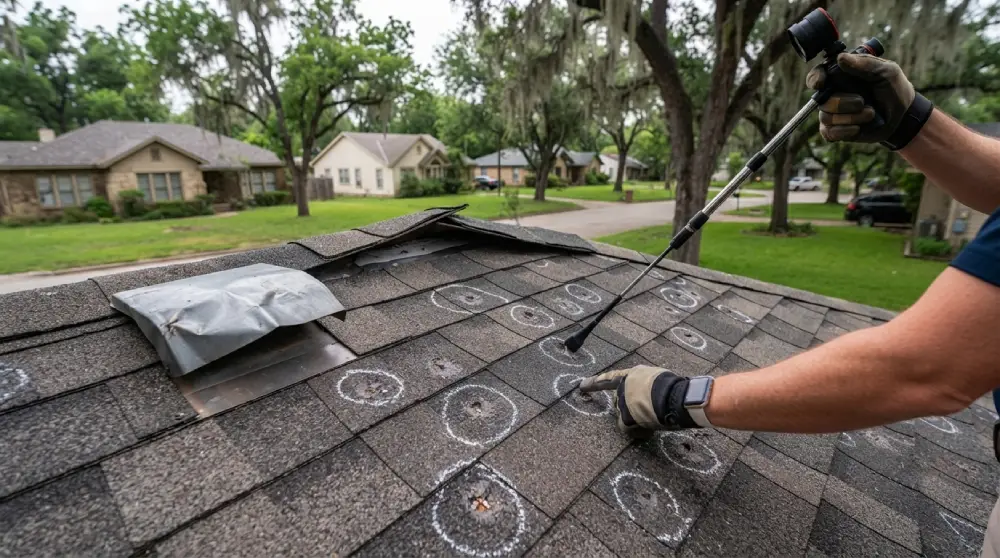
Hail damage is not always obvious from the ground. A roof can appear intact while shingles have impact marks, fractured mats, loosened granules, or reduced service life. Damage may also appear on:
- Roof vents and metal flashing
- Gutters and downspouts
- Window screens
- Siding and exterior finishes
- HVAC condenser fins
- Skylights
- Garage doors
- Fences and gates
- Patio covers
- Commercial rooftop equipment
- Flat and low-slope roofing systems
A proper hail claim should consider the complete exterior system, not just a few test squares on the roof.
We document the storm-related damage, compare it with the carrier’s scope, and identify components that may have been omitted. When appropriate, we also review whether the proposed repair method is practical and whether damaged materials can be reasonably matched.
Wind and Storm Damage Claims
Straight-line wind can cause substantial damage without producing a tornado. Shingles may lift, crease, tear, or detach. Flashing can separate. Tree limbs and windborne debris may strike roofs, walls, fences, vehicles, and outdoor equipment.
Some wind losses become water claims when rain enters through a storm-created opening. The resulting damage may affect:
- Attic insulation
- Roof decking
- Drywall
- Ceiling texture
- Paint
- Flooring
- Cabinets
- Electrical fixtures
- Personal property
The insurer may separate the exterior and interior portions of the claim or dispute whether the water entered through a covered opening. Photographs, weather information, moisture documentation, repair records, and a clear timeline can become important. Property owners can also review our guide to property damage after a hurricane for more information about documenting wind, water, debris, and structural damage after a major storm.
Roof Damage Claims
Roof claims in Elgin commonly involve hail, wind, falling trees, debris impact, fire, and water intrusion. Both residential and commercial roofs can be under-scoped when the inspection does not account for all roofing components.
A complete roof damage assessment may include:
- Field shingles or roofing membrane
- Ridge and hip caps
- Underlayment
- Decking
- Flashing
- Pipe jacks and vents
- Drip edge
- Valleys
- Skylights
- Gutters
- Downspouts
- Roof-mounted equipment
- Interior water damage
- Required access and setup
Insurance estimates sometimes price only isolated repairs. That approach may not address brittleness, material availability, matching, installation requirements, or damage across multiple roof slopes.
A public adjuster for a roof claim can review the carrier’s repair assumptions and prepare a documented scope based on the observed damage and policy conditions.
Water Damage Claims
Water losses can develop quickly in Elgin homes and businesses. Common causes include plumbing failures, appliance supply lines, roof leaks, water heater failures, HVAC drain problems, fire suppression systems, and storm-related intrusion. Knowing how to handle communication with the carrier is especially important when dealing with an insurance adjuster after water damage.
A water claim can involve more than drying visible surfaces. Moisture may travel under flooring, behind cabinets, into wall cavities, or through insulation. Depending on the loss, the claim may require documentation of:
- Emergency water extraction
- Moisture mapping
- Removal of wet materials
- Drying equipment
- Mold-prevention measures
- Plumbing access
- Cabinet or countertop removal
- Flooring replacement
- Drywall and insulation repairs
- Contents manipulation and storage
- Temporary relocation expenses
Coverage often depends on the cause of the water and the wording of the policy. Floodwater entering from outside is generally treated differently from a sudden plumbing loss or rain entering through storm damage.
Elgin’s formal mapped floodplain is limited in parts of the city, but the city’s drainage planning documents note that properties outside defined floodplain boundaries can still experience flooding during extreme rainfall or from localized runoff. Property owners should not assume that being outside a mapped flood zone eliminates every water risk.
Fire and Smoke Damage Claims
A fire insurance claim may include structural damage, smoke contamination, water from firefighting efforts, damaged contents, debris removal, odor treatment, and temporary living or operating expenses. A fire insurance adjuster can help organize the building damage, smoke contamination, contents loss, cleanup expenses, and additional living or operating costs.
Smoke can travel far beyond the room where the fire started. It may affect HVAC systems, insulation, furniture, clothing, electronics, cabinets, porous finishes, and concealed spaces. A surface cleaning allowance may not address the full scope.
Fire claims can become especially complicated when the carrier and policyholder disagree about:
- Which materials can be cleaned
- Which contents can be restored
- Whether odor has been eliminated
- The extent of demolition needed
- Replacement cost
- Code-related repairs
- Additional living expenses
- Business income loss
- Debris removal
- Inventory valuation
Our role is to organize the loss into a clear, supported claim package and account for each applicable coverage category.
Freeze and Plumbing Claims
Although Elgin is known for hot Central Texas summers, winter freezes can damage exposed plumbing, exterior faucets, attic lines, water heaters, and fire suppression systems.
A burst pipe may release water for hours before it is discovered. The visible stain may represent only a small part of the damage. Flooring, baseboards, drywall, cabinets, insulation, and electrical systems may require further inspection.
Freeze claims can also create disputes over maintenance, heat, vacancy, and policy conditions. Early documentation helps preserve evidence about the cause and extent of the loss.
Commercial Property Claims
Elgin’s commercial property claims may involve downtown shops, restaurants, offices, light industrial facilities, agricultural operations, churches, multifamily properties, retail buildings, and businesses along U.S. 290 and State Highway 95.
A commercial property claim may involve:
- Building repairs
- Business personal property
- Inventory
- Equipment
- Signs and awnings
- Tenant improvements
- Code upgrades when covered
- Debris removal
- Extra expense
- Business income loss
- Multiple tenants or buildings
Commercial claims require careful coordination. Repairs may need to occur while the business continues operating. A delay can affect employees, tenants, customers, suppliers, and revenue.
TX Public Adjusting assists commercial property owners in documenting both physical damage and applicable financial impacts.
Why Elgin Insurance Claims Become Underpaid
An underpaid claim does not always result from one obvious mistake. It often develops through several small omissions. Many common property insurance claim mistakes involve incomplete documentation, missed damage, premature repairs, or misunderstandings about the carrier’s estimate.
Damage Was Missed During the Initial Inspection
Carrier inspections may be limited by time, access, weather, or the areas made available. Detached structures, interior rooms, fencing, gutters, HVAC components, or commercial equipment may receive little attention.
The Scope Includes Only Visible Surface Damage
The estimate may cover paint and drywall without addressing wet insulation, damaged underlayment, cabinetry access, flooring transitions, or hidden moisture.
Repair Assumptions Are Unrealistic
An estimate may assume that one section can be repaired without affecting connected materials. This commonly occurs with roofing, continuous flooring, cabinets, siding, and custom finishes.
Depreciation Was Applied Incorrectly
Recoverable and nonrecoverable depreciation can affect the amount initially paid and the amount available after repairs. Property owners may not understand what documentation is needed to recover withheld depreciation.
Pricing Does Not Reflect the Actual Work
The carrier’s estimate may use labor, material, or equipment assumptions that differ substantially from qualified local contractor estimates. Line items may also be missing for setup, protection, access, demolition, disposal, permits, or supervision.
Documentation Is Incomplete
A claim may be delayed or underpaid because the insurer has not received photographs, inventories, invoices, moisture records, estimates, repair documentation, or other requested information.
Multiple Coverages Were Not Fully Presented
A fire or major water loss may involve the dwelling or building, contents, additional living expenses, debris removal, and other coverage categories. Focusing on only the building estimate can leave significant portions of the claim unresolved.
Concerned that your Elgin property claim is missing damage or priced too low? TX Public Adjusting offers a Free Claim Review with no upfront fees.
Our Public Adjusting Process
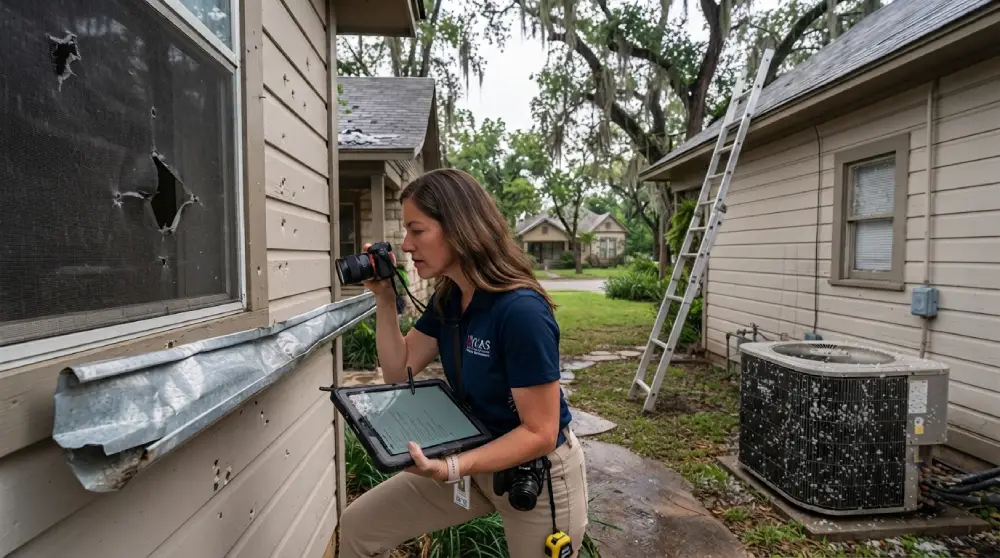
Understanding what a public adjuster does can help a policyholder decide whether professional representation is appropriate for the claim.
1. Claim Review
We begin by learning what happened, when the damage occurred, what inspections have taken place, and what the insurance company has communicated.
We review available materials such as:
- The insurance policy
- Carrier estimates
- Payment letters
- Reservation-of-rights letters
- Denial letters
- Contractor estimates
- Photographs and videos
- Invoices and receipts
- Prior repair records
2. Property Inspection
We inspect the accessible areas related to the reported loss. The inspection may include the roof, exterior elevations, interior rooms, detached structures, commercial spaces, contents, or equipment.
The objective is to identify and document the complete damage scope—not simply confirm the items already listed by the carrier.
3. Documentation and Estimating
We organize photographs, measurements, observations, inventories, estimates, and other relevant claim information. When additional specialists are needed, the claim may also involve contractors, engineers, hygienists, restoration professionals, accountants, or other qualified experts.
4. Claim Presentation
We submit the documented claim position to the insurer and respond to requests for relevant information. A clear presentation can help separate covered storm damage from unrelated wear, maintenance, or prior conditions.
5. Negotiation and Settlement Support
We communicate with the insurer regarding scope, pricing, documentation, and disputed items. We also help the property owner understand outstanding issues and the next steps needed to move the claim forward.
Every claim depends on its facts, policy language, evidence, and deadlines. No ethical public adjuster can promise a specific settlement amount.
Why Choose TX Public Adjusting
Licensed Texas Representation
TX Public Adjusting is operated by Rise Public Adjusting LLC, Texas License #3356839. We represent policyholders in Texas property insurance claims.
Independent of the Insurance Company
We do not work for the carrier. Our responsibility is to the policyholder who hires us.
Residential and Commercial Experience
We assist with homes, rental properties, multifamily buildings, restaurants, retail spaces, offices, churches, warehouses, and other insured properties.
Experience Across Major Claim Types
Our experience includes hail, wind, roof, water, fire, smoke, freeze, and complex commercial property claims.
Detailed Claim Documentation
A strong claim requires more than saying the payment is too low. We focus on evidence, scope, repair requirements, estimates, policy provisions, and clear communication.
No Upfront Fees
Property owners can request an initial claim review without paying an upfront fee. The engagement terms and fee structure are explained before representation begins.
Areas We Serve Near Elgin
View additional public adjuster service areas in Texas or explore the nearby communities listed below. TX Public Adjusting serves property owners throughout Elgin and surrounding Central Texas communities, including:
- Manor
- Bastrop
- Taylor
- Pflugerville
- Hutto
- Coupland
- McDade
- Paige
- Smithville
- Lexington
- Austin
- Eastern Travis County
- Bastrop County
- Southern Williamson County
- Western Lee County
We also assist property owners in Historic Downtown Elgin, Elm Creek, Harvest Ridge, Peppergrass, Saratoga Farms, Homestead Estates, Briarwood, Creeks Crossing, and rural areas surrounding the city.
Frequently Asked Questions
What does a public adjuster in Elgin do?
A public adjuster represents the policyholder during a property insurance claim. The work may include reviewing the policy and carrier estimate, inspecting the property, documenting omitted damage, preparing a repair scope, organizing claim evidence, and negotiating with the insurer.
Unlike the insurance company’s adjuster, a public adjuster is hired by the property owner.
When should I hire a public adjuster for an Elgin property claim?
A public adjuster may be helpful soon after a significant loss, especially when the claim involves several rooms, multiple structures, commercial operations, extensive contents, or disputed storm damage.
You can also seek help after receiving a low estimate, partial denial, full denial, or delayed response. Claim deadlines may apply, so the file should be reviewed promptly. Property owners who have already received a payment, denial, or claim-closure notice can review our guide explaining when it may be too late to hire a public adjuster.
Can you help if my Elgin roof claim was underpaid?
Yes. We can review the insurer’s roof estimate, photographs, payment documents, policy information, and contractor proposals. We then compare the carrier’s scope with the documented damage and identify potentially omitted components or unrealistic repair assumptions.
An underpaid claim does not automatically mean additional coverage is owed, but a detailed review can clarify the differences.
Can a public adjuster reopen a closed claim?
In some situations, a closed claim may still be reviewed, supplemented, or reopened. The available options depend on the policy, loss date, reason for closure, prior payments, releases, and applicable deadlines.
A closed status in an insurer’s system does not always mean every claim right has ended. The documents should be reviewed before making that assumption.
Does homeowners insurance cover hail damage in Elgin?
Many Texas homeowners policies cover sudden hail damage, subject to the policy’s terms, exclusions, deductible, and roof settlement provisions. Some policies may pay roof losses differently based on age, condition, or endorsements.
Coverage should be confirmed from the actual policy rather than assumed from a general description.
Is flood damage covered by a standard property policy?
Standard homeowners and commercial property policies often exclude surface flooding. Flood coverage may require a separate flood policy. However, water entering through a storm-created roof or wall opening may be evaluated differently, depending on the policy language and facts.
The source of the water must be documented carefully.
How much does a public adjuster cost in Texas?
Public adjusters generally charge a fee governed by a written contract and applicable Texas requirements. The fee structure can depend on the claim and the stage at which the adjuster becomes involved.
TX Public Adjusting explains the agreement before representation begins. There are no upfront fees for the initial claim review.
How long does an Elgin insurance claim take?
The timeline depends on the size of the loss, the insurer’s response, the quality of the documentation, the need for specialists, and the number of disputed issues. Texas policyholders may also have questions about how long an insurance adjuster has to contact you after a claim is reported.
A straightforward roof claim may move faster than a major fire or commercial loss involving contents, income, engineering, and extensive reconstruction. We keep the policyholder informed as the claim progresses.
Can you help commercial property owners in Elgin?
Yes. We assist with commercial property claims involving buildings, equipment, inventory, tenant improvements, business personal property, extra expenses, and potential business income losses.
Commercial claims benefit from early organization because physical repairs and business operations often need to be addressed at the same time.
What should I do immediately after property damage?
Protect people first and contact emergency services when needed. Take reasonable steps to prevent additional damage, but avoid permanent repairs until the property has been documented and the insurer has had an appropriate opportunity to inspect.
Photograph the damage, save damaged items when safe, keep receipts, record communications, and request a copy of the insurance policy and carrier estimate.
Get Insurance Claim Help in Elgin
Property owners pay insurance premiums for protection when a covered loss occurs. When the resulting estimate does not reflect the full damage, the policyholder deserves a clear explanation and a properly documented review.
TX Public Adjusting helps Elgin homeowners, landlords, business owners, and commercial property managers evaluate new, denied, delayed, and underpaid claims.
Rise Public Adjusting LLC
Texas License #3356839
Request your Free Claim Review today. There are no upfront fees. Contact TX Public Adjusting to discuss your Elgin property damage claim.