

Property damage in Industry can look very different from a loss in Houston, Dallas, or another major Texas metro. Properties here sit among the rolling rural landscape of northwestern Austin County, where homes, ranch properties, barns, workshops, churches, small businesses, and agricultural structures can all be exposed to severe thunderstorms, hail, straight-line winds, plumbing failures, fire, and water intrusion. Industry sits near the junction of State Highway 159 and FM 109 and is recognized as the first permanent German settlement in Texas, giving the community a distinctive mix of historic and newer properties.
If your home or commercial property has been damaged, a Public Adjuster in Industry, TX can help you understand what the insurance company has included in its estimate—and what may have been missed.
TX Public Adjusting represents policyholders, not insurance companies. We inspect damaged property, review coverage and estimates, document the loss, prepare a detailed claim scope, and communicate with the carrier throughout the adjustment process. TX Public Adjusting is operated by Rise Public Adjusting LLC, Texas License #3356839.
Have an open, delayed, denied, or underpaid property claim in Industry? Contact TX Public Adjusting for a Free Claim Review. There are no upfront fees.
Why Property Owners Hire a Public Adjuster in Industry
Industry is a small community, but insurance claims here can become complicated quickly.
The surrounding Austin County area includes traditional residences, acreage properties, metal buildings, agricultural improvements, detached garages, workshops, older construction, and locally operated commercial properties. One storm can affect several different roof coverings and structures on the same property.
That creates challenges during an insurance inspection.
A carrier’s initial estimate may concentrate on obvious roof damage while overlooking gutters, fencing, siding, windows, detached buildings, interior moisture, mechanical equipment, or other damaged components. On rural properties, a loss can involve far more than the main dwelling.
A licensed public adjuster works for the policyholder. Our job is to investigate the covered loss from your side of the claim and document the damage as thoroughly as possible.
Industry property owners may seek our assistance when:
- The insurance estimate appears too low.
- Roof damage was partially approved but other exterior damage was omitted.
- A claim has been denied.
- Water entered the building after storm damage.
- Multiple structures were affected.
- The carrier’s scope does not match contractor findings.
- Depreciation significantly reduced the initial payment.
- Interior damage has expanded since the first inspection.
- A commercial claim involves inventory, equipment, or business operations.
- The claim has become difficult to manage without professional representation.
Our team has experience reviewing thousands of residential and commercial property claims across Texas. That experience helps us recognize where damage, measurements, repair operations, or required line items may need additional documentation.
Property Damage Risks in Industry, Texas
Industry’s location in Austin County gives local property owners a different risk profile than properties along the immediate Gulf Coast or deep in North Texas.
The community sits in the rolling countryside of northwestern Austin County. Severe Texas thunderstorms can bring hail, lightning, strong winds, and tornado-producing conditions, while intense rainfall can produce drainage problems and water intrusion. Central and southeast portions of Texas regularly experience severe thunderstorms involving hail, high winds, tornado threats, and periods of heavy rainfall.
Hail and Severe Thunderstorms
Hail can damage an Industry property in minutes.
Asphalt roofs may show bruising, fractured matting, granule displacement, or damaged ridge material. Metal roofs and agricultural buildings may develop impact dents across panels, flashing, vents, and accessories.
A hailstorm can also damage:
- Gutters and downspouts
- Window screens
- Exterior paint
- Siding
- Fences
- HVAC condenser fins
- Skylights
- Metal structures
- Detached garages
- Shops and outbuildings
One difficulty with a hail damage insurance claim is that much of the damage is not obvious from the ground.
A roof may still be shedding water normally while its expected service life has been affected by storm impacts. That is one reason a detailed inspection and good photographic documentation matter.
Wind Damage
Straight-line wind is another concern around Industry.
Strong thunderstorm winds can lift shingles, loosen flashing, damage ridge caps, move metal panels, break tree limbs, and drive rain beneath roofing materials.
On acreage properties, wind may affect several structures differently. The residence may have missing shingles while a nearby shed has damaged metal panels and fencing has been blown down.
The claim scope should reflect the covered damage across the insured property rather than focusing only on the most visible structure.
Heavy Rain and Water Intrusion
Water damage claims frequently begin with another problem.
Wind lifts roofing material. Rain enters through the exposed area. Water reaches insulation, ceiling drywall, wall cavities, flooring, cabinetry, or electrical components.
The resulting claim is no longer only a roof claim.
Industry property owners may also experience water losses from:
- Broken supply lines
- Plumbing leaks
- Water heaters
- Appliance failures
- Overflow events
- HVAC drainage problems
- Storm-created roof openings
Water can migrate considerably farther than the first visible stain. Property owners dealing with a larger loss may also benefit from understanding what to expect when dealing with an insurance adjuster after water damage.
That is why the source, pathway, affected materials, and extent of moisture should all be evaluated.
Freeze-Related Damage
Hard freezes are less frequent than summer heat and thunderstorms, but Texas freeze events can create expensive losses.
Exterior plumbing and pipes in unconditioned spaces can be particularly vulnerable on rural properties. A broken line can release large quantities of water before anyone discovers the problem, especially in detached buildings or properties that are temporarily unoccupied.
Fire and Smoke Losses
Industry’s rural setting also means fire losses can involve residences, workshops, barns, detached garages, equipment, and surrounding improvements.
Fire insurance claims often involve considerably more than visibly burned materials. Smoke and soot may travel into rooms that were never touched by flames. Firefighting activities can add water damage, and electrical systems, insulation, contents, finishes, and mechanical equipment may also require evaluation. For larger losses, working with a fire insurance adjuster who represents the policyholder can help organize and document the claim.
A Community With Historic and Rural Properties
Industry has a character that should not be reduced to a generic “small Texas town” description.
The community was settled in 1831 by Friedrich Ernst and became the first permanent German settlement in Texas. Local historical sites include Ernst Memorial Park, the historic Industry United Methodist Church, the Lindemann-Ott House, historic markers, and structures associated with the Industry West-End Historical Society.
Industry City Hall itself sits in Industry City Park on property with roots in the area’s agricultural history. The site was once associated with a cotton gin dating to the nineteenth century, and the last bale of cotton in Austin County was reportedly ginned there in 1973.
That local building history matters in property claims.
Older homes and historic structures can contain construction assemblies that do not match modern production housing. Rural properties may include additions completed at different times, custom millwork, older siding, metal roofs, barns, and detached improvements.
Accurately documenting a loss sometimes requires understanding what actually exists at the property rather than relying on a simplified estimate.
Common Insurance Claims in Industry
Hail Damage Claims
Hail claims are among the property losses we commonly evaluate throughout Texas.
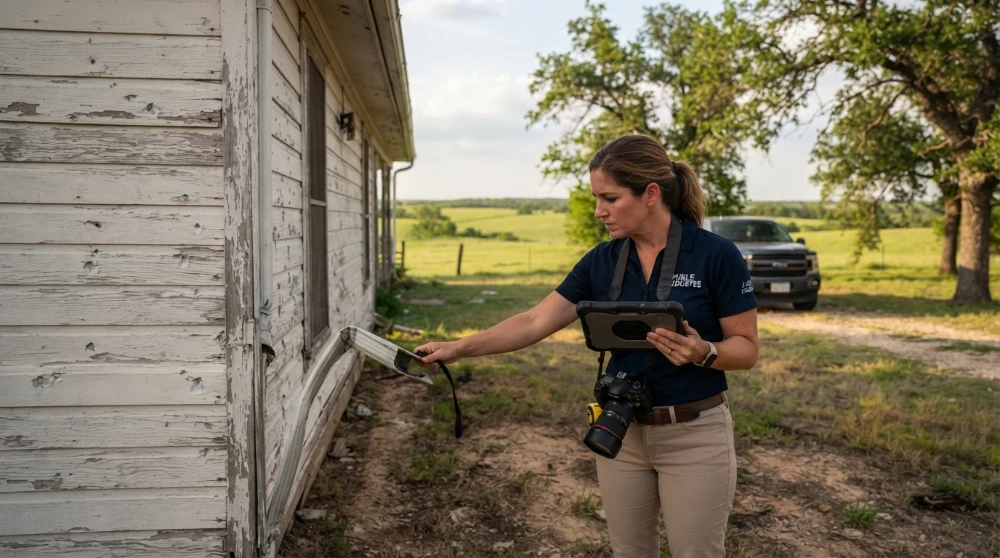
After a significant storm, damage may involve the roof, vents, gutters, screens, siding, metal surfaces, fences, detached structures, and outdoor equipment.
Disagreements can arise over whether marks are storm-related, how much of the roof was affected, whether individual repairs are practical, or which additional components belong in the scope.
TX Public Adjusting helps document the physical evidence of hail damage and presents the claim from the policyholder’s perspective.
Water Damage Claims
Water losses can spread quickly through an Industry home or business.
Drywall may appear dry on the surface while insulation or other concealed materials remain affected. Flooring can absorb moisture. Cabinetry can swell. Water may travel between rooms or floors.
Our claim review considers the source of the loss, affected areas, mitigation records, photographs, estimates, and the carrier’s existing scope.
Coverage always depends on the specific policy and circumstances, but complete documentation can help ensure the carrier evaluates all claimed damage.
Fire Damage Claims
A fire claim may involve:
- Structural damage
- Smoke contamination
- Soot
- Odor
- Contents
- Electrical systems
- HVAC systems
- Water used during suppression
- Temporary repairs
- Debris removal
The difference between a visible-damage estimate and a complete fire-loss scope can be substantial.
A public adjuster can organize the claim documentation, inspect affected areas, review the insurance company’s estimate, and communicate disputed items to the carrier.
Storm Damage Claims
A severe Industry storm may create multiple types of damage simultaneously.
Hail can strike the roof while wind damages flashing and rain enters the building. Trees or limbs may strike structures. Power fluctuations may affect equipment.
Treating each issue as an unrelated event can result in an incomplete picture of the loss.
We work to document how the covered event affected the entire property.
Roof Damage Claims
Roof claims frequently become disputed because the extent and repairability of the damage are not always obvious. When the extent of the damage or the insurer’s repair scope is disputed, a public adjuster for a roof claim can review the carrier’s estimate against the documented condition of the roofing system.
A carrier estimate might allow limited repairs while the property owner or contractor believes additional work is necessary.
Our review may examine:
- Roofing material
- Slopes and measurements
- Ridge and hip components
- Flashing
- Valleys
- Underlayment-related operations
- Roofing accessories
- Vents
- Gutters
- Related interior water damage
We then compare those observations with the insurer’s estimate and available policy information.
Commercial Property Claims
Industry may be small, but local commercial and agricultural operations can still face substantial losses.
A commercial claim can involve buildings as well as business personal property, equipment, inventory, tenant improvements, or other insured interests.
Commercial losses often require more documentation because repairs can affect operations and multiple parts of the property may need separate evaluations.
TX Public Adjusting handles both residential and commercial claims throughout Texas.
Why Insurance Claims Become Underpaid
An insurance carrier’s first estimate is not necessarily the final measure of the loss.
Property claims become underpaid for many reasons.
Missed Damage
Some damage is difficult to see during a short initial inspection.
Roof accessories, concealed moisture, detached structures, interior rooms, fencing, mechanical equipment, or secondary storm impacts can be missed.
Scope Omissions
An estimate can recognize that damage exists while still leaving out necessary repair operations.
Those omissions can create a large difference between the insurer’s estimate and the actual work required to return the property to its pre-loss condition, subject to coverage.
Low Estimates
Measurements, quantities, material assumptions, labor operations, or repair methodologies can differ between estimates.
A detailed comparison helps identify where those differences occur.
Depreciation Issues
Insurance payments can involve depreciation depending on the policy and type of coverage.
Property owners sometimes receive an initial payment without fully understanding what was withheld or what must happen before recoverable depreciation may become available.
We review these calculations as part of the overall claim evaluation.
Documentation Problems
A strong claim requires more than telling the insurance company something was damaged.
Photographs, measurements, inventories, estimates, invoices, mitigation records, repair information, and communication records may all become important.
Incomplete documentation can make legitimate damage harder to evaluate. Documentation is also where many common property insurance claim mistakes occur, particularly when photographs, inventories, invoices, or damage descriptions are incomplete.
Think your Industry insurance claim is missing damage or priced too low? TX Public Adjusting offers a Free Claim Review with no upfront fees.
Our Public Adjusting Process
1. Claim Review
We begin by learning what happened and reviewing the status of your insurance claim.
If available, we examine the policy, carrier estimate, payment information, denial or coverage letters, contractor estimates, photographs, and other relevant documents.
2. Property Inspection
Next, we inspect the damaged property.
The inspection is designed to identify and document damage associated with the claimed event. Depending on the loss, that can involve the roof, exterior elevations, interior rooms, detached buildings, contents, or commercial areas.
3. Documentation and Scope
We organize the claim evidence and prepare the documentation needed to support our evaluation.
That can include photographs, measurements, damage descriptions, estimates, inventories, invoices, and supporting records.
4. Claim Presentation and Negotiation
TX Public Adjusting communicates with the insurance carrier on behalf of the policyholder.
When we identify differences between our assessment and the carrier’s scope, we present the supporting documentation and work through the adjustment process.
5. Settlement and Claim Resolution
Our objective is to help the policyholder pursue the insurance benefits available under the policy for the covered loss.
We cannot guarantee a particular settlement, but we can make sure your claim is professionally documented and presented.
Why Choose TX Public Adjusting for an Industry Claim?
Licensed Texas Public Adjuster
TX Public Adjusting operates through Rise Public Adjusting LLC, Texas License #3356839.
You are working with a public adjusting firm focused on Texas property insurance claims.
We Represent Policyholders
The insurance company’s adjuster works for the insurer.
A public adjuster represents the policyholder.
That distinction matters when there is disagreement over the amount or extent of property damage.
Residential and Commercial Experience
Our experience includes thousands of claim reviews involving residential and commercial losses.
That broad exposure is useful when a single Industry property includes multiple buildings, mixed construction types, specialized equipment, or complicated interior damage.
Texas-Focused Claim Experience
Texas claims involve recurring weather patterns ranging from hail and severe thunderstorms to hurricanes, freeze events, fire, and water losses.
Our work is centered on Texas property owners and the types of claims Texans encounter.
Independent Claim Evaluation
We do not work for your insurance carrier.
Our responsibility is to evaluate the loss from the policyholder’s perspective and help document the claim accordingly.
Areas We Serve Around Industry
Our service is not limited to properties within Industry’s municipal boundaries.
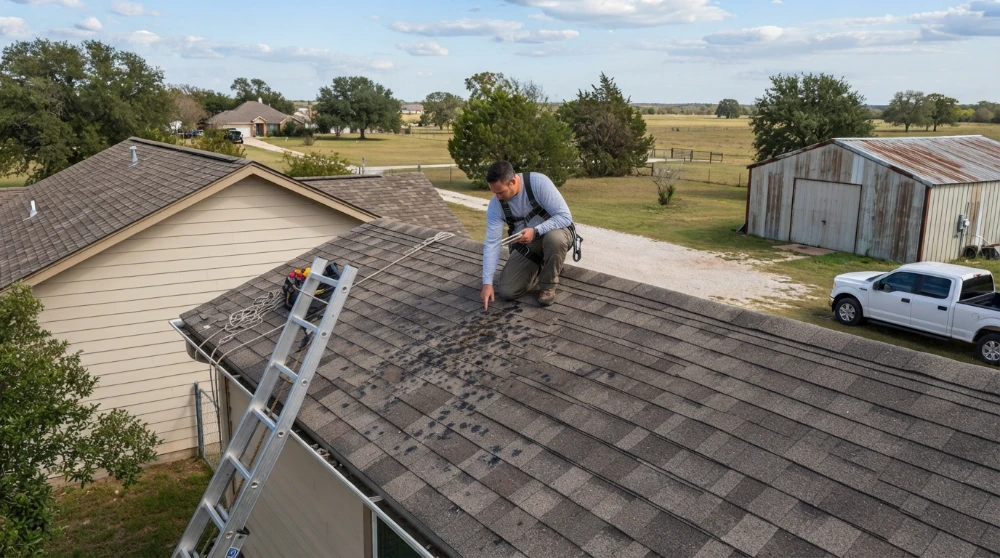
Industry sits in northwestern Austin County near several small communities connected by FM roads and State Highway 159. Local and nearby areas include Welcome, Shelby, New Ulm, Bellville, Nelsonville, Bleiblerville, Cat Spring, Kenney, and surrounding rural portions of Austin County. The surrounding region reflects the same mix of small towns, ranchland, residences, agricultural properties, and local businesses seen around Industry.
We also assist policyholders elsewhere across Texas.
Frequently Asked Questions About Public Adjusters in Industry
What does a public adjuster in Industry do?
A public adjuster represents you, the policyholder, during a property insurance claim. We inspect damage, review the carrier’s estimate, document additional items when appropriate, prepare claim materials, and communicate with the insurance company. Property owners who want a deeper explanation can read our guide to what a public adjuster does.
For an Industry property with a main residence plus sheds, workshops, fencing, or other insured structures, this can be particularly helpful because the loss may involve several separate areas.
When should I hire a public adjuster after an Industry storm?
You can speak with a public adjuster shortly after a loss, while the carrier is adjusting the claim, or after receiving an estimate that appears insufficient. If the claim has already been open for some time, review our guide explaining when it may be too late to hire a public adjuster.
Waiting too long can create additional complications because policies contain duties, deadlines, and other requirements. If you are unsure about timing, having the claim reviewed early can help you understand your options.
Can you help if my Industry roof claim was underpaid?
Yes. Underpaid roof claims are a common reason property owners contact public adjusters.
We can review the roof damage, the insurance company’s scope, measurements, repair assumptions, related exterior damage, and any interior water damage that may have resulted from the storm.
Can a public adjuster help with damage to barns or detached buildings?
Potentially, depending on the property and policy coverage.
This is especially relevant around Industry because many properties include structures beyond the primary residence. We can review what structures are insured, inspect claimed damage, and document the loss for covered property.
What if the insurance company already inspected my property?
You can still have your claim reviewed.
Carrier inspections sometimes result in a complete claim resolution, while other inspections may miss damage or produce differences over repair scope. A public adjuster’s inspection provides an independent evaluation from the policyholder’s side.
Can TX Public Adjusting help with water damage in Industry?
Yes.
We handle water damage claims involving plumbing failures, storm-created openings, appliance leaks, interior water migration, and other covered causes of loss.
Because water can spread behind walls and beneath flooring, documenting the full affected area is often important.
Do you handle commercial insurance claims in Industry?
Yes. TX Public Adjusting works with both residential and commercial property owners.
Commercial claims may involve buildings, contents, equipment, inventory, and other insured property. We help organize and document these losses and communicate with the carrier during adjustment.
How much does it cost to have my Industry claim reviewed?
TX Public Adjusting offers a Free Claim Review and there are no upfront fees.
Before you retain a public adjuster, the compensation arrangement should be clearly explained in the agreement so you know how fees work.
Can you guarantee that my insurance payment will increase?
No reputable public adjuster should guarantee a specific claim outcome.
Every property, policy, cause of loss, and existing claim file is different. Our role is to identify and document covered damage, prepare a professional claim presentation, and advocate for the policyholder during the adjustment process.
Why hire a Texas public adjuster instead of handling the claim myself?
Many property owners successfully handle straightforward claims themselves. Others contact us when the loss is large, documentation is complicated, multiple structures are involved, or there is a disagreement with the insurer.
Hiring a public adjuster allows you to have a licensed professional managing the property-damage side of the claim while representing your interests rather than the insurance company’s.
Get Insurance Claim Help in Industry, TX
Storm damage, fire, water intrusion, and roof losses can turn into complicated insurance claims faster than most property owners expect.
If you believe your insurance company missed damage, underestimated repairs, denied part of your claim, or offered a settlement that does not reflect the documented loss, you do not have to evaluate the claim alone.
TX Public Adjusting provides professional property insurance claim assistance for homeowners, commercial property owners, and other policyholders in Industry and throughout Austin County.
Rise Public Adjusting LLC
Texas License #3356839
Request a Free Claim Review
Contact TX Public Adjusting to discuss your Industry property damage claim.
- Free Claim Review
- No upfront fees
- Licensed Texas Public Adjuster
- Residential & Commercial Claims
- Independent policyholder representation