

Property damage in Hull can turn into an insurance dispute quickly. This small Liberty County community sits in Southeast Texas, where Gulf Coast weather, heavy rainfall, tropical systems, strong thunderstorms, wind, lightning, and occasional hail can create expensive losses for homes, rental properties, agricultural buildings, and local businesses. Hull is also part of a humid, low-elevation region where water intrusion after a roof or exterior failure can make a storm claim considerably more complicated.
If your property has been damaged and the insurance company’s estimate does not appear to account for the full loss, a Public Adjuster in Hull, TX can independently document the damage and represent your interests during the claim. TX Public Adjusting, operated by Rise Public Adjusting LLC, Texas License #3356839, assists residential and commercial policyholders with property insurance claims throughout Hull, Liberty County, and surrounding Southeast Texas communities.
Our role is different from that of the adjuster sent by your insurance company. We work for the policyholder, not the carrier. For storm-related roof losses, understanding the difference between a public adjuster vs. insurance adjuster for hail claims can help property owners understand who represents whom during the claim. That means our attention is on the policy, the physical damage, the repair scope, supporting documentation, and the amount legitimately owed under the coverage available.
Need help with a Hull property claim? Contact TX Public Adjusting for a Free Claim Review. There are no upfront fees.
Hull is an unincorporated community and census-designated place in eastern Liberty County. Its development was closely tied to the railroad and the discovery of oil in the Hull oilfield in 1918, making the community’s history distinctly different from that of the larger Houston-area cities to the west.
Why Property Owners Hire a Public Adjuster in Hull
An insurance company sends an adjuster to investigate a reported loss, but that adjuster is working within the carrier’s claim-handling process. A Hull public adjuster provides a different form of representation: we prepare and present the policyholder’s side of the claim.
That can become especially valuable when the damage extends beyond the obvious problem.
For example, wind may remove or loosen roof materials, but the complete loss can also involve flashing, vents, decking, insulation, ceilings, interior paint, flooring, electrical components, or personal property affected by subsequent water intrusion. If only the most visible damage appears in an estimate, the proposed payment may not reflect the full covered repair scope.
Property owners commonly contact TX Public Adjusting when:
- The insurance estimate appears substantially lower than contractor estimates.
- Important rooms, roof components, or exterior items are missing from the carrier’s scope.
- A claim has been partially denied.
- The insurer attributes storm damage to age, deterioration, maintenance, or prior conditions.
- Depreciation or deductible calculations are difficult to understand.
- Additional damage is discovered after the first inspection.
- A commercial loss involves numerous building components, contents, equipment, or business-related documentation.
- The policyholder simply wants experienced representation before accepting a settlement.
Our team has experience reviewing thousands of property claims and working with both residential and commercial losses. The objective is not to inflate a claim. It is to document the loss accurately and pursue the benefits supported by the policy and evidence.
Property Damage Risks Specific to Hull and Liberty County
Hull should not be treated like a generic Texas city page. The property risks here are shaped by the community’s location in eastern Liberty County, its proximity to the upper Texas Gulf Coast, and the hot, humid, rain-prone climate of Southeast Texas.
Liberty County lies between the Houston and Beaumont areas, is bisected by the Trinity River, and has a humid subtropical climate with historically high annual rainfall. Hull itself is roughly 43 miles northwest of Beaumont and sits along FM 834 near FM 770.
Hurricanes and Tropical Storms
Hull is inland, but inland does not mean immune from tropical weather.
Hurricanes and tropical storms moving through Southeast Texas can carry destructive wind and exceptional rainfall far from the immediate coastline. For a property owner in Hull, the resulting claim may involve roof damage, damaged siding, broken exterior components, fallen trees, water entering through storm-created openings, or prolonged power-related problems.
A tropical-weather claim can become complicated when multiple causes of loss are involved. Wind damage and flood damage, for example, may be treated differently under an insurance policy. Standard property policies frequently contain limitations or exclusions involving surface flooding, while wind-created openings and ensuing interior water can involve a different coverage analysis.
That makes cause-of-loss documentation particularly important.
Heavy Rain and Water Intrusion
Liberty County has dealt with serious flooding and has received substantial funding for flood-mitigation projects, reflecting the region’s continuing exposure to high-water events.
Not every water loss is a flood loss.
Hull homeowners can encounter water damage from:
- Wind-driven openings in roofs or walls
- Burst or leaking plumbing
- Failed water heaters
- HVAC drain failures
- Appliance supply lines
- Damaged roofing after a severe thunderstorm
- Interior leaks following tree or debris impact
Determining where the water came from and what caused the opening or failure can be central to the insurance claim.
Strong Wind and Severe Thunderstorms
Warm Gulf moisture helps fuel strong storms across Southeast Texas. High winds can damage shingles without removing an entire roof section. They may also affect ridge caps, flashing, vents, soffits, fascia, metal roofing, fences, detached structures, and trees.
Damage may appear minor from ground level but become more significant during a detailed inspection.
Hail Damage
Hull is not as closely associated with giant-hail outbreaks as portions of North Texas, but Southeast Texas thunderstorms can still produce hail.
Hail claims deserve careful documentation because impact damage can be subtle. Asphalt shingles can lose granules or develop bruising, while metal panels, gutters, vents, soft metals, window screens, and exterior finishes may show impact evidence that helps establish the extent of the storm.
Fire, Lightning, and Electrical Losses
Thunderstorms also create lightning and electrical risks. Separately, residential and commercial fires can produce losses extending well beyond the burned area.
A serious fire claim may include:
- Structural damage
- Smoke and soot contamination
- Water used for firefighting
- Electrical damage
- Personal property or business contents
- Debris removal
- Temporary repairs
- Additional living or operating expenses where covered
These losses require considerably more documentation than simply estimating the visibly burned materials.
Common Insurance Claims in Hull, TX
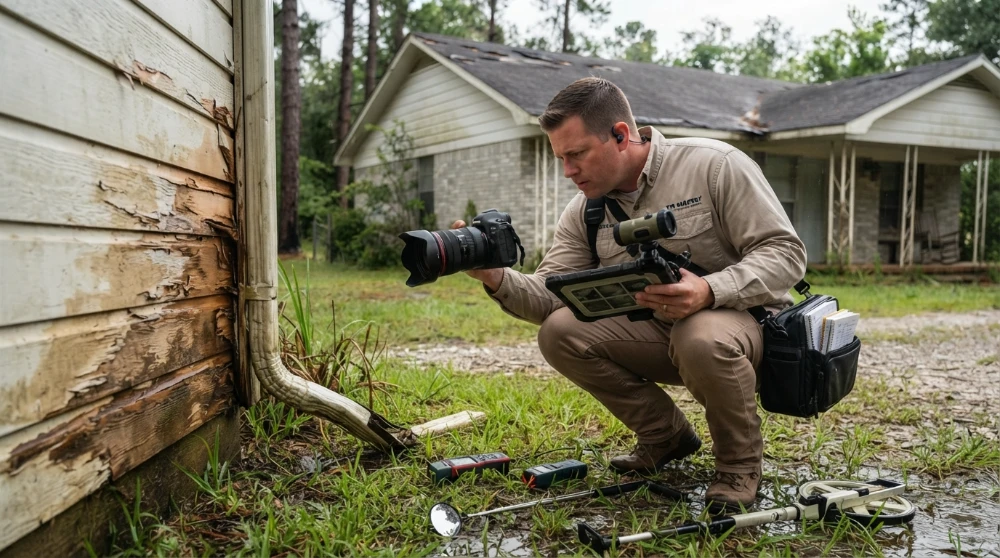
Hail Damage Claims
After hail moves through the Hull-Daisetta area, a roof can appear intact while still containing impact damage. We review roofing materials along with related components such as vents, flashing, gutters, exterior metals, siding, and other affected surfaces.
For property owners preparing a hail damage roof insurance claim, proper photographs, storm information, measurements, repair estimates, and component-level documentation can become critical.
Property owners who are still gathering evidence can also review our guide on how to document hail damage for an insurance claim before repairs or cleanup make the original damage harder to establish.
Water Damage Claims
Water claims can spread quickly in Hull’s humid climate. Moisture that enters walls, insulation, flooring, cabinets, or ceilings can create a much larger repair scope than the original leak suggests.
A water damage public adjuster can evaluate both the source of the loss and the resulting property damage so covered components are not overlooked simply because they are concealed.
Fire Damage Claims
Fire claims can involve multiple categories of damage at once. Burned structural materials may be only one portion of the loss. Smoke, soot, odor, water, electrical systems, contents, and code-related repairs may all require evaluation.
For a substantial fire loss, a fire insurance adjuster working for the policyholder can help organize the claim, document the repair scope, and address differences between competing estimates.
Storm Damage Claims
Storm losses in Hull frequently require separating several related issues: direct wind damage, tree impact, exterior damage, interior water intrusion, and pre-existing conditions.
A detailed inspection can establish a clearer record of what happened and which damaged components are connected to the reported event.
Roof Damage Claims
Roof claims are among the most disputed property losses because age-related wear and storm damage may exist on the same roof. When the carrier’s inspection or estimate does not account for the complete damage, hiring a public adjuster for a roof claim can provide the policyholder with an independent review of the scope and supporting documentation.
A proper scope may require evaluation of:
- Shingles or metal panels
- Underlayment
- Flashing
- Ridge and hip components
- Pipe jacks and roof vents
- Gutters and downspouts
- Decking where damaged
- Interior finishes affected by a covered opening
TX Public Adjusting also reviews whether the insurer’s estimate accounts for reasonable repair methods and all applicable covered components.
Commercial Property Claims
Hull and the surrounding Liberty County area include small businesses, agricultural operations, oil-and-gas-related property, shops, warehouses, offices, rental properties, and other commercial buildings.
Hull’s economic history is closely connected to the oilfield that accelerated development here in the early twentieth century. Today, commercial claims can still become especially documentation-heavy because one incident may affect roofing, interiors, equipment, inventory, tenant spaces, and multiple structures.
Why Hull Insurance Claims Become Underpaid
A low insurance payment does not always stem from one dramatic disagreement. More often, several smaller omissions add up.
| Claim Issue | What It Can Mean for the Property Owner |
| Missed damage | Roofing, exterior, interior, or related components never enter the original estimate |
| Limited scope | The estimate addresses the obvious repair but not connected work |
| Cause-of-loss dispute | Damage is attributed to wear, maintenance, or another excluded cause |
| Depreciation | Significant amounts may be withheld depending on policy terms and the condition of the property |
| Low unit pricing | Estimated labor or material costs may differ substantially from actual repair requirements |
| Documentation gaps | The file may not contain sufficient photographs, measurements, inventories, or estimates |
| Supplement issues | Newly discovered damage may not be properly presented for additional consideration |
A public adjuster reviews these issues from the policyholder’s side.
Our goal is to identify legitimate gaps, build a documented scope, and communicate the basis for requested changes to the carrier.
Our Public Adjusting Process for Hull Property Claims
1. Claim Review
We begin by reviewing what has already happened.
That can include the policy, notice of loss, carrier correspondence, estimates, photographs, contractor proposals, payment documents, denial letters, or other relevant records.
If you have not filed the claim yet, we can discuss the loss and determine what documentation should be preserved before the process moves forward.
2. Property Inspection
Next, we inspect the damaged property.
For a Hull storm claim, that may involve the roof, exterior elevations, interior rooms, detached structures, or commercial components associated with the loss.
We look beyond the single area that initially attracted attention.
3. Documentation and Scope Preparation
A claim becomes stronger when the requested amount is supported by evidence.
Depending on the loss, documentation can include photographs, measurements, inventories, estimates, repair scopes, supporting reports, and records of damaged items.
The objective is a claim file that clearly explains what was damaged and what restoration requires.
4. Carrier Communication and Negotiation
TX Public Adjusting communicates with the insurance company regarding the documented claim.
When there are disagreements concerning quantity, scope, pricing, damaged components, or causation, we present supporting information and pursue resolution through the applicable claims process.
5. Claim Settlement
The carrier ultimately determines what it will pay under the policy, but our job is to advocate for the policyholder and pursue a settlement supported by the coverage and documented damage.
We review revisions, supplemental estimates, and settlement documentation so you have a clearer understanding of the claim before it concludes.
Already received a low estimate for your Hull property? Request a Free Claim Review from TX Public Adjusting before assuming the carrier’s first estimate is the final word.
Why Choose TX Public Adjusting for a Hull Insurance Claim?
Hull property owners do not need another representative working for the insurance company. They need someone focused on their side of the file.
TX Public Adjusting is operated by Rise Public Adjusting LLC, Texas License #3356839.
Our approach includes:
- Texas-focused claim experience. We understand the types of storm, roof, fire, and water losses Texas policyholders regularly encounter.
- Licensed representation. We provide public adjusting services through Rise Public Adjusting LLC, License #3356839.
- Independent policyholder advocacy. Public adjusters represent insured property owners rather than insurance carriers.
- Residential and commercial experience. We handle losses involving homes as well as commercial buildings and more complicated property schedules.
- Detailed claim documentation. We focus on physical evidence, repair scope, estimates, claim records, and policy provisions.
- Experience reviewing thousands of claims. That experience helps us identify problems that can be easy to miss when a property owner is handling a major loss for the first time.
- Free Claim Review. Property owners can speak with us about the claim before deciding how to proceed.
- No upfront fees. Ask us to explain the applicable fee agreement and terms before engagement.
Local Claim Considerations in Hull
Hull is too small for credible copy to invent a list of trendy “neighborhoods.” It is better understood through the Hull-Daisetta area, its rural roads and properties around FM 834 and FM 770, and its relationship to nearby eastern Liberty County communities.
The community developed as a railroad station and later grew rapidly following the 1918 Hull oilfield discovery. It historically served as a shipping point for nearby Daisetta.
Those local characteristics matter because property claims here can look different from claims in a dense Houston subdivision. A loss may involve:
- A home with outbuildings or detached structures
- Larger rural lots with tree-impact exposure
- Metal roofing or agricultural structures
- Older homes with repairs completed over several decades
- Small commercial properties
- Properties connected to the broader Hull-Daisetta community
Hull is also served as part of the Hull-Daisetta school district area, and Liberty County identifies Hull among the communities within its county planning and emergency-management structure.
Areas We Serve Near Hull

TX Public Adjusting assists property owners throughout Hull and surrounding Liberty County communities, including Daisetta, Hardin, Raywood, and Liberty, along with Devers, Moss Hill, Kenefick, Ames, and other parts of eastern Liberty County.
Daisetta lies immediately south of Hull, while Liberty—the county seat—is farther southwest. Hull sits roughly 13 miles northeast of the city of Liberty.
That regional connection is useful after a widespread storm because the same weather system can create claims across multiple communities rather than within one municipal boundary.
Frequently Asked Questions About Public Adjusters in Hull
What does a public adjuster in Hull do?
A public adjuster in Hull represents the property owner during an insurance claim. The work can include reviewing the policy and carrier estimate, inspecting damage, preparing documentation, developing an appropriate scope, communicating with the insurer, and negotiating disputed claim items.
The important distinction is who the adjuster represents. TX Public Adjusting represents policyholders, not insurance companies.
When should I hire a public adjuster after Hull storm damage?
The best time to seek advice is generally before evidence disappears and before you agree to a settlement you do not understand. Early involvement allows damage to be documented before significant repairs alter the property.
That does not mean it is automatically too late if you already filed the claim. Public adjusters are often hired after an insurer has inspected the property or issued an estimate.
Can TX Public Adjusting help if my Hull claim has already been underpaid?
Potentially. We can review the carrier’s estimate, claim documentation, property damage, and current status of the file to determine whether there appear to be legitimate omissions or unresolved items.
The available options depend on the policy, type of loss, documentation, deadlines, previous payments, and whether a final release or other binding agreement has been executed.
Can a public adjuster help with hurricane or tropical-storm damage in Hull?
Yes, when the property has covered damage and public-adjuster involvement is appropriate. Hull’s location in Southeast Texas exposes the area to tropical-system wind and heavy rain even though the community is inland.
These claims can require careful evaluation when wind, rain intrusion, and surface flooding occur during the same event because different causes of loss may be treated differently by the policy.
Does homeowners insurance cover flooding in Hull?
Do not assume that all water is treated the same.
Standard homeowners and commercial property policies commonly distinguish between water entering because of a covered building opening or plumbing event and rising surface water or flooding. Flood coverage may require a separate policy. The exact answer depends on your policy and what physically caused the damage.
What if the insurer says my roof damage is old?
That is a common point of disagreement in roof claims. Roofs can have normal aging and still sustain new storm damage.
A thorough review considers the condition of the materials, documented storm event, pattern of damage, affected components, photographs, prior condition where available, and other evidence rather than relying solely on the roof’s age.
Can you help with commercial property claims in Hull?
Yes. TX Public Adjusting handles both residential and commercial property claims.
Commercial losses can require more extensive documentation because several building systems, contents, equipment, inventories, tenant improvements, or multiple structures may be involved in a single event.
How much does a Hull public adjuster charge?
Public adjusting agreements commonly use a contingency-based fee structure, meaning the fee is connected to the insurance recovery rather than requiring an upfront professional fee.
Specific terms can vary by claim and must comply with applicable Texas requirements. TX Public Adjusting explains the agreement before you decide whether to hire us.
Can I hire a public adjuster after the insurance company has already inspected my property?
Yes, in many circumstances. A carrier inspection does not necessarily prevent you from retaining your own licensed public adjuster. If your claim is already well underway, our guide explaining when is it too late to hire a public adjuster covers some of the timing issues property owners should consider.
It can be especially useful to request a review when the insurance estimate arrives and appears to omit damage or differs materially from the repair scope you are receiving from contractors.
What should I do immediately after property damage in Hull?
Protect people first and take reasonable emergency measures needed to prevent additional damage when it is safe to do so. Preserve photographs and videos before substantial cleanup, keep damaged materials when practical, retain receipts, save carrier communications, and avoid discarding evidence prematurely.
Then review your reporting obligations under the policy. If the loss is substantial or the scope is unclear, contact TX Public Adjusting for a Free Claim Review so you can understand your options before the claim progresses too far.
Get Insurance Claim Help in Hull, TX
A storm, roof leak, fire, or major water loss is difficult enough without spending weeks trying to determine whether an insurance estimate includes everything necessary to restore your property.
TX Public Adjusting helps Hull homeowners, business owners, landlords, and other policyholders document property losses and pursue the insurance benefits supported by their policies.
Rise Public Adjusting LLC
Texas License #3356839
Residential & Commercial Claims
Free Claim Review
No Upfront Fees
If your claim was underpaid, partially denied, delayed, or simply feels incomplete, contact TX Public Adjusting and have the file reviewed before accepting an outcome that may leave covered damage unresolved.