

Property damage in Cleveland can move from manageable to expensive fast. Severe thunderstorms can push wind-driven rain beneath roofing materials, falling trees can damage structures, tropical systems can bring widespread wind and water losses, and a single plumbing failure can affect multiple rooms before the source is stopped. When the insurance company’s estimate does not account for the full scope of damage, working with a public adjuster in Cleveland, TX gives the property owner independent representation throughout the claim.
TX Public Adjusting is a licensed Texas public adjuster helping Cleveland homeowners, landlords, business owners, and commercial property owners document and present property insurance claims. We represent policyholders—not insurance companies—and help evaluate damage, review carrier estimates, prepare supporting documentation, and negotiate covered property claims.
TX Public Adjusting operates through Rise Public Adjusting LLC, Texas License #3356839. Current Texas Department of Insurance records list Rise Public Adjusting LLC as a licensed public insurance adjusting entity.
If your Cleveland property claim has been delayed, denied, underpaid, or simply does not seem to reflect what it will actually cost to restore the property, contact TX Public Adjusting for a Free Claim Review. There are no upfront fees.
Why Property Owners Hire a Public Adjuster in Cleveland
Cleveland sits in Liberty County in the northern portion of Southeast Texas, close enough to the Gulf Coast region that tropical systems can still deliver significant inland wind and rainfall while also being exposed to the severe thunderstorms, tornadoes, hail, and flash-flooding risks common across Southeast Texas. Liberty County identifies Cleveland as one of its principal communities, and the city serves a mix of established neighborhoods, newer residential development, rural-edge properties, and commercial corridors.
The insurance company has its own adjusters and claim procedures. A public adjuster gives the policyholder a professional focused on the policyholder’s side of the loss.
That distinction can matter when a claim involves several categories of damage at once. A storm may affect shingles, metal roofing components, gutters, fencing, windows, ceilings, insulation, flooring, electrical components, and personal property. If the original inspection or estimate focuses on only the most obvious damage, the settlement may not include everything required to restore the property.
Property owners often contact a Cleveland public adjuster when:
- The carrier’s estimate appears too low.
- Roof damage was classified as repairable when broader replacement may need to be evaluated.
- Interior water damage was omitted from a storm claim.
- A claim was denied because the cause of loss is disputed.
- Depreciation or deductible calculations are difficult to understand.
- The property has both residential and detached-structure damage.
- A commercial loss includes equipment, inventory, tenant, or business interruption concerns.
- Additional damage becomes visible after repairs begin.
- Communication with the carrier has stalled.
Our team has reviewed thousands of residential and commercial property claims. That experience helps us identify documentation gaps and scope issues that are easy to overlook when a property owner is trying to manage the claim alone.
Cleveland’s Storm and Property Damage Risks
Cleveland’s location creates a different insurance-claim profile than a city in West Texas or the Panhandle. Property owners here need to account for both inland severe weather and Gulf-related storm systems.
National Weather Service records show that the Cleveland and Liberty County area has experienced damaging winds, tornado activity, and extreme rainfall. Historical NWS reporting describes a Cleveland-area event involving strong damaging winds and an F0 tornado, while another documented EF-1 tornado caused intermittent damage south and southeast of Cleveland Municipal Airport.
Tropical systems also remain relevant this far inland. Hurricane Beryl crossed Southeast Texas in July 2024 after making landfall as a Category 1 hurricane, with tropical-storm warnings covering inland portions of the Houston/Galveston forecast area. Cleveland property owners can also review our guide to property damage after a hurricane for more information about roof, water, structural, and exterior losses after a major tropical system.
Wind and Tropical Storm Damage
Strong straight-line winds and tropical systems can loosen shingles, crease tabs, lift roofing membranes, damage flashing, break tree limbs, and drive rain through areas of the building envelope that normally remain dry.
A Cleveland storm claim may start as a roof claim and later involve attic insulation, ceiling drywall, flooring, electrical fixtures, siding, fencing, or detached structures. That is why documenting the complete path of damage matters.
Heavy Rain and Water Intrusion
Southeast Texas storms can produce intense rainfall. Water may enter through storm-damaged roofs, windows, doors, flashing, vents, or other openings. Separate plumbing failures can also cause sudden interior losses.
Water claims frequently create disagreements about what materials must be removed, dried, cleaned, repaired, or replaced. Moisture can also travel farther than the visible stain suggests.
Tornado and Falling-Tree Damage
Cleveland’s storm history includes tornado activity, making tree impact and windborne-debris losses a genuine local concern.
Tree damage can affect more than the point of impact. Roof framing, decking, fascia, soffits, gutters, electrical service, windows, fencing, and interior finishes may all require inspection.
Hail and Severe Thunderstorms
Hail can damage asphalt shingles, metal roofing, vents, gutters, flashing, siding, windows, HVAC equipment, fencing, and other exterior components. Property owners dealing with this type of loss can review our guide to filing a hail damage insurance claim, including common roof-damage and documentation issues. Some hail damage is immediately visible; other damage is subtle and requires a close inspection of the roofing system.
Freeze and Pipe Damage
Cold-weather events are less frequent than summer storms, but Cleveland properties can still suffer frozen or broken plumbing lines during major Texas freezes. A pipe break inside a wall or attic can damage drywall, insulation, cabinets, flooring, and contents within minutes.
Cleveland Neighborhoods and Local Property Areas
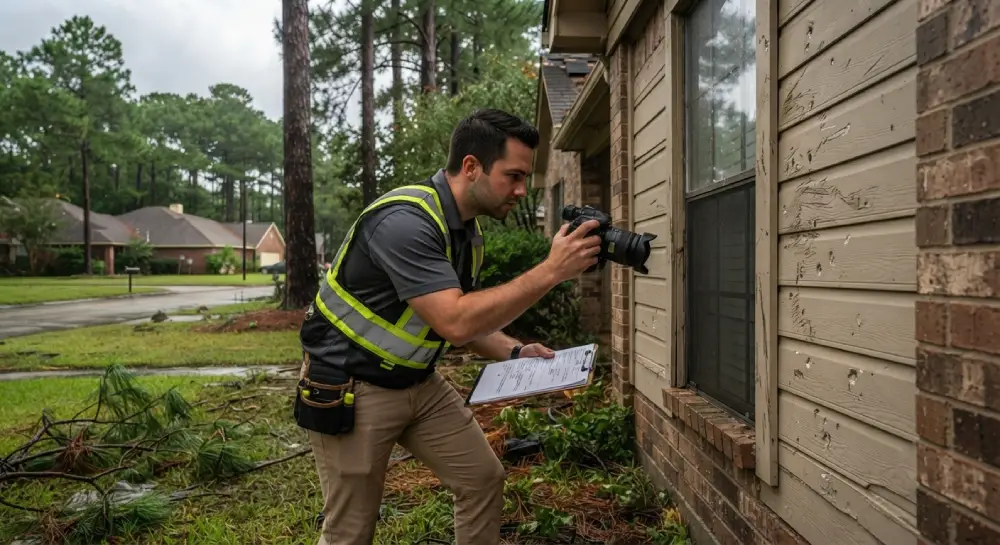
Cleveland is not one uniform housing market. Claim conditions differ between older homes near central Cleveland, newer subdivisions, commercial corridors, and larger properties near the city’s edges.
Recognizable Cleveland-area residential communities include Grand Oaks Reserve, Glen Park, and Kirby Woods, with continued new-home development in and around ZIP code 77327. Grand Oaks Reserve is specifically identified as a Cleveland residential community in Liberty County, while local property records and listings identify Glen Park and Kirby Woods within the Cleveland market.
We also help property owners throughout central Cleveland, the SH 105 and US 59/I-69 corridors, and the rural-residential areas surrounding the city.
Local references such as Cleveland Municipal Airport, Stancil Park, Old City Park, and Austin Memorial Library help define the community. The City of Cleveland lists Cleveland Municipal Airport as a city-owned public-use airport approximately five miles east of Cleveland, while municipal records identify Stancil Park and Old City Park among the city’s recreation properties.
For insurance claims, the age, construction type, roof system, surrounding trees, drainage conditions, and property use can be just as important as the neighborhood itself.
Common Insurance Claims in Cleveland
Hail Damage Claims
A hailstorm may affect multiple elevations and roofing components during the same event. We inspect the roof and surrounding exterior components, compare documented conditions with the carrier’s estimate, and identify damage that may have been omitted.
Hail claims may involve shingles, metal panels, gutters, downspouts, vents, flashing, window screens, siding, fences, HVAC components, and interior water damage.
Water Damage Claims
Water losses require careful documentation because the visible damage is not always the entire loss. Our water damage public adjuster resource explains how documentation, scope review, and carrier estimates can affect a Texas water-damage claim.
We review claims involving burst pipes, appliance or plumbing failures, roof leaks following covered storm damage, water intrusion, damaged flooring, drywall, cabinets, insulation, and related mitigation work.
The goal is to document the cause and resulting damage clearly rather than treating each affected material as an unrelated repair.
Fire Damage Claims
Fire losses can be among the most detailed property insurance claims a Cleveland owner faces.
Damage may include burned structural materials, smoke contamination, soot, damaged electrical systems, HVAC contamination, personal property, debris removal, temporary living costs, and portions of the property that were damaged by water during firefighting efforts.
A strong fire claim must account for more than the rooms touched directly by flames. For more detail on documenting these losses, see how a fire insurance adjuster can help evaluate smoke, structural, contents, and related property damage.
Storm Damage Claims
Severe thunderstorms can produce combinations of wind, rain, hail, lightning, falling limbs, and debris impact.
TX Public Adjusting reviews the entire loss so the claim does not become artificially divided into disconnected repairs. We look at roofing, exterior components, interiors, detached structures, and other affected property.
Roof Damage Claims
Roof claims are one of the most common reasons Cleveland property owners seek insurance claim assistance. A public adjuster for a roof claim can review measurements, damaged roofing components, related interior damage, and differences between the contractor’s or policyholder’s scope and the carrier’s estimate.
A carrier estimate may allow for a localized repair even when additional damaged components require evaluation. We review roof measurements, photographs, materials, penetrations, flashing, accessories, related interior damage, and the carrier’s scope.
A roof claim should reflect the actual covered damage—not simply the smallest visible section.
Commercial Property Claims
Cleveland businesses may occupy offices, retail spaces, restaurants, warehouses, churches, apartment properties, self-storage facilities, medical offices, and other commercial structures. Property owners facing larger or more complicated commercial property claims can work with TX Public Adjusting on building damage, roofing systems, equipment, tenant improvements, inventory, and other covered components of the loss.
Commercial claims can involve roofing systems, exterior walls, mechanical equipment, inventory, tenant improvements, interior finishes, code-related considerations, and business interruption documentation.
TX Public Adjusting handles both residential and commercial property claims in Cleveland.
Why Cleveland Insurance Claims Become Underpaid
Underpayment does not always result from one dramatic mistake. More often, several smaller scope omissions combine to create a settlement that falls short of the actual repair requirements.
Missed Damage
An inspection may identify obvious roof damage but overlook gutters, flashing, fencing, siding, attic moisture, ceilings, or other affected components.
Once the first estimate becomes the working document for the claim, omitted items can remain omitted unless somebody documents them.
Scope Omissions
Insurance estimates are built line by line. If a necessary operation or material never appears in the scope, there may be no payment for it.
This can include demolition, removal, disposal, access, detach-and-reset work, underlayment, flashing, insulation, texture, painting, or related repair operations.
Depreciation Issues
Replacement-cost policies may include depreciation that is withheld until certain conditions are satisfied. Other policies may settle some property on an actual-cash-value basis.
We review the carrier’s calculations alongside the policy and damage documentation so the property owner understands what was withheld and what may be recoverable.
Low Repair Estimates
The carrier’s estimate and the real cost of restoring the property can differ.
Differences may involve quantities, labor, material selection, roofing measurements, missing components, or simply a scope that does not include every covered repair.
Documentation Problems
Photos without context, incomplete inventories, missing measurements, vague contractor estimates, and inconsistent descriptions can make a legitimate claim harder to evaluate.
A public adjuster’s role is to organize the evidence into a claim package that clearly explains what happened, what was damaged, and what is required to restore the covered property.
Our Public Adjusting Process
1. Claim Review
We start by reviewing the loss, insurance claim status, carrier correspondence, estimates, photographs, and available policy information.
If the claim has already been paid, we compare the settlement with the documented damage. If it is still open, we identify what needs to be developed before negotiations continue.
2. Property Inspection
We inspect the affected areas and document visible damage related to the loss.
For storm claims, that may include roofing, exterior elevations, gutters, windows, fencing, attic spaces, ceilings, walls, flooring, and detached structures.
3. Documentation and Scope Development
We organize photographs, measurements, repair requirements, estimates, inventories, and supporting claim information.
This step is critical because an insurance claim is ultimately evaluated through documentation.
4. Carrier Communication and Negotiation
TX Public Adjusting communicates with the insurer on the policyholder’s behalf regarding the scope and valuation of the covered damage.
When the carrier’s estimate differs from our findings, we present the documentation supporting the claim.
5. Settlement and Claim Resolution
We continue working through the claim process until the covered scope and settlement issues are addressed.
Not every claim produces the same outcome, and no public adjuster can guarantee a particular settlement. The objective is to give the policyholder experienced representation and a thoroughly documented claim.
Have a Cleveland claim that seems too low? Request a Free Claim Review from TX Public Adjusting before accepting the carrier’s estimate as the final word.
Why Choose TX Public Adjusting in Cleveland
TX Public Adjusting focuses on Texas property insurance claims and represents policyholders—not carriers.
Property owners choose our team because we provide:
- Licensed Texas public adjusting services
- Rise Public Adjusting LLC — Texas License #3356839
- Independent representation for policyholders
- Thousands of claims reviewed
- Residential and commercial claim experience
- Roof, hail, wind, water, fire, storm, and commercial claim expertise
- Detailed property inspections and documentation
- Carrier estimate and scope reviews
- Claim negotiation assistance
- Free Claim Reviews
- No upfront fees
Our job is not to sell roofing, reconstruction, or insurance. Our job is to represent the policyholder’s financial interest in the property insurance claim.
Areas We Serve Near Cleveland
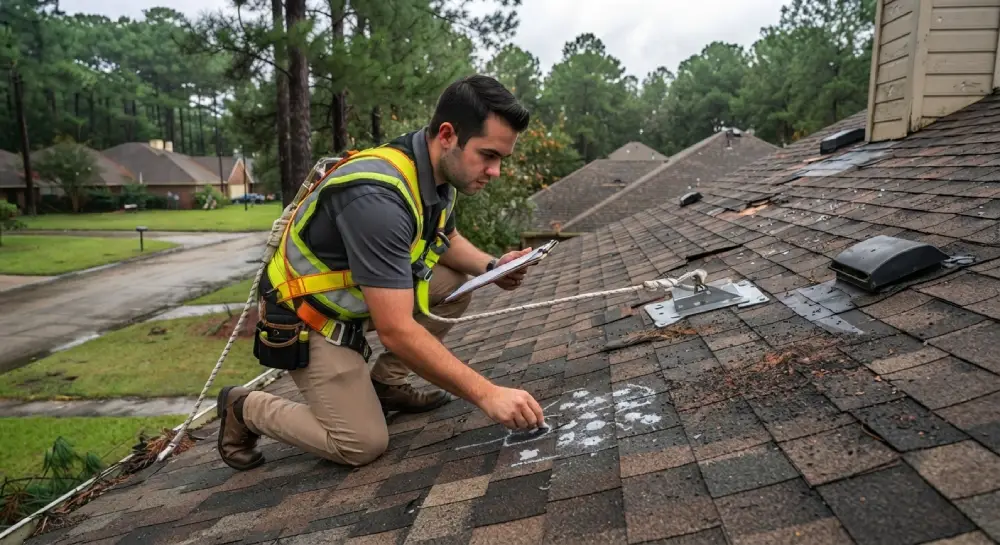
Our service area extends beyond Cleveland throughout Liberty County and nearby Southeast Texas communities.
Property owners seeking insurance claim assistance can contact TX Public Adjusting from Liberty, Dayton, Plum Grove, Hardin, Kenefick, Tarkington Prairie, Splendora, Porter, New Caney, Shepherd, and surrounding communities.
The existing TX Public Adjusting site architecture also includes dedicated nearby area pages for Liberty, Dayton, Plum Grove, Porter, Hardin, and Kenefick.
Frequently Asked Questions About Public Adjusters in Cleveland
What does a public adjuster in Cleveland do?
A public adjuster represents the property owner during a property insurance claim. We inspect damage, review policy and claim documents, prepare supporting evidence, evaluate the carrier’s estimate, and negotiate covered property damage issues.
The insurance company’s adjuster represents the insurer. TX Public Adjusting represents the policyholder. If you want a deeper explanation of that distinction, read our comparison of a public adjuster vs. independent adjuster.
When should I hire a public adjuster for a Cleveland property claim?
Many property owners call us when a settlement appears too low, important damage is missing from the estimate, a claim has been denied, or communication with the carrier has become difficult.
You can also contact a public adjuster earlier on a significant loss. Getting the scope and documentation organized correctly from the beginning can prevent problems later.
Can you help with an already underpaid insurance claim?
Yes. An existing payment does not automatically mean every issue has been resolved.
We can review the carrier’s estimate, photographs, scope, depreciation calculations, and remaining property damage to determine whether additional covered items may need to be documented.
Do you handle Cleveland roof and hail claims?
Yes. Roof and hail claims are a major part of our work.
We review shingles or roofing systems, gutters, vents, flashing, exterior components, and related interior damage. If the carrier’s scope does not reflect the documented loss, we prepare evidence supporting the additional items.
Can a public adjuster help after hurricane or tropical-storm damage in Cleveland?
Yes. Cleveland is inland, but tropical systems crossing Southeast Texas can still produce damaging winds, heavy rain, falling trees, and water intrusion. Hurricane Beryl’s 2024 passage through Southeast Texas is a recent example of why inland properties cannot ignore tropical-weather risk.
We review wind and storm-related property damage and help document the resulting covered loss.
Do you handle commercial claims in Cleveland?
Yes. TX Public Adjusting handles commercial property claims involving offices, retail properties, warehouses, multifamily buildings, churches, restaurants, self-storage properties, and other business locations.
Commercial claims often require a more detailed scope because roofing, equipment, tenant spaces, inventory, and operational impacts can all be involved.
How much does it cost to speak with TX Public Adjusting?
The initial claim review is free, and there are no upfront fees.
During the review, we can explain how public adjusting fees apply to your specific claim before you decide whether to hire us.
What if the insurance company says my Cleveland roof only needs repairs?
A repair recommendation should be evaluated against the actual documented condition of the roof, the scope of covered damage, the roofing materials involved, and applicable policy terms.
We can inspect the loss and compare the carrier’s repair scope with what is actually present at the property.
Is it too late to hire a public adjuster after my claim was closed?
Not necessarily. Timing depends on the loss date, policy terms, claim history, and applicable deadlines.
If you believe covered damage was missed or the claim was underpaid, request a review promptly. Waiting can make documentation and deadline issues more difficult. Our guide explains when it may be too late to hire a public adjuster and why the timing of a claim review can matter.
Why use a local Texas public adjuster for a Cleveland claim?
Texas property claims involve local weather patterns, Texas insurance practices, and construction conditions that can affect the scope of a loss.
Cleveland’s combination of Gulf-influenced storms, severe thunderstorms, tornado risk, heavy rain, mature trees, newer subdivisions, and rural-edge properties makes local claim knowledge especially useful when documenting storm damage.
Get a Free Cleveland Insurance Claim Review
If your home or commercial property has been damaged by hail, wind, a severe storm, water, fire, a fallen tree, or another covered event, you do not have to rely solely on the insurance company’s estimate.
TX Public Adjusting can review your claim, inspect the property, identify potential scope gaps, prepare supporting documentation, and represent you during negotiations with the carrier.
TX Public Adjusting
Rise Public Adjusting LLC
Texas License #3356839
Residential & Commercial Claims
Free Claim Review
No Upfront Fees
Contact TX Public Adjusting today and find out whether your Cleveland property damage claim deserves a closer look.