

Property damage in Benbrook can become expensive long before the full extent of the loss is visible. A spring hailstorm may bruise shingles, damage metal vents, and open small pathways for water intrusion. A strong North Texas thunderstorm can tear off roofing materials, push rain through flashing, or send tree limbs into a home. Plumbing failures, appliance leaks, fires, and winter freezes create another set of problems for residential and commercial property owners.
When the insurance company’s estimate does not account for the complete loss, a public adjuster in Benbrook can help document the damage and present the policyholder’s claim.
TX Public Adjusting represents property owners—not insurance companies. As a licensed Texas public adjuster, we help policyholders document covered damage and present a detailed claim to their insurance carrier. Our team reviews policies, inspects damaged property, prepares claim documentation, identifies missing scope items, and negotiates with the carrier. We assist with residential and commercial property damage claims throughout Benbrook, southwest Fort Worth, and the surrounding Tarrant County area.
TX Public Adjusting is operated by Rise Public Adjusting LLC, Texas License #3356839.
Your initial claim review is free. There are no upfront fees. Contact TX Public Adjusting to discuss a denied, delayed, disputed, or underpaid Benbrook property claim.
Insurance Claim Help for Benbrook Property Owners
Benbrook sits in southwest Tarrant County beside Fort Worth, with Interstate 20, Loop 820, and U.S. 377 connecting the city to the wider Dallas–Fort Worth region. The community includes established homes, newer residential developments, apartments, retail corridors, offices, churches, and properties near Lake Benbrook.
That combination creates a wide range of insurance exposures.
Homes around Timbercreek Road, Mont Del, Westpark, Chapin Road, Whitestone, and the Lake Benbrook area may have different roof ages, exterior materials, drainage conditions, and repair requirements. Some properties have steep residential roofing systems. Others have metal components, tile, low-slope sections, detached structures, fences, pools, or mature trees that add complexity to a storm claim.
Commercial properties near Benbrook Boulevard, Interstate 20, Winscott Road, and Mercedes Street can involve flat roofs, rooftop equipment, signage, inventory, tenant improvements, business interruption, and code-related repair costs.
A carrier inspection may last only a limited amount of time. The resulting estimate may focus on obvious damage while leaving out related repairs, concealed water intrusion, matching issues, access costs, overhead, damaged contents, or portions of the building envelope.
Our job is to examine the claim from the policyholder’s side and determine whether the insurance company’s scope reflects the property’s actual covered damage.
Why Property Owners Hire a Public Adjuster in Benbrook
An insurance company assigns an adjuster to investigate a claim for the carrier. A public adjuster serves a different role. The public adjuster is retained by the policyholder and works to document and present the policyholder’s position.
Benbrook property owners may hire a public insurance adjuster when:
- The insurance estimate appears too low.
- Part of the damage was omitted from the carrier’s scope.
- A roof claim was denied or classified as wear and tear.
- Interior water damage was addressed without identifying the affected roofing or exterior components.
- The insurer paid for spot repairs that may not return the property to a reasonably consistent condition.
- Depreciation was calculated incorrectly or not clearly explained.
- A commercial claim involves equipment, inventory, tenant improvements, or lost income.
- The claim has become difficult to manage alongside work, family, or business responsibilities.
- The carrier has requested extensive documentation.
- A reopened claim or supplemental claim needs a stronger supporting package.
Property owners who are unsure about the different roles involved in a claim can review our guide comparing a public adjuster vs. independent adjuster. A public adjuster does not guarantee coverage or a particular settlement. Coverage depends on the policy language, cause of loss, exclusions, endorsements, deductibles, reporting requirements, and available evidence. What we provide is experienced, independent claim representation focused on the property owner’s interests.
Benbrook Storm Risks and Property Damage Patterns
Benbrook’s location in North Texas exposes properties to severe thunderstorms, large hail, damaging straight-line winds, tornado-producing storms, flash flooding, extreme heat, and occasional winter weather.
The National Weather Service has documented severe storms across Tarrant County capable of producing very large hail, damaging winds, and heavy rainfall. Benbrook is also near the Clear Fork of the Trinity River and Benbrook Lake, making drainage and water movement relevant concerns for some properties.
Hail and Wind Across Southwest Tarrant County
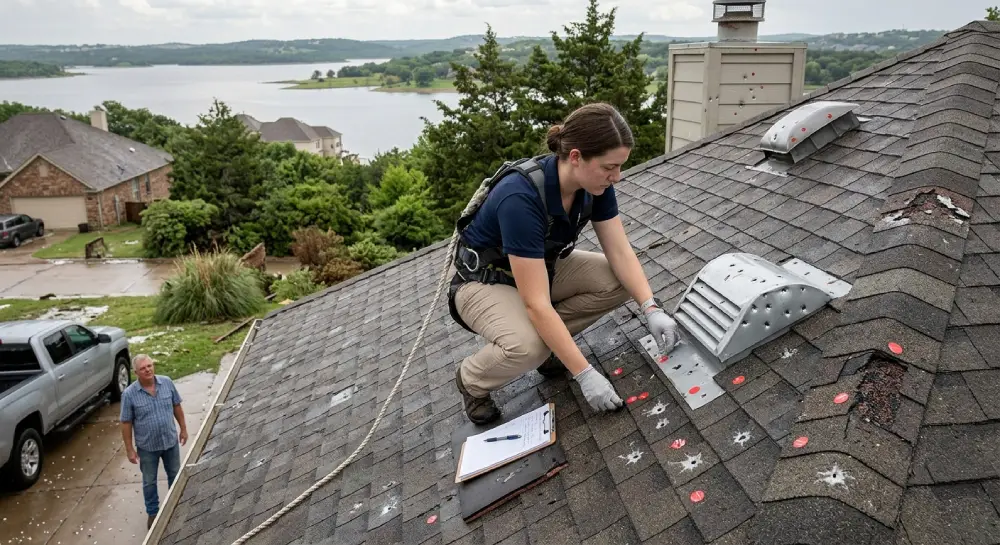
Hail is one of the most frequent reasons property owners seek insurance claim assistance in Benbrook. Damage may affect more than the field shingles on a roof. For a detailed explanation of inspections, documentation, carrier estimates, and disputed roofing damage, read our Texas guide to a hail damage roof insurance claim.
A proper hail inspection may need to evaluate:
- Asphalt shingle matting and granule displacement
- Metal roof panels and seams
- Tile or specialty roofing materials
- Ridge caps and hip caps
- Roof vents, flashing, and pipe jacks
- Gutters and downspouts
- Window screens and glazing
- Garage doors
- Fences and exterior paint
- HVAC condenser fins
- Solar equipment
- Detached garages, sheds, and patio covers
Wind damage can be equally complicated. High winds may lift or crease shingles without removing them completely. They can loosen flashing, damage fascia, pull gutters away from the structure, break windows, and drive rain beneath roofing or siding.
A quick ground-level inspection may not reveal these conditions.
Heavy Rain and Water Intrusion
Lake Benbrook is a major local landmark and flood-control reservoir on the Clear Fork of the Trinity River. The U.S. Army Corps of Engineers manages the lake as part of the Trinity Regional Project.
Even when a building is not directly affected by rising surface water, heavy rainfall can expose weaknesses in roofs, windows, walls, drainage systems, and foundations. Common claim issues include:
- Wind-driven rain entering through damaged roofing
- Water penetration around vents or flashing
- Ceiling and wall staining
- Wet insulation
- Flooring damage
- Cabinet and millwork swelling
- Mold-related concerns
- Water entering through damaged doors or windows
- Overflow from failed drainage systems
Insurance treatment depends heavily on the source of the water. A standard property policy may treat wind-driven rain differently from groundwater, surface flooding, plumbing discharge, or long-term seepage. The cause should be investigated carefully before the loss is characterized.
Winter Freeze Damage
North Texas freezes can damage supply lines, plumbing fixtures, fire-suppression systems, exterior pipes, and mechanical equipment. A burst pipe may release water into walls, ceilings, flooring, cabinetry, and electrical components before the problem is discovered.
Freeze claims can become underpaid when the estimate covers only visible finishes and does not account for demolition, drying, plumbing access, insulation, matching, or reconstruction of the affected assemblies.
Fire, Smoke, and Electrical Losses
Fire damage claims often involve several distinct categories of loss:
- Burned structural materials
- Smoke and soot contamination
- Water used during firefighting
- Demolition and debris removal
- Damaged personal property
- Electrical and mechanical systems
- Temporary housing or relocation
- Code-related upgrades
- Business interruption
Smoke may travel far beyond the room where the fire started. Porous materials, insulation, ductwork, electronics, textiles, and contents may require specialized evaluation. A claim that focuses only on visibly burned materials may not account for the complete loss.
Common Insurance Claims in Benbrook
Hail Damage Claims
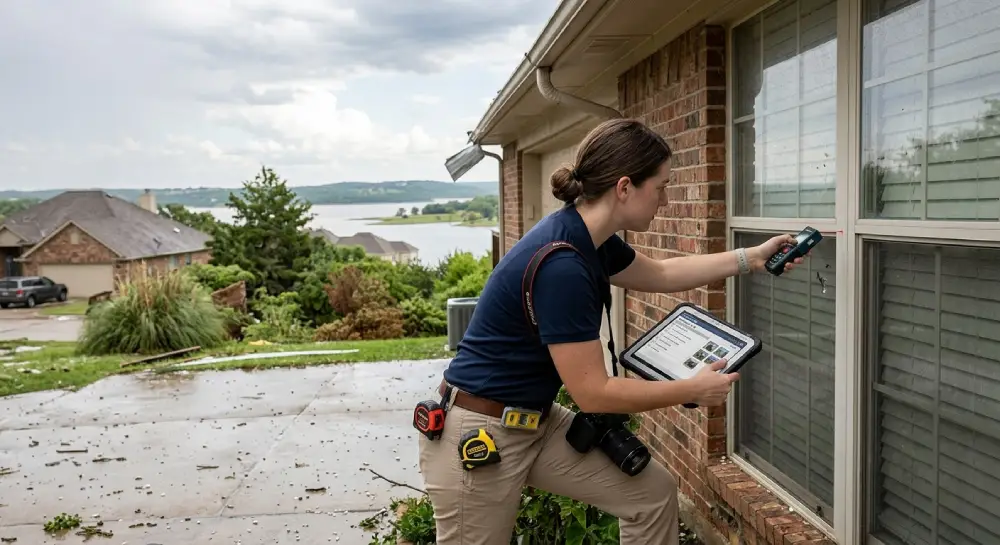
Benbrook hail claims frequently involve disputed roof damage, incomplete exterior scopes, or disagreements about whether damage resulted from a recent storm or long-term deterioration.
We review the roof, exterior elevations, soft metals, accessories, and available storm evidence. We also compare the carrier’s estimate with the conditions observed at the property. Property owners should preserve photographs, contractor observations, damaged materials, and storm information as early as possible. Our guide explains how to document hail damage for an insurance claim before repairs or weather conditions alter the evidence. When the carrier attributes the condition to age, wear, or maintenance, review the steps to take if you are deciding what to do if your hail claim was denied.
Water Damage Claims
Water losses may result from plumbing failures, appliance leaks, damaged roofing, overflowing systems, or firefighting efforts. Documentation should identify the water source, affected rooms, damaged materials, required drying, and necessary reconstruction.
Moisture can travel beneath flooring and behind walls, meaning the visible stain may represent only a small portion of the affected area. A water damage public adjuster can review whether the carrier’s scope includes drying, demolition, access, damaged finishes, and necessary reconstruction.
Fire and Smoke Damage Claims
Fire claims require detailed inventories, repair scopes, cleaning evaluations, and documentation of additional living expenses or business interruption. The difference between cleaning, restoring, and replacing an item can materially affect the claim. A fire insurance adjuster working for the policyholder can help organize structural damage, smoke contamination, contents, debris removal, temporary relocation expenses, and other documented portions of the loss.
Storm and Wind Damage Claims
Thunderstorms can damage roofing, fencing, windows, gutters, siding, trees, exterior structures, and commercial signage. Wind-driven rain may create interior damage that appears several days after the storm.
Roof Damage Claims
Roof claims are often disputed because roofs also experience normal aging. That does not mean every condition is wear and tear.
A thorough review considers the date and direction of the storm, the damage pattern, roofing material, age, prior repairs, collateral damage, installation details, and the carrier’s stated basis for approving or denying coverage. When the carrier’s roof estimate omits related components or the cause of damage is disputed, a public adjuster for a roof claim can review the inspection findings, policy documents, scope, and supporting evidence.
Commercial Property Claims
Benbrook commercial claims may involve retail buildings, restaurants, offices, multifamily properties, warehouses, churches, medical facilities, and mixed-use properties.
A commercial loss may include:
- Building repairs
- Contents and inventory
- Machinery or equipment
- Tenant improvements
- Debris removal
- Extra expenses
- Lost rental income
- Business interruption
- Code upgrades
- Professional fees
- Temporary protection and mitigation
Learn more about how TX Public Adjusting handles large-loss and commercial property claims involving buildings, equipment, inventory, tenant improvements, extra expenses, and business interruption. Commercial policies often contain detailed conditions, sublimits, valuation provisions, and reporting requirements. Early organization can prevent critical documentation from being lost.
Why Benbrook Insurance Claims Become Underpaid
An underpaid claim is not always caused by one major error. It often results from multiple omissions that add up.
Damage Was Missed
The insurer may inspect only the most obvious areas. A roof estimate may exclude gutters, vents, window screens, fences, interiors, HVAC equipment, or detached structures.
The Scope Is Too Narrow
The estimate may include removal and replacement of a damaged material without including access, protection, disposal, adjacent materials, or required steps to perform the repair correctly.
Depreciation Was Applied Incorrectly
Policies may distinguish between actual cash value and replacement cost. Recoverable and nonrecoverable depreciation should be reviewed carefully, along with the conditions for claiming withheld amounts.
Repair Pricing Is Too Low
Labor rates, material costs, equipment charges, permit expenses, and specialty trade requirements vary. An estimate based on incomplete quantities or outdated assumptions may not reflect the work needed at the property.
Documentation Is Incomplete
Photographs alone may not explain the complete claim. Depending on the loss, the file may require measurements, moisture readings, contractor estimates, inventories, invoices, engineering reports, weather records, repair specifications, and a written explanation connecting the evidence to the requested scope.
Damage Was Labeled Wear and Tear
Carriers may attribute roof or exterior conditions to age, maintenance, installation defects, or deterioration. Those exclusions may apply to some conditions, but the conclusion should be compared with the physical evidence and reported cause of loss.
Matching and Consistency Were Not Addressed
A spot repair may create a visible inconsistency or may not be practical because the original product is discontinued, brittle, or unavailable. Policy language and Texas claim circumstances should be reviewed before assuming that a limited repair is sufficient.
Our Public Adjusting Process
1. Claim Review
We begin by discussing what happened, when the loss occurred, what the carrier has done, and what concerns you have about the claim.
We may review:
- The policy and declarations
- The carrier’s estimate
- Payment letters
- Denial or reservation-of-rights letters
- Contractor estimates
- Photographs and videos
- Repair invoices
- Prior claim documents
- Communications with the insurer
2. Property Inspection
We inspect accessible areas related to the reported loss. The scope may include roofing, exterior elevations, interior rooms, contents, mechanical systems, or commercial operations.
The purpose is to identify and document damage—not simply to repeat the carrier’s findings.
3. Damage Documentation
We organize the evidence needed to support the claim. Depending on the property and loss, this may include measurements, photographs, inventories, estimates, reports, invoices, timelines, and policy-based explanations.
4. Claim Preparation
We prepare the policyholder’s claimed scope and supporting documentation. Missing items and differences between the observed damage and the carrier’s estimate are identified.
5. Carrier Communication and Negotiation
We communicate with the insurer and present the documented claim. We respond to questions, participate in inspections when appropriate, and address disputed scope or valuation issues.
6. Resolution and Payment Review
When the carrier issues revised estimates or payments, we review them with the property owner. We also help clarify depreciation, deductibles, mortgage-company involvement, and remaining documentation requirements.
A Local Claim Requires More Than a City Name
Benbrook is not simply another Fort Worth-area location to insert into a generic claims page.
Properties near Lake Benbrook and Baja Beach may face different drainage, wind exposure, vegetation, and access considerations than homes closer to Interstate 20. Established subdivisions near Timbercreek Road may have older roofing systems, mature trees, and additions completed under different building standards. Newer homes near Whitestone may use different exterior assemblies and roofing materials. Commercial properties along U.S. 377 may have flat roofs, rooftop units, signage, and tenant-related losses that do not exist in a typical residential claim.
The city’s proximity to Fort Worth also means repair demand can rise quickly after a widespread DFW hailstorm. Contractors, roofers, drying companies, engineers, and specialty trades may all be working across the metroplex at the same time. Material availability and repair timelines may change as claim volume increases.
These local conditions matter when documenting the scope, estimating the repair, and explaining why a carrier’s initial figure may not be sufficient.
Concerned that your Benbrook insurance claim is missing damage or repair costs? Request a free claim review from TX Public Adjusting. There are no upfront fees.
Why Choose TX Public Adjusting
Licensed Texas Public Adjuster
TX Public Adjusting is operated by Rise Public Adjusting LLC, Texas License #3356839.
Representation for Policyholders
We work for residential and commercial policyholders. We do not represent the insurance company.
Texas Claim Experience
Our team has reviewed thousands of property claim files involving Texas hail, wind, water, roof, fire, freeze, and commercial losses. We understand how policy language, documentation, construction scope, and claim presentation work together.
Residential and Commercial Expertise
A residential roof claim and a commercial property loss require different documentation. We adapt the claim strategy to the building, policy, occupancy, and type of damage.
Detailed Scope Review
We look beyond the total at the bottom of the carrier’s estimate. Quantities, repair methods, omitted components, depreciation, pricing, and policy provisions can all affect the result.
No Upfront Fees
Benbrook property owners can request an initial claim review without paying an upfront fee. Any fee arrangement is explained in writing before representation begins.
Residential and Commercial Properties We Assist
Our public adjusting services may be appropriate for:
| Property Type | Common Claim Concerns |
| Single-family homes | Roofing, interiors, contents, fences, detached structures |
| Apartments and multifamily properties | Multiple units, tenant damage, common areas, lost rent |
| Retail properties | Roofing, glass, signage, inventory, business interruption |
| Offices | Interior finishes, electronics, equipment, temporary relocation |
| Churches | Specialty roofs, stained glass, sound systems, contents |
| Restaurants | Equipment, food inventory, smoke, water, business income |
| Warehouses | Roof systems, inventory, loading areas, machinery |
| Medical and professional facilities | Equipment, records, specialized interiors, downtime |
Areas We Serve Near Benbrook
TX Public Adjusting assists property owners throughout Benbrook and nearby Tarrant County and western DFW communities, including:
- Fort Worth
- Southwest Fort Worth
- Aledo
- White Settlement
- Westover Hills
- Westworth Village
- River Oaks
- Crowley
- Burleson
- Edgecliff Village
- Willow Park
- Hudson Oaks
Benbrook is immediately southwest of Fort Worth and is served by major routes including Interstate 20, Loop 820, and U.S. 377.
Frequently Asked Questions
What does a public adjuster in Benbrook do?
A public adjuster represents the policyholder during a property insurance claim. The adjuster reviews the policy, inspects the damage, prepares supporting documentation, identifies missing or undervalued items, and communicates with the insurance company.
TX Public Adjusting works for Benbrook property owners—not their insurance carriers.
When should I hire a public adjuster after Benbrook property damage?
The best time to request a claim review is before important evidence disappears or permanent repairs begin. Early involvement may help preserve documentation, organize the loss, and reduce avoidable claim mistakes.
A public adjuster may also become involved after the insurance company issues a low estimate, partial denial, or disputed coverage decision. The available options depend on the policy, claim status, deadlines, and evidence. Because policies and claim circumstances vary, property owners should also understand when it may be too late to hire a public adjuster or submit additional documentation.
Can you help if my Benbrook roof claim was denied?
Yes. We can review the carrier’s denial, estimate, inspection findings, policy language, and available evidence. A denied roof claim is not automatically reversible, but the stated reason should be evaluated carefully.
Disputes commonly involve wear and tear, improper installation, maintenance, age, prior damage, or whether the reported storm caused functional damage.
Can a public adjuster reopen an underpaid claim?
Some claims may be reopened or supplemented when additional covered damage or repair costs can be documented. The right approach depends on the policy, payment history, proof of loss, prior communications, repair status, and applicable deadlines.
Do not assume that a closed file means no further action is possible. It is better to have the documents reviewed before deciding.
How much does a public adjuster cost in Benbrook?
Public adjusters generally charge a fee based on the claim arrangement permitted by Texas law and stated in the written contract. The exact fee depends on the circumstances and services involved.
TX Public Adjusting offers a free initial claim review and does not charge upfront fees. The fee agreement is explained before you retain the firm.
Does a public adjuster replace my contractor?
No. A contractor determines how to perform construction or restoration work and provides repair services. A public adjuster represents the policyholder in the insurance claim.
The roles may involve some of the same property information, but they are not interchangeable. A public adjuster handles claim scope, documentation, valuation, and carrier communication.
What damage is common after a Benbrook hailstorm?
Common damage includes bruised or fractured shingles, damaged ridge caps, dented vents and flashing, damaged gutters, torn screens, fence damage, HVAC fin damage, and water intrusion.
Hail damage may vary across the same neighborhood because roof slope, material, building height, tree cover, wind direction, and hail size affect each property differently.
Does homeowners insurance cover flooding near Lake Benbrook?
Standard homeowners policies generally distinguish surface flooding from water entering because of covered building damage or an internal plumbing event. Flood coverage is commonly provided through a separate flood policy, but the exact answer depends on the source of the water and policy language.
Because water-source classification can affect coverage, property owners should avoid guessing about the cause before the loss is investigated.
Can you handle commercial insurance claims in Benbrook?
Yes. TX Public Adjusting assists commercial policyholders with building damage, inventory, contents, equipment, tenant improvements, extra expenses, lost income, and other documented elements of a covered loss.
Commercial claims should be organized early because operational records, invoices, sales history, leases, and mitigation costs may become part of the claim.
How long does a Benbrook property claim take?
There is no universal timeline. A straightforward residential claim with agreed coverage and scope may move faster than a large commercial loss, fire claim, disputed roof claim, or claim requiring expert reports.
The timeline may be affected by inspections, document requests, contractor availability, mortgage-company requirements, policy conditions, supplements, and disagreements over the cause or value of damage. Property owners waiting for an initial response may also find it helpful to understand how long an insurance adjuster has to contact you after a claim is reported.
Get a Free Benbrook Insurance Claim Review
Contact TX Public Adjusting for a free review of your Benbrook property claim, carrier estimate, payment documents, photographs, and coverage concerns. When a claim is denied, delayed, or underpaid, you should not have to rely only on the insurance company’s estimate of its own obligation.
TX Public Adjusting can review your policy documents, carrier estimate, payment history, photographs, and claim concerns. We assist Benbrook property owners with hail, wind, roof, water, fire, freeze, storm, and commercial property claims.
Contact TX Public Adjusting for a free claim review.
- Licensed Texas public adjuster
- Residential and commercial claims
- Independent policyholder representation
- No upfront fees
- Rise Public Adjusting LLC
- Texas License #3356839