

Property damage in Snyder can happen quickly. One severe West Texas thunderstorm can leave a roof bruised by hail, tear metal panels from a commercial building, damage HVAC equipment, break windows, or allow wind-driven rain into walls and ceilings. When the repair estimate from the insurance company does not reflect the full scope of the loss, a public adjuster in Snyder, TX can help the property owner document the claim and pursue a fair settlement under the policy.
TX Public Adjusting is a Texas public adjusting firm representing residential and commercial policyholders—not insurance companies. Our team reviews damage, studies the policy, prepares supporting documentation, and communicates with the carrier throughout the claim process.
TX Public Adjusting is operated by Rise Public Adjusting LLC, a licensed Texas public adjusting firm. Texas License #3356839.
Concerned that your Snyder property claim is underpaid, delayed, or missing damage? Contact TX Public Adjusting for a free claim review. There are no upfront fees.
Insurance Claim Help for Snyder Property Owners
Snyder is the county seat of Scurry County and serves as an important commercial, educational, agricultural, and energy center for the surrounding region. The community sits near the intersection of U.S. Highways 84 and 180, with Western Texas College, downtown Snyder, industrial properties, retail corridors, churches, ranch-related businesses, and residential neighborhoods spread across the city.
That mix of property types creates a wide range of insurance claim concerns.
A hailstorm may damage asphalt shingles on a house near Towle Memorial Park while also denting metal roofs, rooftop equipment, signage, and exterior panels on a commercial property closer to the highway corridors. A plumbing leak can affect one room in a residence or interrupt operations throughout an office, restaurant, retail building, or multifamily property.
Insurance carriers frequently inspect losses soon after they are reported. That does not always mean every damaged component will appear in the carrier’s estimate. Some problems are subtle. Others become visible only after moisture testing, a more detailed roof inspection, or a comparison between the damaged materials and the repairs actually required.
A Snyder public adjuster provides an independent claim assessment from the policyholder’s side.
Why Property Owners Hire a Public Adjuster in Snyder
The insurance company assigns an adjuster to investigate the loss for the carrier. Understanding the difference between a public adjuster and an independent adjuster helps clarify who each professional represents. A public adjuster represents the insured property owner during the preparation and negotiation of the property claim.
Property owners often contact TX Public Adjusting when:
- The carrier’s estimate appears too low.
- Visible damage was left out of the scope.
- The roof claim includes only minor repairs despite widespread damage.
- Interior water damage was addressed, but the source or hidden moisture was not.
- A commercial claim is interfering with normal business operations.
- The carrier is requesting extensive documentation.
- Depreciation or repair pricing is difficult to understand.
- The claim has stalled.
- A supplemental claim needs to be prepared.
- The property owner does not have time to manage repeated inspections and communications.
Hiring a public adjuster does not guarantee a particular outcome. Coverage depends on the policy, the cause of loss, exclusions, deductibles, endorsements, documentation, and the facts of the claim. Our job is to identify covered damage, prepare a detailed claim presentation, and advocate for the policyholder based on the available evidence.
Snyder’s Most Significant Property-Damage Risks
Large Hail and Severe Thunderstorms
Hail is one of the most important property risks in Snyder and Scurry County.
The National Weather Service documented a major Snyder hailstorm on May 16, 2021. Reports included golf-ball- to baseball-size hail within minutes of the storm reaching the city. More recently, 1.5-inch hail was reported approximately one mile from Snyder on May 10, 2026.
Those storms can damage far more than shingles. A complete hail investigation may include:
- Asphalt shingles
- Metal roofing
- Modified bitumen and built-up roofing
- Roof vents and flashing
- Gutters and downspouts
- Window screens
- Siding and exterior finishes
- Fencing
- Garage doors
- HVAC condenser fins
- Skylights
- Solar equipment
- Commercial rooftop units
- Metal wall panels
- Signs and exterior lighting
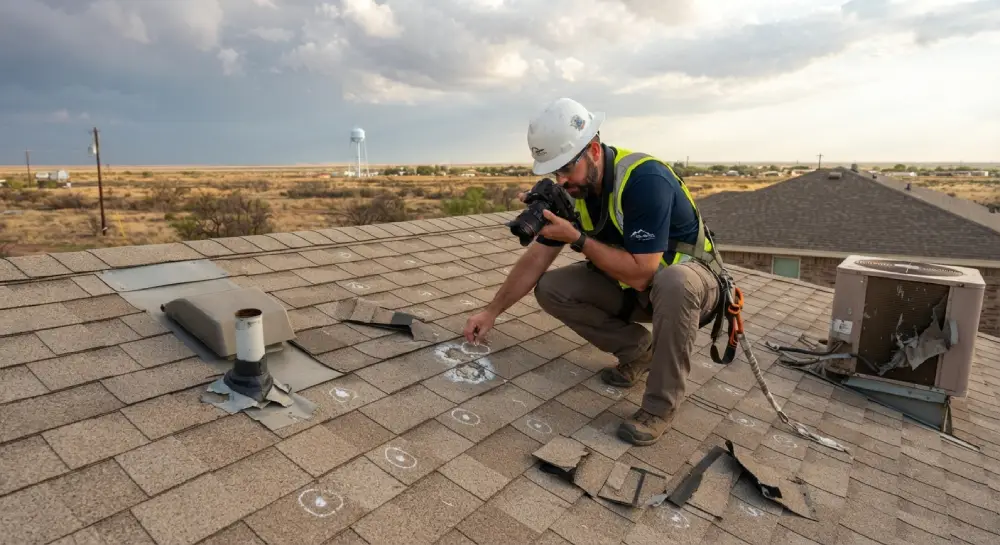
Hail damage is not always obvious from ground level. Shingle impacts may remove protective granules or fracture the mat beneath the surface. Metal roofs may remain watertight while still sustaining widespread functional or cosmetic damage that must be evaluated under the specific policy language.
High Winds and Wind-Driven Rain
West Texas thunderstorms can produce sudden, forceful wind. Even without a tornado, straight-line winds may loosen shingles, lift roof edges, damage membranes, pull flashing away from walls, topple trees, and drive rain through openings.
After a windstorm, the interior stain may receive most of the attention. The more important question is how the water entered.
A thorough claim assessment may need to connect interior water damage to:
- Missing or creased shingles
- Displaced flashing
- Damaged roof penetrations
- Open seams in a commercial roof
- Broken windows
- Failed exterior cladding
- Wind-damaged doors
- Openings around vents or rooftop equipment
When the estimate treats only the ceiling stain but omits the storm-created opening, the claim scope may not be complete.
Tornado and Rotational-Wind Damage
Snyder is in West Texas, where severe storms can produce rotating winds and occasional tornadoes. Tornado frequency is generally lower in western portions of Texas than in some parts of North and East Texas, but the risk is not zero.
Even a brief circulation can cause concentrated damage to roofs, detached structures, fences, windows, utility connections, signage, and lightweight commercial construction.
Properties in open areas near the edge of Snyder may also face greater wind exposure because there are fewer surrounding buildings and trees to interrupt gusts.
Water and Plumbing Losses
Not every serious Snyder insurance claim begins with a storm.
Common water losses include:
- Burst supply lines
- Failed water heaters
- Toilet overflows
- Plumbing leaks behind walls
- Appliance supply-line failures
- Roof leaks
- HVAC drain backups
- Sprinkler-system discharges
- Commercial equipment leaks
The visible water is only one part of the loss. Moisture can migrate beneath flooring, into insulation, behind cabinets, and through adjoining rooms. When documentation is incomplete, the estimate may cover paint and drywall but overlook flooring transitions, cabinetry, insulation, electrical work, drying equipment, or access required to reach the damaged materials.
Freeze-Related Damage
Cold weather can create significant claims even in West Texas. Frozen pipes may rupture in walls, ceilings, attics, or mechanical spaces. The resulting water damage may not be discovered until temperatures rise and the frozen section begins leaking.
Commercial facilities, vacant properties, detached buildings, and poorly insulated plumbing are especially vulnerable.
Fire, Smoke, and Electrical Damage
Fire claims are often among the most complex losses a Snyder property owner can face.
The damage may include:
- Direct fire damage
- Smoke and soot contamination
- Water used during suppression
- Damaged electrical systems
- Compromised framing
- HVAC contamination
- Personal property loss
- Debris removal
- Temporary repairs
- Business interruption
- Additional living expenses
Smoke can travel well beyond the room where the fire started. It may enter wall cavities, insulation, ductwork, closets, ceiling systems, and adjoining rooms. A limited estimate focused only on visibly burned materials may not address the full extent of the loss.
Common Insurance Claims in Snyder
Hail Damage Claims
A Snyder hail claim should account for every affected exterior component—not only the most obvious roof impacts.
Our review may include the roof surface, soft metals, vents, flashing, gutters, windows, screens, HVAC equipment, exterior paint, siding, fencing, and detached structures. On commercial properties, we also evaluate rooftop equipment, metal panels, membrane systems, signage, and interior water intrusion.
Roof Damage Claims
Property owners may hire a public adjuster for a roof claim when the carrier proposes limited repairs but the documented damage appears more extensive.
The carrier may estimate a small repair, while the contractor or property owner believes the damage is more extensive. Questions may involve matching, brittle materials, discontinued products, code requirements, roof geometry, underlayment, flashing, edge metal, access, and whether repairs can be completed without damaging surrounding materials.
A public adjuster can document these issues and present them as part of the claim.
Water Damage Claims
A water damage public adjuster can help document the source of the loss, affected materials, moisture migration, drying work, demolition, and reconstruction.
For a home, that could involve flooring, drywall, baseboards, cabinets, paint, insulation, and contents. For a commercial property, the claim may also involve inventory, equipment, tenant improvements, suspended ceilings, electrical systems, and lost operating time.
Fire and Smoke Damage Claims
A fire insurance adjuster working for the policyholder can help organize structural damage, smoke cleaning, contents, debris removal, temporary protection, and living or operating expenses.
Our role is to help organize the claim so that separate categories of damage are not overlooked or improperly combined.
Storm and Wind Damage Claims
Wind claims may involve lifted shingles, torn roof membranes, damaged fences, broken glass, fallen limbs, exterior cladding, and rain intrusion.
Because wind damage can appear in scattered areas, a quick inspection may not capture the full pattern.
Commercial Property Claims
Snyder supports businesses connected to energy, agriculture, education, healthcare, retail, food service, storage, construction, and professional services. Commercial losses can be more complicated than residential claims because the damaged property may include specialized equipment, tenant improvements, inventory, signage, mechanical systems, and income-related coverage.
A commercial public adjuster can help document building damage, equipment losses, inventory, tenant improvements, and other covered business-property concerns. TX Public Adjusting assists with commercial claims involving:
- Office properties
- Retail buildings
- Restaurants
- Warehouses
- Churches
- Multifamily properties
- Self-storage facilities
- Industrial buildings
- Metal buildings
- Agricultural and ranch-related facilities
- Professional and medical offices
Claim Concerns in Different Parts of Snyder
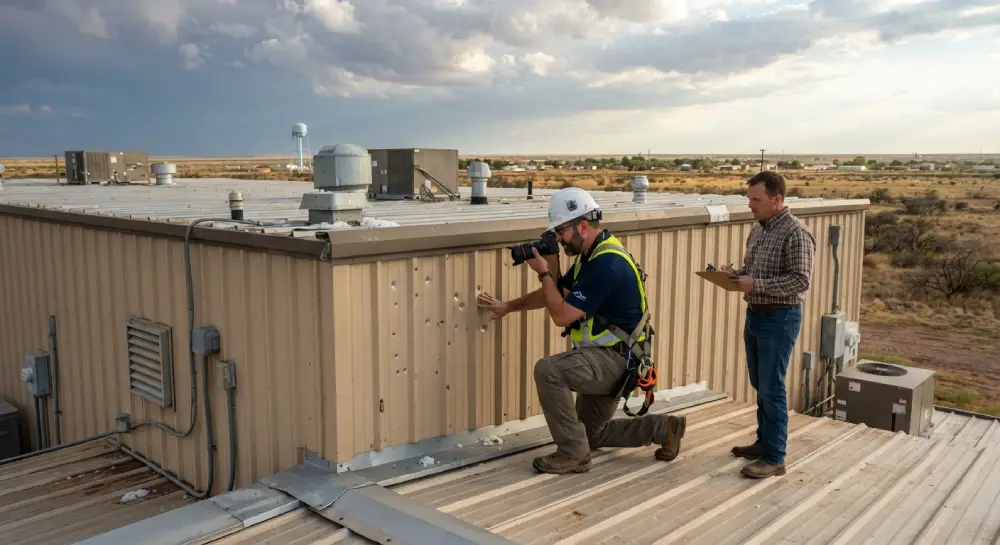
Snyder does not need to be divided into formal big-city neighborhoods for property risks to vary across the community. Building age, roof type, exposure, occupancy, and construction all affect how a loss should be evaluated.
Downtown Snyder and the Courthouse Square
The downtown square and surrounding commercial blocks include older buildings, storefronts, offices, civic properties, and structures with multiple layers of repairs or improvements. Scurry County promotes a downtown walking trail featuring 14 historical markers, reflecting the concentration of older and historically significant properties in this part of Snyder.
Claims involving older commercial buildings may require closer review of:
- Roofing transitions
- Parapet walls
- Masonry
- Interior finishes
- Older electrical components
- Shared walls
- Code-related repairs
- Water migration between connected spaces
Western Texas College Area
Western Texas College is one of Snyder’s major institutions and an important local landmark. Properties near the college include residences, apartments, educational facilities, athletic spaces, and service businesses.
Hail and wind claims in this area may involve a mix of residential roofing, multifamily construction, flat or low-slope commercial roofs, and exterior mechanical equipment.
Towle Memorial Park and Central Residential Areas
Homes near Towle Memorial Park and established central sections of Snyder may have mature trees, older roofing systems, detached garages, fences, and additions built at different times.
After severe weather, claim documentation should distinguish between storm-created damage and ordinary wear while still accounting for all affected components.
East Snyder and the Coliseum Drive Area
Heritage Village, located at 900 East Coliseum Drive, preserves historic and replica buildings connected to Snyder and Scurry County’s past.
The broader east Snyder area contains a range of residential, civic, recreational, and commercial properties. Roof age and construction type may vary significantly from one block to another.
Highway 84 and Highway 180 Commercial Corridors
Snyder’s location at U.S. Highways 84 and 180 makes these routes important for local businesses and regional traffic.
Commercial claims along these corridors may include damage to:
- Metal roofs and wall panels
- Signs
- Storefront glass
- Canopies
- Rooftop HVAC equipment
- Flat roofing systems
- Inventory
- Parking-lot lighting
- Fences and gates
When a business must close or reduce operations after a covered loss, the claim may also involve extra expenses or business-income considerations, depending on the policy.
Why Snyder Insurance Claims Become Underpaid
An underpaid claim is not always caused by one large mistake. More often, several smaller omissions reduce the overall estimate. Many common property insurance claim mistakes involve incomplete documentation, missed damage, misunderstood depreciation, or accepting an estimate before the full scope has been evaluated.
Damage Was Missed During the Inspection
The initial inspection may be brief or limited to visible areas. Damage can be overlooked on steep roofs, low-slope roofs, rooftop equipment, rear elevations, detached structures, or interior spaces where moisture has not yet produced obvious staining.
The Scope Covers Symptoms but Not the Cause
An estimate may include ceiling paint and drywall after a storm without addressing the damaged roofing or flashing that allowed the water to enter.
Repair Pricing Is Too Low
Labor rates, material prices, equipment, access costs, and contractor overhead can change. An estimate based on incomplete measurements or pricing assumptions may not reflect the reasonable cost of completing the repairs in the Snyder area.
Required Repair Steps Are Missing
A scope may list the main material but omit related work such as:
- Removal and disposal
- Detaching and resetting fixtures
- Contents manipulation
- Surface preparation
- Primer
- Texture matching
- Insulation
- Underlayment
- Flashing
- Edge metal
- Permit costs
- Equipment access
- Final cleaning
Each omission may appear small. Together, they can create a substantial difference.
Depreciation Is Misunderstood
Insurance estimates may include recoverable or nonrecoverable depreciation depending on the policy and damaged property. Property owners sometimes mistake the initial payment for the final amount available.
A public adjuster can explain how the estimate is structured and identify documentation that may be required to pursue recoverable amounts.
Code-Related Work Was Not Addressed
Older Snyder properties may require repairs that interact with current building requirements. Coverage for ordinance or law-related costs depends on the policy, but these issues should still be identified and reviewed rather than ignored.
Commercial Losses Are Oversimplified
A commercial estimate may address the building while overlooking equipment, inventory, tenant improvements, debris handling, temporary protection, or the operational consequences of the loss.
Our Public Adjusting Process
1. Free Claim Review
We begin by discussing what happened, when the damage occurred, what the insurance company has done, and what concerns you have about the claim.
When available, we may review:
- The insurance policy
- Carrier estimates
- Payment letters
- Coverage correspondence
- Photographs
- Contractor estimates
- Repair invoices
- Engineering reports
- Prior claim documents
2. Property Inspection
We inspect the reported damage and look for related conditions that may have been missed.
The inspection is tailored to the loss. A hail claim requires a different approach from a plumbing leak, fire, freeze, or commercial interruption claim.
3. Scope and Documentation
We organize the loss into a detailed claim presentation. Documentation may include photographs, measurements, repair estimates, inventories, moisture information, invoices, reports, and supporting records.
4. Claim Communication
We communicate with the carrier and respond to claim-related requests within the scope of our representation.
This reduces the burden on the property owner and helps keep the claim focused on documented damage and applicable policy provisions.
5. Negotiation and Resolution
We present the documented scope and negotiate with the insurance company.
The final outcome depends on the facts, coverage, policy terms, evidence, and carrier decisions. We do not promise a specific settlement, but we work to ensure the policyholder’s claim is thoroughly prepared and supported.
Need a Second Look at Your Snyder Claim?
A low estimate does not automatically mean the claim is finished.
TX Public Adjusting can review the carrier’s scope, identify possible omissions, and explain practical next steps. We assist with new, active, delayed, denied, and underpaid property claims when the circumstances and policy allow.
Request a free claim review. There are no upfront fees.
Why Choose TX Public Adjusting?
Licensed Texas Public Adjuster
TX Public Adjusting operates through Rise Public Adjusting LLC, Texas License #3356839.
We Represent Policyholders
The insurance company’s adjuster works within the carrier’s claim operation. We represent the residential or commercial policyholder.
Texas-Focused Claim Experience
Our work is focused on Texas property losses, including hail, wind, water, fire, roof, freeze, and commercial claims.
Residential and Commercial Knowledge
A house claim and a commercial claim should not be handled as though they are the same. Commercial losses may involve specialized roofs, equipment, inventory, tenant improvements, and business-related coverage.
Detailed Claim Preparation
Successful claim advocacy depends on evidence. We focus on inspection, documentation, scope review, pricing, and clear communication.
Experience Reviewing Thousands of Claims
Our team brings experience from reviewing thousands of residential and commercial claim files. That experience helps us recognize common omissions, documentation problems, and estimating issues without inventing results or promising outcomes.
No Upfront Fees
Property owners can begin with a free claim review. Public adjusting services are generally provided under a written agreement with compensation tied to the claim recovery, subject to Texas law and the terms of the contract.
Areas We Serve Near Snyder
TX Public Adjusting assists property owners throughout Snyder, Scurry County, and surrounding West Texas communities.
Nearby service areas include:
- Hermleigh
- Ira
- Dunn
- Fluvanna
- Camp Springs
- Dermott
- Colorado City
- Sweetwater
- Rotan
- Roby
- Loraine
- Post
- Big Spring
- Abilene
- Lubbock
Hermleigh, Ira, Dunn, Fluvanna, Camp Spring, and Dermott are among the communities associated with Scurry County.
Property owners outside Snyder can contact our team to confirm service availability.
Frequently Asked Questions
What does a public adjuster in Snyder do?
A public adjuster represents the policyholder during a property insurance claim. Property owners who want a fuller explanation of what a public adjuster does can review our Texas property-owner guide. The work may include reviewing the policy, inspecting damage, preparing an estimate, organizing supporting records, communicating with the carrier, and negotiating the documented claim.
TX Public Adjusting does not work for the insurance company. Our responsibility is to the residential or commercial client who hires us.
When should I hire a Snyder public adjuster?
You may benefit from a public adjuster when the claim is large, technically complicated, underpaid, delayed, denied, or difficult to manage. Property owners also contact us when the carrier’s estimate omits obvious damage or when competing assessments differ significantly.
The strongest time to seek help is usually before damaged materials are removed and before important claim deadlines pass. Our guide explains when it may be too late to hire a public adjuster and why earlier claim review usually preserves more documentation options.
Can a public adjuster help with a Snyder hail claim?
Yes. Hail claims are a major part of property adjusting in West Texas. The investigation may include roofing, gutters, vents, flashing, windows, screens, HVAC equipment, siding, fences, metal panels, and interior water damage.
Because Snyder has experienced significant hail events—including a 2021 storm with golf-ball- to baseball-size hail—property owners should not assume a quick ground-level inspection will identify every affected component.
Can you help when my roof claim only pays for repairs?
Possibly. We can inspect the damage, review the carrier’s measurements and estimate, and evaluate whether the proposed repair scope accounts for all affected materials and necessary work.
The appropriate repair depends on the roof system, extent of damage, material condition, matching concerns, installation requirements, policy language, and applicable coverage.
What if my insurance company already issued a check?
Receiving a check does not always mean the claim is closed. The payment may be an initial undisputed amount, may include depreciation, or may be based on an incomplete scope.
Do not assume additional documentation is prohibited simply because a payment was issued. A public adjuster can review the estimate and payment letter to determine what the carrier included and whether further claim activity may be appropriate.
Can you help with a denied property claim?
We can review denied claims to understand the stated reason, the supporting documentation, and the relevant policy provisions. Some denials involve exclusions or uncovered causes of loss. Others may involve insufficient documentation or disagreement about how the damage occurred.
A public adjuster cannot provide legal advice or force an insurer to reverse a decision. When a matter requires legal interpretation or litigation, the policyholder may need to speak with a qualified insurance attorney.
How much does a public adjuster cost in Snyder?
Public adjusters generally work for a fee described in a written contract, often calculated as a percentage of the claim recovery. Our guide to public adjuster fees explains how these arrangements generally work and why the terms should be reviewed before representation begins.
TX Public Adjusting offers a free initial claim review and does not charge upfront fees. The specific fee and terms are explained before a representation agreement is signed.
How long does a property claim take?
There is no single timeline. A straightforward residential loss may move faster than a large fire, commercial hail claim, disputed roof loss, or claim involving engineering questions.
Timing can be affected by inspection scheduling, documentation, contractor input, carrier response times, supplemental estimates, policy issues, and the extent of disagreement. Property owners may also review our guide explaining how long an insurance adjuster has to contact you after a claim is reported.
Do you handle commercial claims in Snyder?
Yes. We assist owners of commercial and multifamily properties with hail, wind, water, fire, roof, and other covered property losses.
Commercial claims may involve metal roofing, membrane roofs, equipment, inventory, interior improvements, signage, temporary repairs, debris removal, and business-related coverage. Each policy and loss must be evaluated individually.
What should I do immediately after storm damage?
Protect people first. Then take reasonable steps to prevent additional damage, such as temporary covering or emergency water extraction, when it is safe to do so.
Photograph the property before cleanup, keep damaged materials when practical, save receipts, record the date and time of the event, and avoid permanent repairs until the damage has been adequately documented. Review your policy and report the claim promptly.
Contact a Public Adjuster in Snyder, TX
Insurance claims can become overwhelming when the damage is widespread, the paperwork is unclear, or the carrier’s estimate does not match the repairs your property needs.
TX Public Adjusting helps Snyder homeowners, landlords, business owners, commercial property owners, churches, and multifamily operators document property damage and present supported insurance claims.
Rise Public Adjusting LLC
Texas Public Adjuster License #3356839
Residential and Commercial Property Claims
Free Claim Review
No Upfront Fees
Contact TX Public Adjusting today to request your free Snyder insurance claim review.