

Property damage in Beasley can turn into an insurance dispute faster than many owners expect. A severe thunderstorm can damage a roof and exterior in minutes. Wind-driven rain can enter around lifted shingles or flashing. Plumbing failures can affect flooring and drywall before the leak is discovered. And because Beasley sits in southwestern Fort Bend County within the greater Houston region, local properties are also exposed to heavy rainfall, tropical systems, hail, high winds, and flooding concerns associated with the Lower Brazos watershed. Beasley itself developed as a railroad and agricultural community and remains surrounded by open prairie and farmland, creating a different property profile from denser parts of Fort Bend County.
If your insurer has delayed, denied, or underpaid a property claim, a Public Adjuster Beasley, TX can represent your side of the claim. TX Public Adjusting helps residential and commercial policyholders inspect damage, document the full scope of loss, review insurance estimates, prepare supporting evidence, and negotiate with the insurance company.
TX Public Adjusting operates through Rise Public Adjusting LLC, Texas License #3356839. We represent policyholders—not insurance carriers.
Need a second opinion on your claim? Request a Free Claim Review. There are no upfront fees for the initial review.
Why Property Owners Hire a Public Adjuster in Beasley
Insurance companies send adjusters to investigate claims, but those adjusters work for or on behalf of the carrier. A public adjuster has a different role.
A licensed public adjuster represents the policyholder.
That distinction becomes especially important when the insurance company’s estimate does not match what you see at the property, when repair contractors identify items that were omitted, or when the carrier attributes storm damage to age, maintenance, or wear and tear.
For Beasley homeowners and business owners, we commonly become involved when:
- A roof claim receives a low estimate.
- Hail or wind damage was missed during the first inspection.
- Only part of a roofing system was approved.
- Interior water damage was excluded from the carrier’s scope.
- The insurer disputes the cause of damage.
- A claim has been denied and the owner wants the file reviewed.
- Repair costs significantly exceed the carrier’s estimate.
- Depreciation or deductible calculations are unclear.
- Commercial damage involves multiple buildings or systems.
- The claim requires extensive photographs, measurements, inventories, or supporting estimates.
Our job is not to manufacture damage or promise a particular settlement. It is to identify and document covered damage accurately, compare that damage with the carrier’s scope, review applicable policy provisions, and advocate for the benefits available under the policy.
TX Public Adjusting reviews thousands of claim files through its residential and commercial work, including approximately 1,400 annual claim files based on firm volume.
Property Claims in Beasley Have a Distinct Local Risk Profile
Beasley is a small Fort Bend County city roughly 11 miles southwest of Richmond. The city’s history is closely tied to the railroad, agriculture, and the surrounding prairie. The Texas Historical Commission’s Beasley marker at Loop 540 and 4th Street reflects those roots, while the community remains centered around a compact street grid surrounded by agricultural land.
That setting matters when evaluating property losses.
Homes, agricultural-related structures, workshops, metal buildings, warehouses, small commercial properties, detached garages, and other improvements may respond differently to wind, hail, and water exposure. Large open areas also provide less shielding from severe thunderstorms than heavily built urban neighborhoods.
Hail and Severe Thunderstorms
Spring and early-summer thunderstorms can produce hail, strong straight-line winds, lightning, and intense rainfall throughout Fort Bend County.
Hail damage is not limited to obvious holes or missing shingles. A Beasley insurance claim may involve damage to:
- Asphalt shingles
- Metal roofing
- Ridge caps
- Roof vents
- Flashing
- Gutters
- Downspouts
- Window screens
- Exterior trim
- Siding
- HVAC equipment
- Fences
- Detached buildings
One common claim problem occurs when the insurer identifies damage to soft metals such as gutters or vents but disputes damage to the roofing surface itself.
Another occurs when an inspection recognizes damage on one elevation or roof slope while omitting collateral damage elsewhere.
Property owners can learn more about properly recording storm evidence in our guide to documenting hail damage for an insurance claim.
Wind Damage and Tropical Weather
Beasley is inland, but that does not eliminate tropical-weather exposure.
Storm systems moving through the Gulf Coast region can bring strong winds and heavy rainfall well into Fort Bend County. Wind can lift shingles, loosen flashing, damage ridge materials, displace metal panels, break fencing, damage exterior structures, and create openings for rainwater.
The resulting insurance claim can become complicated when the carrier separates roof damage from interior water intrusion or argues that the opening existed before the storm.
A proper investigation should consider the entire chain of damage.
Heavy Rain and Flooding Concerns
Fort Bend County maintains floodplain maps, Brazos River inundation mapping, rainfall resources, and river-level monitoring because flooding is a meaningful regional hazard. The county’s drainage resources include studies and mapping associated with the Brazos River and surrounding watershed.
Property owners should understand an important insurance distinction: flood damage and covered water damage are not always insured under the same policy.
A standard property policy may respond differently to:
- A burst plumbing line
- A roof opening caused by wind
- Wind-driven rain
- An appliance leak
- Water entering from surface flooding
- Rising river water
- Sewer or drain backup
Coverage depends on the wording of the specific policy and any applicable endorsements.
We review both the physical damage and the coverage position so the claim is documented around the actual cause of loss rather than assumptions.
Common Insurance Claims in Beasley
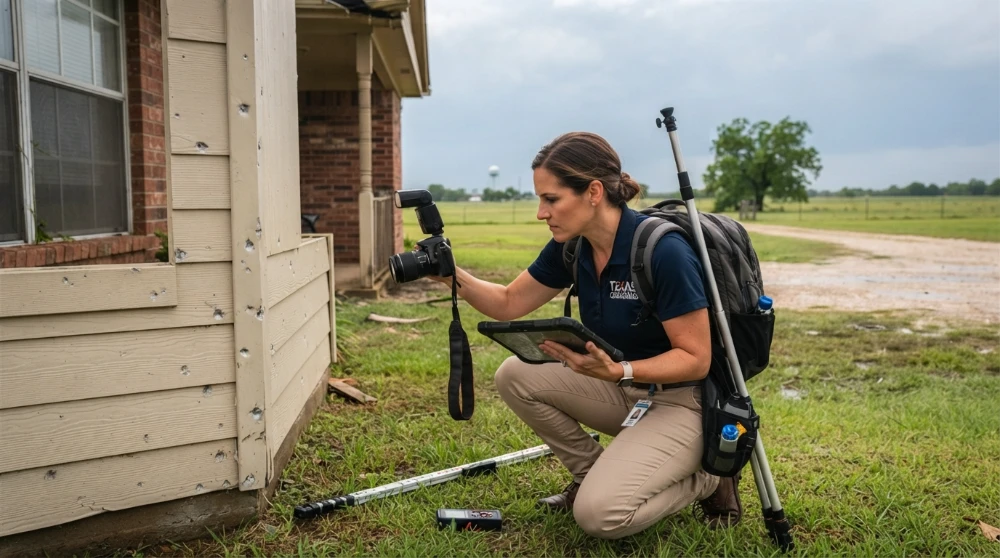
Hail Damage Claims
A Beasley hail claim can involve much more than the roof.
We inspect roofing materials together with gutters, vents, flashing, fencing, siding, windows, exterior mechanical components, and other surfaces that can help establish storm impact.
Common hail-claim disputes include:
- Damage classified as cosmetic
- Damage blamed on normal aging
- Missing roofing components
- Partial roof approvals
- Low material quantities
- Missing accessories
- Incorrect waste factors
- Omitted gutters or soft metals
- Disagreement over repairability
- Damage discovered after the original inspection
If your carrier has already issued a decision, our guide to an underpaid hail damage insurance claim explains why a carrier’s first estimate may not represent the final scope.
Property owners dealing with a denial can also review our information on a denied hail damage insurance claim.
Water Damage Claims
Water damage frequently spreads beyond the first visible stain.
A leak can affect:
- Drywall
- Insulation
- Flooring
- Baseboards
- Cabinets
- Electrical components
- Interior paint
- Personal property
- Subflooring
- Ceiling assemblies
The source of the water is critical because policy coverage often depends on how the water entered the building.
We help document the affected materials, compare mitigation records with the carrier’s estimate, and identify portions of the loss that may have been omitted.
Read our water damage public adjuster guide for a deeper look at hidden moisture and scope disputes.
Fire Damage Claims
Fire losses are rarely limited to the area touched directly by flames.
Smoke and soot can travel through rooms, wall cavities, attic spaces, ventilation systems, and personal property. Firefighting efforts can also create substantial water damage.
A complete fire claim may involve:
- Structural repairs
- Smoke remediation
- Soot cleaning
- Contents inventories
- HVAC cleaning
- Electrical work
- Debris removal
- Demolition
- Temporary living expenses when covered
- Code-related repairs
- Reconstruction costs
These claims often require substantial documentation, particularly when personal property must be inventoried item by item.
Our fire insurance adjuster guide explains how complex fire-loss scopes are evaluated.
Storm Damage Claims
A severe Beasley storm can create several categories of damage during the same event.
For example, a single thunderstorm may produce hail impact, wind uplift, broken fencing, roof openings, exterior damage, and subsequent interior water intrusion.
Looking only at the most obvious damage can leave major portions of the claim undocumented.
We evaluate the property as a system and look for related damage across:
- Roof surfaces
- Exterior elevations
- Windows
- Doors
- Gutters
- Fencing
- Detached structures
- Interior ceilings
- Walls
- Flooring
- Commercial equipment
Roof Damage Claims
Roof claims are among the most frequently disputed property claims in Texas.
The insurance company may approve a small repair even when contractors identify broader damage. In other cases, the carrier may attribute storm-related deterioration to age.
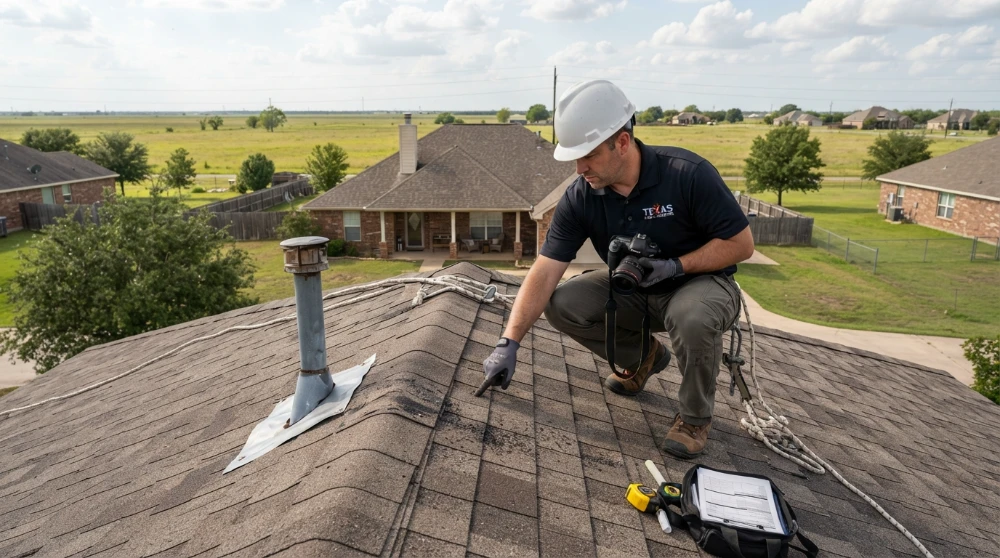
A proper roof evaluation can include:
- Shingle uplift
- Hail bruising
- Granule displacement
- Ridge and hip damage
- Flashing
- Vents
- Pipe jacks
- Underlayment
- Decking
- Metal components
- Water entry points
Our guide to hiring a public adjuster for a roof claim explains why roofing scopes often require more detail than the initial carrier inspection provides.
Commercial Property Claims
Beasley’s location along the US-59/I-69 corridor and its agricultural and small-business character create a mix of commercial property types different from heavily urban portions of Fort Bend County.
Commercial claims may involve:
- Metal buildings
- Warehouses
- Retail properties
- Offices
- Workshops
- Multifamily properties
- Agricultural-support buildings
- Restaurants
- Churches
- Storage facilities
A commercial loss can include roof systems, inventory, equipment, interior finishes, electrical systems, mechanical equipment, signage, and business-related property.
Commercial claims also tend to involve larger scopes and more documentation.
TX Public Adjusting handles both residential and commercial property claims throughout Texas.
If your Beasley commercial or residential claim appears low, incomplete, delayed, or denied, request a Free Claim Review before assuming the carrier’s position is final.
Why Insurance Claims Become Underpaid
An insurance estimate is not automatically a complete repair scope.
Several problems can reduce the amount available to restore damaged property.
Missed Damage
Some conditions are difficult to identify during a short inspection.
Wind uplift may not be visible from the ground. Moisture may travel behind finished surfaces. Hail impacts may appear on metal components before they are obvious on the roof.
If the first inspection does not capture those conditions, they may never reach the estimate.
Scope Omissions
A claim can acknowledge that damage occurred while still leaving out required work.
Examples include:
- Flashing
- Drip edge
- Roofing accessories
- Interior painting
- Detach-and-reset operations
- Flooring transitions
- Gutters
- Insulation
- Debris removal
- Code-related items
- Equipment manipulation
- Commercial roofing components
Individually, an omitted line item may seem small. Across a large claim, omissions can materially affect the settlement.
Depreciation Issues
Many policies calculate an initial payment using actual cash value and withhold recoverable depreciation until repairs are completed or other policy requirements are met.
Property owners sometimes receive the first check and assume it represents the entire settlement.
We review the carrier’s estimate to help identify:
- Applied depreciation
- Recoverable versus nonrecoverable amounts
- Deductibles
- Prior payments
- Supplements
- Holdbacks
Low Estimates
Pricing differences can occur because of labor rates, material assumptions, quantities, repair methodology, or an incomplete understanding of the required work.
A strong claim should connect the requested repair scope with actual observed damage and applicable policy terms.
Documentation Problems
Insurance claims are evidence-driven.
Photographs without context, incomplete inventories, missing measurements, undocumented mitigation work, or inconsistent descriptions can weaken an otherwise legitimate claim.
Organized documentation gives the carrier a clearer basis for evaluating the loss.
Our Public Adjusting Process
1. Claim Review
We begin by understanding what happened.
We review available documents such as:
- Insurance estimates
- Coverage letters
- Denial letters
- Contractor estimates
- Photographs
- Repair proposals
- Prior correspondence
- Policy documents when available
The purpose is to determine where the claim currently stands and whether additional review may be warranted.
2. Property Inspection
When appropriate, we inspect the damaged property.
The inspection focuses on the actual scope of loss rather than simply duplicating the insurance company’s report.
For Beasley storm claims, that can include roofs, exterior elevations, interior water damage, detached structures, and commercial components.
3. Documentation and Estimating
We organize supporting evidence around the observed loss.
Depending on the claim, this may include:
- Photographs
- Measurements
- Damage descriptions
- Contents documentation
- Repair estimates
- Contractor information
- Supporting reports
- Policy-related documentation
We then compare the documented scope against the insurer’s existing estimate.
4. Carrier Communication and Negotiation
Once retained, TX Public Adjusting communicates with the insurance company regarding the claim and presents documentation supporting the policyholder’s position.
Disagreements may involve scope, quantities, causation, pricing, depreciation, or other claim issues.
We address those issues professionally and with documentation.
5. Settlement and Claim Resolution
The goal is to reach an accurate settlement supported by the policy and documented loss.
No public adjuster can guarantee an outcome, and every claim depends on its facts and policy language.
What we can provide is experienced representation throughout the process.
Why Choose TX Public Adjusting in Beasley
Property owners do not need another person representing the insurance company’s interests. They need someone reviewing the claim from the policyholder’s side.
Licensed Texas Public Adjuster
TX Public Adjusting operates through:
Rise Public Adjusting LLC
Texas License #3356839
Texas-Focused Claim Experience
We handle property claims throughout Texas and understand the recurring issues created by hail, windstorms, tropical systems, water losses, roof claims, and commercial property damage.
Independent Policyholder Representation
Insurance company adjusters work for insurers.
TX Public Adjusting represents property owners.
Our responsibility is to document and present the policyholder’s claim—not protect the carrier’s financial interest.
Residential and Commercial Experience
We work with:
- Homeowners
- Landlords
- Commercial building owners
- Business owners
- Multifamily property owners
- Owners of large and complex properties
Detailed Claim Review
Many claim problems are hidden inside the estimate rather than visible in the denial letter.
We compare the physical loss with quantities, materials, pricing, depreciation, and omitted work.
Free Initial Claim Review
If you are unsure whether hiring a public adjuster makes sense, start with a claim review.
We can look at where the claim stands and discuss possible next steps without requiring an upfront fee for that initial review.
Areas We Serve Near Beasley
Beasley sits in southwestern Fort Bend County and is closely connected with other communities along the Richmond-Rosenberg and southwest Fort Bend corridor. Fort Bend County identifies Beasley alongside incorporated communities including Richmond, Rosenberg, Needville, Orchard, Kendleton, Sugar Land, and others.
Our service area around Beasley includes property owners in and near:
- Rosenberg
- Richmond
- Needville
- Kendleton
- Pleak
- Fairchilds
- Orchard
- Sugar Land
- Missouri City
- Surrounding unincorporated areas of Fort Bend County
Because Beasley is a compact community rather than a city with numerous named subdivisions, local references tend to center on the established street grid, surrounding rural properties, the US-59/I-69 corridor, Loop 540, Beasley City Hall, and areas around the community’s historic railroad alignment rather than large master-planned neighborhoods.
The city’s historic marker near Loop 540 and 4th Street and Beasley City Hall on South 3rd Street are recognizable local reference points within the community.
Frequently Asked Questions About Public Adjusters in Beasley
What does a public adjuster in Beasley do?
A public adjuster represents the policyholder during a property insurance claim. That can include reviewing the policy, inspecting damage, documenting the loss, preparing estimates, identifying omissions in the carrier’s scope, communicating with the insurance company, and negotiating disputed claim items.
TX Public Adjusting represents homeowners and commercial property owners rather than insurance carriers.
When should I hire a public adjuster in Beasley?
Many owners contact us after receiving a low estimate, partial approval, denial, or repeated requests for additional documentation. Others hire a public adjuster earlier when the property loss is large or technically complex.
The best time depends on the claim. You do not necessarily need to wait for a denial before requesting a second opinion.
Can you help with an insurance claim that has already been paid?
Potentially.
An issued payment does not always mean every covered item was included. Some claims may still allow supplements, additional documentation, or further review depending on the policy, timing, prior releases, and other circumstances.
We can review the claim documents and explain whether additional action appears available.
Can a denied Beasley property claim be reopened?
Some denied claims can be reconsidered when additional evidence becomes available or when the original investigation missed relevant damage.
The ability to reopen or supplement a claim depends on deadlines, policy language, the reason for denial, and the available documentation. Our article on reopening a hail damage insurance claim provides additional information for storm losses.
Do you handle hail claims in Beasley?
Yes.
Hail claims are a major part of Texas property adjusting. We evaluate roofing, gutters, vents, flashing, siding, fencing, windows, mechanical equipment, and other impacted components when relevant to the loss.
We also review claims in which the insurer has attributed observed conditions to wear and tear rather than hail.
Can a public adjuster help after wind-driven rain enters my house?
Yes, when the loss falls within the scope of public-adjusting services and the applicable policy.
The key question is often how the water entered the property. Rain entering through storm-created roof or exterior damage may be treated differently from surface flooding or long-term leakage.
We document the cause and resulting damage so the claim can be evaluated under the appropriate policy provisions.
Do you handle commercial property claims around Beasley?
Yes.
We assist commercial owners with storm, roof, water, fire, and other property claims. Commercial losses can involve roofing systems, contents, equipment, inventory, electrical components, interior finishes, signage, and multiple structures.
These claims often benefit from a detailed scope because small omissions multiplied across a large building can become substantial.
How much does a public adjuster cost in Texas?
Public adjuster compensation is typically established in a written agreement and is subject to Texas law and applicable regulatory requirements.
Before hiring any public adjuster, review the contract carefully so you understand the services and fee structure. TX Public Adjusting offers a Free Claim Review with no upfront fee for that initial evaluation.
Is a public adjuster the same as the insurance company’s adjuster?
No.
The insurance company’s staff adjuster or independent adjuster works for the insurer or has been retained by the insurer.
A public adjuster represents the policyholder.
That difference is the foundation of the service. Our role is to prepare and advocate for your property claim from your side of the insurance contract.
What should I have ready for a Free Claim Review?
Send whatever documentation you currently have.
Helpful items include:
- The carrier’s estimate
- Payment summary
- Coverage or denial letter
- Photos
- Contractor estimate
- Roof report
- Mitigation invoice
- Claim correspondence
- Policy information
Do not delay contacting us simply because your file is incomplete. We can help identify which additional documents may be useful after reviewing what you already have.
Get Insurance Claim Help in Beasley
A property claim should reflect the actual covered damage to your home or business—not simply the items identified during one short insurance inspection.
If your Beasley claim was underpaid, denied, delayed, partially approved, or missing significant damage, TX Public Adjusting can review the file and explain your options.
TX Public Adjusting
Rise Public Adjusting LLC
Texas License #3356839
Free Claim Review
Residential & Commercial Claims
No upfront fee for the initial claim review
Contact TX Public Adjusting and let a licensed Texas public adjuster review the damage, the insurance estimate, and the documentation before you accept an incomplete scope as the final word.