

Property damage in Princeton can turn into a complicated insurance claim faster than many owners expect. A spring hailstorm can damage roofing across an entire subdivision. Wind-driven rain can enter through lifted shingles or damaged flashing. A plumbing failure can spread water beneath flooring before the source is discovered. When the carrier’s estimate does not account for the full scope of the loss, a public adjuster in Princeton, TX can help the policyholder document the damage and present the claim properly.
TX Public Adjusting represents residential and commercial property owners—not insurance companies. We inspect the loss, review the policy and carrier estimate, document covered damage, prepare a detailed claim scope, and negotiate with the insurer on the policyholder’s behalf.
TX Public Adjusting is operated by Rise Public Adjusting LLC, a licensed Texas public adjusting firm. Texas License #3356839.
Need help with a new, delayed, denied, or underpaid Princeton insurance claim? Request a free claim review. There are no upfront fees.
Insurance Claim Help for Princeton Property Owners
Princeton is part of Collin County and sits east of McKinney along the growing northeastern side of the Dallas–Fort Worth region. The city has expanded rapidly, adding new homes, multifamily properties, retail spaces, schools, and supporting infrastructure. Princeton was identified as the fastest-growing U.S. city from 2023 to 2024, with its population increasing by nearly one-third during that period.
That growth creates a varied property-claim environment. Princeton includes older homes near the city’s established core, newer production-built neighborhoods, large residential developments, apartment communities, commercial buildings, and properties near open land and drainage corridors. The city’s official subdivision map identifies communities such as Arcadia Farms, Abbey Crossing, Princeton Crossroads, Princeton Lakes, Monticello Park, White Wing Trails, Winchester Estates, Trails at Riverstone, Princeton West Meadows, and Cypress Bend.
Different construction ages and building types can produce different insurance issues. Newer homes may still experience hail-damaged shingles, damaged vents, fence losses, water intrusion, and construction-material matching disputes. Older properties may have layered roofing, previous repairs, aging plumbing, or code-related considerations that make the scope more complicated.
A Princeton public insurance adjuster evaluates the claim from the policyholder’s side. Property owners can also learn more about working with a Texas public adjuster when a residential or commercial claim becomes delayed, disputed, denied, or underpaid. The goal is not simply to confirm that damage occurred. The goal is to identify the covered damage, measure it, document it, connect it to the reported event, and present a supportable claim package.
Why Property Owners Hire a Public Adjuster in Princeton
The insurance company normally assigns an adjuster to inspect the loss. That adjuster works for the carrier or has been retained to handle the carrier’s investigation. A public adjuster has a different role: representing the insured property owner.
Princeton homeowners and business owners may hire TX Public Adjusting when:
- The carrier’s estimate appears too low.
- Important rooms, elevations, roof components, or detached structures were omitted.
- The claim was denied based on wear, deterioration, maintenance, or another exclusion.
- The insurer approved a repair when replacement may be required.
- Water damage spread farther than the initial estimate reflects.
- The claim involves several contractors or multiple categories of damage.
- Depreciation was applied incorrectly or not explained.
- The owner does not have time to manage inspections, estimates, documentation, and carrier communications.
- A commercial loss is affecting operations, tenants, inventory, equipment, or rental income.
- The claim has stalled without a clear path forward.
A licensed public adjuster does not replace the contractor, engineer, attorney, roofer, mitigation company, or other specialist. Instead, the public adjuster manages and presents the insurance claim while coordinating relevant documentation from those professionals.
Princeton Storm Risks and Local Property-Damage Concerns
Princeton’s location in North Texas exposes local property owners to severe thunderstorms, hail, damaging straight-line winds, tornado activity, heavy rainfall, lightning, and winter freezes.
Hail and Severe Thunderstorms
Hail is one of the most frequent claim concerns across Collin County and the surrounding North Texas region. Property owners who discover storm impacts can review our Texas hail damage insurance claim guide for documentation steps, common coverage issues, and mistakes that may affect the claim. A storm does not need to break windows or create an obvious roof leak to cause covered damage.
Hail can affect:
- Asphalt shingles
- Metal roofing and roof accessories
- Gutters and downspouts
- Window screens
- Exterior paint and siding
- Garage doors
- Fencing
- HVAC condenser fins
- Skylights
- Patio covers
- Commercial membrane roofing
- Rooftop equipment and signage
Damage can vary across a single property. One roof slope may show stronger impacts because of the storm’s direction. Soft metals may be visibly dented while shingle damage remains harder to identify from the ground. An insurance inspection that focuses only on the roof covering may overlook gutters, vents, screens, fencing, exterior finishes, and interior water staining.
High Winds and Tornado Conditions
North Texas thunderstorms may produce wind strong enough to crease shingles, loosen flashing, damage ridge caps, pull siding from walls, topple fences, break tree limbs, and drive debris into the building envelope.
Wind-related claims often become disputed when the carrier attributes the condition to age or installation instead of the reported storm. A detailed inspection can help separate storm-created damage from unrelated wear and document how wind opened a pathway for water intrusion.
Tornado losses may involve broad structural and contents damage, but even nearby circulation can affect roofs, windows, doors, outbuildings, and trees without destroying the main structure.
Heavy Rain, Drainage, and Water Intrusion
Princeton’s growth has increased development activity and attention to stormwater management. The city has continued updating drainage planning as development expands. Princeton also provides floodplain information and advises residents that properties outside designated high-risk flood zones can still experience flooding.
Insurance coverage for water depends heavily on the source. Wind-driven rain entering through storm damage may be handled differently from surface flooding, groundwater, seepage, or a plumbing discharge. A standard property policy often excludes flood, while a separate flood policy may apply to rising surface water.
Because the cause matters, owners should document the point of entry, roof or exterior damage, water path, affected materials, mitigation work, and timing. Our guide to dealing with an insurance adjuster after water damage explains what records to preserve and why the source and extent of the water should be clearly documented.
Winter Freeze Damage
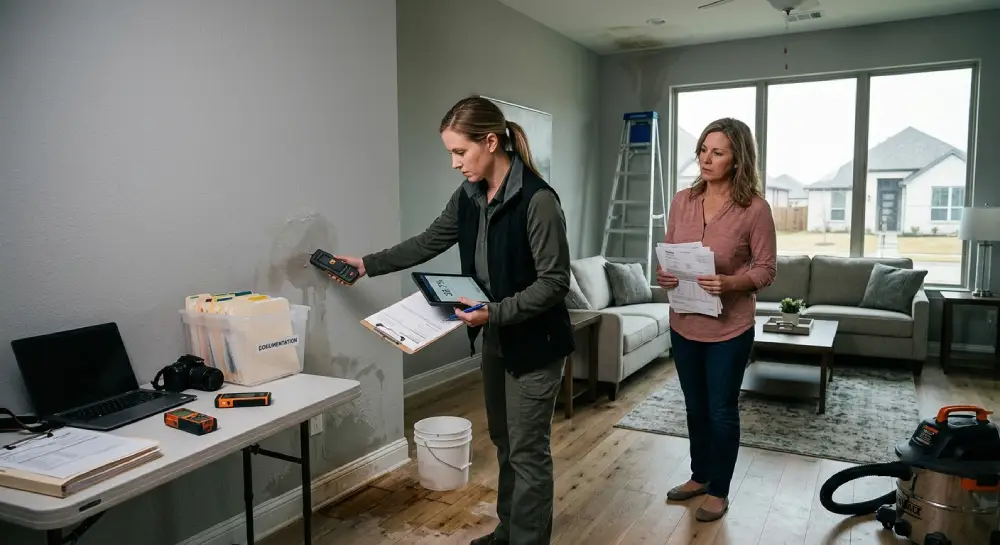
A hard North Texas freeze can burst supply lines, damage exterior plumbing, affect fire-suppression systems, and cause widespread interior water damage. The visible water may be only part of the loss. Moisture can travel into wall cavities, cabinets, insulation, flooring systems, and adjoining rooms.
Freeze claims can become underpaid when the estimate addresses only the pipe repair and immediately visible drywall while overlooking access, demolition, drying, insulation, flooring transitions, cabinet work, paint blending, and reconstruction.
Lightning, Fire, and Electrical Losses
Lightning and electrical events can damage appliances, HVAC controls, wiring, panels, security systems, garage-door equipment, and business electronics. Fire losses may also include smoke residue, odor, heat damage, firefighting water, debris removal, temporary protection, and contents cleaning.
A complete fire claim requires more than a construction estimate. It may also require a detailed inventory, cleaning evaluation, restoration analysis, and documentation of additional living expenses or business interruption.
Common Insurance Claims in Princeton
| Claim type | Damage commonly missed or under-scoped |
| Hail damage | Roof accessories, gutters, screens, fencing, siding, HVAC fins, detached structures |
| Wind damage | Creased shingles, flashing, ridge materials, water entry points, exterior elevations |
| Roof claims | Underlayment, decking, ventilation, code items, steep or high charges, matching issues |
| Water damage | Hidden moisture, cabinetry, flooring continuity, insulation, demolition and drying |
| Fire and smoke | Contents, soot cleaning, odor treatment, electrical damage, debris removal |
| Freeze damage | Access work, pipe locations, wall cavities, flooring, cabinets, drying costs |
| Commercial claims | Equipment, tenant improvements, inventory, signage, business interruption |
| Plumbing leaks | Source access, microbial concerns, adjacent rooms, continuous flooring and finishes |
Hail Damage Claims
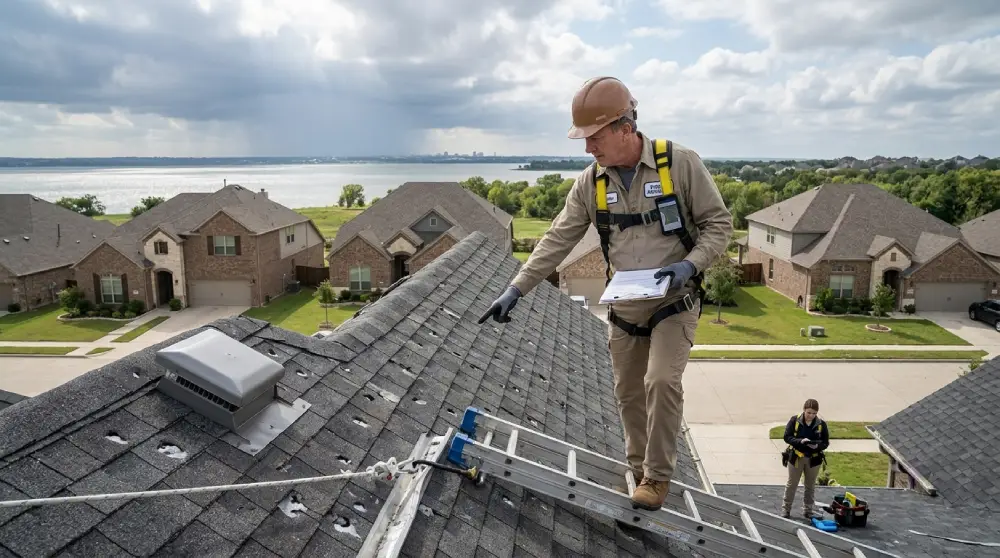
A Princeton hail damage claim may involve much more than replacing shingles. Our detailed hail damage roof insurance claim guide explains how roof materials, storm direction, repairability, documentation, and omitted components can influence a carrier’s estimate. The claim should account for all damaged property covered by the policy, including roof penetrations, vents, flashing, gutters, screens, fence staining, exterior finishes, garage doors, HVAC equipment, and interior damage caused by storm-created openings.
Before temporary or permanent repairs begin, property owners should understand how to document hail damage for an insurance claim, including photographs, storm dates, damaged materials, contractor findings, and carrier correspondence. TX Public Adjusting can compare the carrier’s scope with observed conditions, contractor findings, measurements, photographs, policy provisions, and available storm information.
Water Damage Claims
Water claims are highly dependent on cause, duration, location, and policy language. A sudden plumbing discharge may be handled differently from repeated seepage. Rain entering through wind damage may require proof of the storm-created opening. Surface water may fall under a separate flood policy. A water damage public adjuster can help document the source, moisture migration, affected materials, mitigation work, and reconstruction needed after a covered plumbing or storm-related loss.
We document affected rooms, materials, moisture migration, demolition needs, drying records, and reconstruction requirements. That helps prevent a claim from being reduced to only the most visible stain or damaged section of flooring.
Fire and Smoke Damage Claims
Fire damage can affect the structure, contents, electrical components, HVAC systems, insulation, finishes, and indoor environment. Smoke may travel far beyond the room where the fire began.
A properly prepared fire claim may include:
- Structural repairs
- Smoke and soot cleaning
- Contents inventory
- Pack-out and storage
- Debris removal
- Odor treatment
- Electrical evaluation
- Temporary repairs
- Additional living expenses
- Code-related work when covered
Property owners facing a significant loss should also understand how house fire debris removal costs may be documented and addressed as part of the insurance claim. A fire insurance adjuster for policyholders can coordinate the structural scope, contents documentation, smoke and soot issues, temporary expenses, and supporting records required for a major fire claim.
Storm and Wind Damage Claims
Storm claims often combine several causes of loss. A single event may create wind damage, hail impacts, falling-tree damage, broken fencing, power-related losses, and interior water intrusion.
The scope should tell the full story of the event rather than treat each symptom as an unrelated maintenance issue.
Roof Damage Claims
Roof estimates can differ substantially because of measurement errors, omitted components, material identification, repairability, matching, code requirements, access, pitch, height, and disposal costs. A public adjuster for a roof claim can compare the carrier’s measurements and repair scope with the roof’s actual materials, components, storm damage, access requirements, and replacement needs.
A roof claim review may include:
- Roof measurements
- Slope-by-slope damage documentation
- Roofing material identification
- Flashing and ventilation components
- Underlayment
- Drip edge
- Valleys
- Ridge materials
- Skylights and penetrations
- Detached structures
- Interior leak damage
Commercial Property Claims
Princeton’s growth includes expanding retail, office, multifamily, warehouse, restaurant, church, and service-related properties. Commercial claims can involve more than building repairs. TX Public Adjusting assists owners with commercial property insurance claims involving buildings, equipment, inventory, tenant improvements, rental income, business interruption, and other covered losses.
Depending on the policy and loss, the claim may include:
- Building damage
- Business personal property
- Tenant improvements
- Equipment
- Inventory
- Signage
- Temporary relocation
- Loss of rental income
- Business interruption
- Extra expense
- Debris removal
- Professional fees
Commercial owners with low-slope roofing systems can also review our guide to built-up roof repair and insurance claims, particularly when the loss involves membrane damage, moisture intrusion, or disputed replacement requirements. Commercial losses require careful coordination because delays can affect tenants, employees, customers, revenue, and contractual obligations.
Why Princeton Insurance Claims Become Underpaid
An underpaid claim does not always begin with an outright denial. More often, the carrier accepts part of the loss but issues an estimate that does not fully reflect the work required.
Missed Damage
Some damage is difficult to see during a short inspection. Hail impacts may be spread across multiple elevations. Moisture may extend behind cabinets or beneath flooring. Smoke can affect rooms far from the fire source.
Scope Omissions
A carrier estimate may include shingles but omit vents, gutters, flashing, screens, fencing, interior repairs, or detached structures. In water claims, the scope may omit demolition, drying, insulation, texture, paint, or flooring transitions.
Repair Versus Replacement Disputes
The insurer may estimate a spot repair even when the material cannot be repaired reasonably or the result would leave mismatched, unavailable, or functionally compromised components.
Depreciation Issues
Property estimates may include recoverable and nonrecoverable depreciation. Owners are not always told what must be completed or submitted to recover withheld amounts. Errors in age, condition, material, or useful-life assumptions can affect the payment.
Low Measurements or Pricing
Incorrect roof dimensions, missing waste, omitted labor, insufficient material quantities, or incomplete line items can reduce an estimate. Local labor and material conditions may also differ from the assumptions used in the carrier’s scope.
Weak Documentation
A valid claim can still be difficult to resolve when the file lacks photographs, measurements, mitigation records, contractor estimates, receipts, inventories, timelines, or evidence connecting damage to the reported event.
Policy Interpretation
Deductibles, exclusions, endorsements, duties after loss, replacement-cost provisions, appraisal clauses, matching language, water limitations, and time requirements can affect the claim. The policy should be reviewed rather than assumed.
Our Public Adjusting Process
1. Free Claim Review
We begin by learning what happened, when the loss occurred, what the insurance company has done, and what concerns you have about the claim.
We may review:
- The policy
- Carrier estimates
- Payment letters
- Denial or reservation-of-rights letters
- Photographs
- Contractor or mitigation estimates
- Prior claim documents
- Repair invoices
- Relevant correspondence
2. Property Inspection
We inspect the reported damage and compare physical conditions with the carrier’s findings. The inspection may include the roof, exterior elevations, interior rooms, detached structures, mechanical equipment, and other affected property.
3. Damage Documentation
We organize photographs, measurements, estimates, inventories, reports, receipts, and supporting records. When needed, we may recommend involvement from qualified contractors, engineers, hygienists, roof consultants, inventory specialists, or other professionals.
4. Scope Preparation
We prepare a detailed damage scope based on the loss, policy, measurements, materials, and work required. This can identify omissions or differences between the actual repair needs and the carrier’s estimate.
5. Claim Presentation and Negotiation
TX Public Adjusting communicates with the insurer, submits supporting documentation, addresses claim questions, attends additional inspections when appropriate, and negotiates from the policyholder’s position.
6. Settlement Review
When the carrier issues a revised estimate or payment decision, we review it with the owner and identify remaining issues. Every claim depends on its facts, policy language, evidence, and carrier response, so no particular outcome can be guaranteed.
Why Choose TX Public Adjusting
Licensed Texas Representation
TX Public Adjusting is operated by Rise Public Adjusting LLC, Texas License #3356839.
We Work for Policyholders
An insurance-company adjuster represents the carrier. A public adjuster represents the insured. Our responsibility is to the residential or commercial property owner who hires us.
Texas Claim Experience
Our team has reviewed thousands of property claims and understands the documentation, estimating, policy, and negotiation issues that commonly arise in Texas losses.
Residential and Commercial Expertise
We assist with houses, rental properties, multifamily buildings, retail locations, offices, warehouses, restaurants, churches, and other insured properties.
Detailed Claim Documentation
We focus on the scope. That means identifying affected materials, measuring damaged areas, documenting overlooked components, and organizing support for the claimed amount.
No Upfront Fees
We offer a free claim review and do not charge an upfront fee. Any fee arrangement is explained in the written agreement before representation begins.
Concerned that your Princeton claim was underpaid or handled too narrowly? Contact TX Public Adjusting for a free review of the policy, carrier estimate, and claim documentation.
Princeton Neighborhoods and Properties We Serve
TX Public Adjusting assists property owners throughout Princeton, including homes and businesses near:
- Arcadia Farms
- Abbey Crossing
- White Wing Trails
- Princeton Crossroads
- Princeton Lakes
- Princeton West Meadows
- Princeton Place
- Trails at Riverstone
- Monticello Park
- Winchester Estates and Winchester Crossing
- Cypress Bend
- Princeton Village
- Villas of Monte Carlo
- Park Trails
- De Berry Estates
- Brookside
- Historic and central Princeton
- Properties near U.S. 380 and the Princeton Municipal Center
- Homes and businesses near Lake Lavon
Princeton’s official subdivision planning documents reflect a mix of established and newer developments, including several communities with hundreds of single-family homes.
The city also maintains J.M. Caldwell Sr. Community Park, Veterans Memorial Park, Parkview Heights Park, White Wing Park, and more than six miles of hike-and-bike trails. These familiar local areas help define a community that is growing quickly while retaining connections to its established neighborhoods and open spaces.
Areas We Serve Near Princeton
We also assist property owners in nearby Collin County and eastern North Texas communities, including:
- McKinney
- Lowry Crossing
- Farmersville
- Melissa
- Anna
- New Hope
- Lucas
- Fairview
- Allen
- Wylie
- Lavon
- Nevada
- Blue Ridge
- Josephine
- Culleoka
- Branch
- Altoga
Service availability depends on the claim and property location, but TX Public Adjusting serves policyholders throughout Texas.
Frequently Asked Questions
What does a public adjuster in Princeton do?
A public adjuster represents the policyholder during a property insurance claim. The adjuster reviews the policy, inspects the damage, documents covered losses, prepares a repair scope, communicates with the carrier, and negotiates based on the evidence in the claim file.
The public adjuster does not work for the insurance company. TX Public Adjusting works for the Princeton homeowner, landlord, investor, or business owner who retains our firm.
When should I hire a Princeton public adjuster?
You can hire a public adjuster soon after the loss or later if the claim becomes delayed, denied, or underpaid. Early involvement may help preserve evidence and organize the claim correctly from the beginning.
Owners also contact us after receiving a low estimate, partial denial, repair-only decision, or payment that does not appear sufficient for the documented work.
Can you help after my insurance company already inspected the property?
Yes. The first insurance inspection does not necessarily end the claim. We can review the carrier’s estimate, inspect the property, identify omitted damage, prepare supporting documentation, and request reconsideration where the evidence supports it.
The available options depend on the policy, deadlines, prior communications, repairs already completed, and current status of the claim.
Can a public adjuster help with a denied hail or roof claim?
A public adjuster can review the denial, policy, inspection findings, photographs, roof condition, contractor documentation, and reported storm date. A denial may involve causation, wear and tear, prior damage, late notice, or insufficient evidence. Property owners can also review what to do if a hail claim was denied before accepting the carrier’s decision or completing repairs that may remove important evidence.
We cannot guarantee that a denial will be reversed, but we can determine whether additional documentation or a more complete claim presentation may be appropriate.
How much does a public adjuster cost in Princeton?
Public adjusters generally work under a written fee agreement that explains how the fee is calculated. TX Public Adjusting offers a free initial claim review and charges no upfront fee.
The exact fee and terms are disclosed before representation begins and must comply with applicable Texas requirements.
Does homeowners insurance cover flooding in Princeton?
A standard homeowners policy usually distinguishes between water entering because of covered building damage and rising surface water or flooding. Flood is commonly excluded from standard homeowners coverage and may require a separate flood policy.
Princeton advises owners to review flood risk even outside mapped high-risk areas. The city provides access to local and FEMA floodplain resources. Coverage should be evaluated under the actual policy and source of the water.
What should I do immediately after storm damage?
Protect people first. Then take reasonable steps to prevent additional damage, such as temporary roof covering or water extraction, when it is safe to do so.
Photograph the damage before cleanup, save damaged materials when practical, keep receipts, document emergency work, avoid permanent repairs before the loss is inspected, and notify the insurer according to the policy.
Can you help with a Princeton commercial property claim?
Yes. We assist commercial owners with hail, wind, water, fire, roof, freeze, equipment, inventory, tenant-improvement, business-interruption, and other covered property claims.
Commercial claims often require detailed coordination among ownership, tenants, contractors, accountants, mitigation companies, and the insurance carrier.
What happens if the carrier estimate leaves out part of the damage?
We compare the estimate with the property conditions and supporting records. If covered work appears to be missing, we can document the difference and submit a supplemental claim package.
Examples include omitted roof components, insufficient quantities, missed interior rooms, missing drying work, detached structures, code-related items, exterior elevations, or contents.
Is it too late to hire a public adjuster after receiving payment?
Not necessarily. A prior payment may not prevent further review, but deadlines, releases, repairs, policy conditions, statutes, and the claim’s procedural status can affect available options.
The sooner the file is reviewed, the easier it is to determine what documentation remains available and whether the claim can still be supplemented, reopened, negotiated, appraised, or otherwise addressed.
Get a Free Princeton Insurance Claim Review
Property damage is disruptive enough without having to determine whether every roof component, room, finish, fixture, and expense made it into the carrier’s estimate.
TX Public Adjusting helps Princeton property owners understand the claim, document the full scope of covered damage, and communicate with the insurance company from a stronger position.
TX Public Adjusting
Rise Public Adjusting LLC
Texas License #3356839
- Licensed Texas public adjuster
- Residential and commercial claims
- Free claim review
- No upfront fees
- Independent representation for policyholders
Contact TX Public Adjusting today to request your free Princeton property claim review.